As a new marketing leader at Adobe, I expected to learn about a new portfolio. What I didn't expect was a completely new way of thinking.
For decades, my career was focused on understanding the underlying technology stack — hardware, software, cloud, data, infrastructure and platforms. Being a part of Adobe feels like a full-circle moment because I can see how all these elements come together at the application layer to solve the very challenges I have faced as a marketing leader. However, my true “aha!” moment came when I realised that the forces I had always viewed as competing can coexist.
At Adobe, the story isn’t about choosing one force over another.
It’s not art versus science.
It’s not creativity versus productivity.
It’s not personalisation versus scale.
At Adobe, it’s “and,” not “versus.”
I have often seen these terms described as trade-offs. How do you move quickly while staying on brand? How do you scale while delivering personalised experiences? And how do you empower creativity while maintaining operational discipline?
What I am learning at Adobe is that these seemingly opposing forces do not have to compete. When brought together through the right platform, they become the foundation for a modern customer experience.
The power of “and.”
I’ve always believed that marketing should be run like a business. While creativity is essential to marketing, so are data, measurement, optimisation, performance and operating discipline. A great idea alone isn’t enough. The best marketing organisations connect great ideas to customer insights, measurable outcomes and scalable execution.
That’s why Adobe’s mission, “empowering everyone to create,” resonates so strongly with me. Creation is not limited to designers, agencies or creative professionals. In enterprises today, creation happens everywhere. Marketers create campaigns, customer experience teams create journeys, analysts create insights, sales teams create conversations and partners create new routes to market.
But the important point is, technology doesn’t replace human creativity. It expands where, how and what people can create.
This is one of the first things I have come to appreciate about Adobe. The company doesn’t treat creativity as something separate from enterprise execution. Instead, it views creativity as a core business capability.
Where art meets science.
The phrase “art and science” is often used in marketing, but it is rarely put into practise effectively.
Art is the creative idea, the brand expression, the story, the experience, the content and the emotional connection. Science is the data, segmentation, analytics, testing, optimisation and the ability to understand what is working.
Throughout my career, I have seen firsthand how wide the gap between the art and science of marketing can be. The reason is simple: these capabilities often reside in different parts of the business. Creative, marketing and analytics teams work in separate systems and operate differently.
I’ve seen teams come up with a great campaign or idea. But when they are asked the dreaded question, “how are we going to operationalise this” or “how are we going to measure this,” it can feel as though the air has gone out of the room and the inspiration has begun to fade.
Adobe’s enterprise portfolio brings the forces of art and science together. We help businesses create, get discovered, engage customers, create content at scale, measure results and power everything with AI.
That’s the art and science of marketing, connected.
Creativity and productivity can coexist.
Another challenge I see is the perceived trade-off between creativity and productivity.
Creative teams want space to develop great ideas, business teams demand speed, volume, efficiency and outcomes. Brand teams want governance and consistency, field and regional teams require flexibility. Last but not least, executives want growth, performance and ROI.
One thing I often say is that the buyer's journey isn't linear. Customers move fluidly among discovery, research, validation and purchase, drawing information from AI assistants, search engines, peers, partners and brands along the way. Yet most marketing stacks are designed around a predictable funnel, even though buyers rarely behave that way.
However, today, the marketing funnel is no longer predictable. A single mention by an influencer can create a tsunami of interest in a product, driving the need to personalise engagement, show up across more channels and move faster. But personalisation and speed both require content. Not just more content, but the right content at the right time: on brand, governed, localised, measured and optimised.
Adobe’s content supply chain solutions address this exact challenge. The portfolio helps organisations create, manage, govern and scale content production, particularly through generative AI. This matters because content has become one of the biggest constraints in modern marketing.
This is where Adobe’s portfolio connects creativity with productivity. It helps enterprises move from fragmented content creation to a more connected content operating model. Creativity remains central, but it becomes easier to scale, manage and measure.
That’s not creativity versus productivity. It’s creativity and productivity, working together.
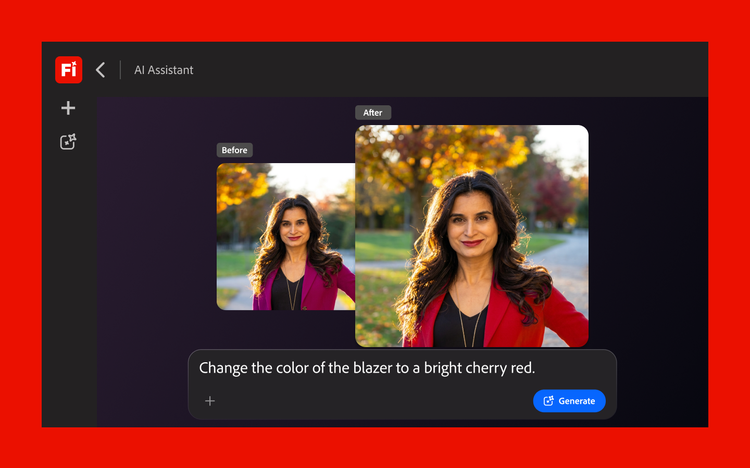
Let me illustrate a simple example of creativity and productivity in action. One of the first things I did at Adobe was update my headshot to match our corporate colour using Adobe Creative Cloud. The prompt I used in Adobe Firefly was as simple as “Change the colour of the blazer to a bright cherry red.”
Personalisation and scale.
The same principle applies to personalisation and scale.
While marketers need to deliver the right message to the right customer at the right moment, a new reality is emerging — before brands can personalise an experience, they need to be discovered.
Historically, discovery happened through search engines and websites. Today, customers are increasingly turning to AI assistants and large language models (LLMs) to research products, compare providers and evaluate solutions. More than half of early consideration now happens in AI chats long before a customer reaches a brand’s website.
This means marketing organisations can no longer focus only on the experiences customers have after they arrive. They must also consider how their brand is represented before customers arrive.
Adobe helps organisations think differently about visibility in the AI era. Adobe Brand Visibility is a unified, AI-first application designed for generative engine optimisation (GEO). It helps companies monitor, measure and improve how their brands appear across AI-driven search platforms such as ChatGPT, Microsoft Copilot and Perplexity. When customers ask AI assistants which product to buy, which company to trust or which solution best meets their needs, the AI tool often generates an answer rather than directing them to a list of search results. Those answers are based on the content, signals and sources that AI models can access and interpret.
This creates another “and” moment. Brands must win with both humans and AI agents. They must optimise for both search and AI-driven discovery. And they must ensure their content can engage people and be understood by AI.
When brand visibility, customer engagement, content, data and AI come together, personalisation becomes more than a campaign tactic. It becomes an enterprise capability that scales across the entire customer journey.
Adobe CX Enterprise: Orchestration for the experience lifecycle.
All these solutions come together in Adobe CX Enterprise, which was announced earlier this year. It is an AI-first customer experience orchestration system designed to help businesses automate and manage marketing workflows.
I’d like to explain it in simpler terms through the lens of the customer experience lifecycle:

Enterprises need to get discovered, engage customers, create content at scale, measure results and power the entire system with intelligence.
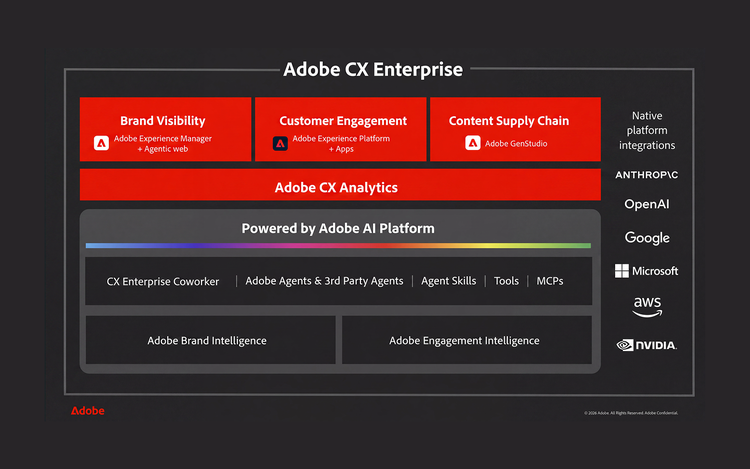
Adobe CX Enterprise is organised around three business outcomes — brand visibility, customer engagement and content supply chain. These outcomes are built on a unified data foundation. At the same time, Adobe CX Analytics measures outcomes and the Adobe AI Platform powers the entire system with intelligence, generative AI and autonomous agents. Through native integrations with Microsoft, OpenAI, Anthropic, Google, AWS, IBM and NVIDIA, customers can use the AI ecosystem of their choice while keeping content, data and customer experiences connected through Adobe's platform.
This isn’t a collection of isolated applications. It’s a connected enterprise portfolio designed considering how companies actually need to operate — connecting brand and demand, content and data, journeys and insights, creativity and accountability and human imagination and AI-powered execution.
The partner perspective.
As someone leading partner marketing for Adobe Enterprise in the Americas, I find this especially exciting.
Partners play a critical role in helping enterprises turn strategy into outcomes. They do more than implement technology. They bring industry-specific innovation, proprietary frameworks, assessment capabilities, managed services and deep integrations that help customers accelerate outcomes. They connect Adobe's capabilities with the broader enterprise ecosystem, helping organisations to unlock more value from the technologies and platforms they already have in place.
This matters because enterprise customers are not looking for more disconnected tools. They are looking for platforms, partners and ecosystems that can help them move faster and execute with greater confidence.
Adobe, together with its partners, provides a powerful way to tell that story.
My first impression.
Adobe is a company built for the moment we are in.
Enterprises are under pressure to grow, personalise, automate, create more content, demonstrate impact and adopt AI responsibly. At the same time, they are trying to simplify complexity, protect their brands, govern their data and deliver better customer experiences.
These priorities can feel like opposing forces. But Adobe’s enterprise portfolio shows that they do not have to be.
Art and science can work together. Creativity and productivity can reinforce each other. Personalisation and scale can coexist.
At Adobe, it isn’t about choosing one side of the equation. It’s about bringing the right forces together.
At Adobe, it’s “and,” not “versus.”
Recommended for you
https://business.adobe.com/fragments/resources/cards/thank-you-collections/generic-dx