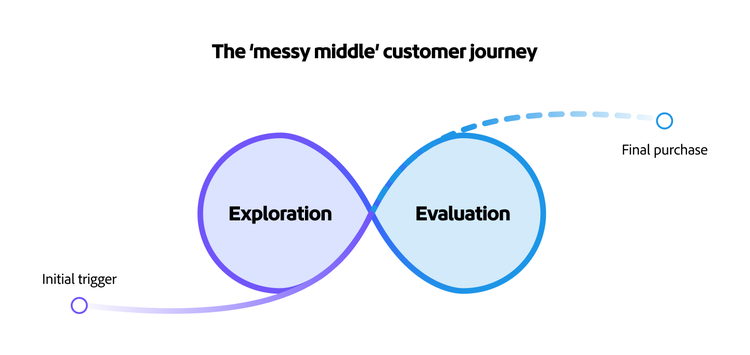
Acknowledging complexity is the first step. Visualizing and strategizing for it requires practical tools. Customer journey mapping needs models that are sophisticated enough to capture non-linear paths while still remaining actionable across teams.
The following three models address distinct enterprise contexts. Each provides a framework for documenting the messy middle within specific business models.
Model 1: The B2B buying committee journey.
B2B purchases rarely involve a single decision-maker. Enterprise deals typically include several buyer personas with different priorities, timelines, and interactions. This model maps the buyers’ journey across three primary stakeholder types.
- The user. They represent the person who interacts with your product daily. They care about functionality, ease of adoption, and how the solution affects their workflow. Their journey often begins with peer recommendations or industry content.
- The IT buyer. They evaluate security, integration requirements, and technical specifications. They enter the journey later, typically after “the user” has already expressed interest, and their concerns can derail deals that seemed certain.
- The executive sponsor. They control budget approval. They may never interact with your product directly but need to understand business impact and return on investment (ROI).
Mapping these parallel journeys reveals where customer journey stages overlap and where they diverge. You might discover that deals stall when “IT buyers” lack technical documentation, or that “executive sponsors” need case studies from similar enterprises.
To create customer journey maps for B2B buying committees, document each persona's entry point, information needs at each stage, and the handoffs between stakeholders that either accelerate or delay decisions.
Model 2: The omnichannel retail journey.
Retail customers move fluidly between channels in ways that make traditional attribution models nearly useless. This model captures the looping paths characteristic of modern consumer behavior. Consider a typical customer journey: A social media ad creates initial awareness. The customer downloads your mobile app to browse products during their commute. They visit a physical store to examine items in person. They leave without purchasing. They then complete the transaction on their laptop three days later, after receiving an abandoned cart email.
This model visualizes these transitions as a continuous loop rather than a linear progression. Key mapping elements include channel entry points, cross-channel triggers that move customers between touchpoints, friction moments where customers exit the journey, and re-engagement techniques that bring them back.
Lifecycle marketing strategies depend on understanding these patterns. Without visibility into how customers move between mobile, desktop, physical stores, and customer service interactions, personalization efforts remain fragmented and ineffective.
Model 3: Digital subscription lifecycle.
Software as a Service (SaaS) and streaming subscription businesses face unique customer journey stages that extend far beyond the initial conversion. This model maps the entire subscription lifecycle from first touch through long-term retention. The journey begins with “free trial signup”, where customers enter with varying levels of intent and product knowledge. “Email onboarding” sequences guide new users toward activation milestones. “First feature use” represents the critical moment when customers experience a core value.
The model then tracks ongoing engagement patterns, identifying “usage dips” that signal churn risk. These warning signs might include decreased login frequency, reduced feature adoption, or support ticket patterns indicating frustration. Finally, the “renewal offer stage” captures the decision point where customers either commit to continued subscription or exit. Mapping touchpoints across this entire lifecycle reveals opportunities for intervention before customers reach the cancellation page. Maintaining customer journey data transparency across these touchpoints ensures that product, marketing, and customer success teams share a unified view of subscriber health and engagement.