The future of marketing isn’t on a distant horizon. It’s already here, unfolding before us. Every day, brands are reorienting to stand out in a world shaped by conversational engagement and LLM-driven search. Understanding the interplay between agents acting on behalf of customers, the agentic‑enabled brand, and the role of agentic AI across traditional marketing and customer experience workstreams has become a top priority for marketing and C‑suite leaders as they chart the path forward for brand and customer experience strategy.
The rapid pace of change in marketing and customer engagement has become a call to action for marketers to reimagine everything from brand discoverability and visibility to creating and producing content to designing experiences for both humans and agents. Marketers are being asked to do more, do it faster, prove the impact, think about how customers are experiencing a brand and how agents are engaging with a brand’s content, and do it without losing the brand’s soul. All this while learning to work with new agentic tools, developing new ways of working across teams with new agent teammates, and experimenting with vibe coding. An interesting stat from our recent 2026 AI and Digital Trends customer research revealed that 61% of employees go as far as saying they should now consider AI an indispensable coworker rather than just a tool.
In this moment, the brands that will succeed aren’t simply adopting AI into their tech stack. They are rethinking who they market to and how they work. As AI agents increasingly act on behalf of customers, marketing is expanding beyond human audiences to agentic audiences. This new agent audience will have a foundational impact on how brands orchestrate end-to-end customer experience and scale it across the organization. In this series, I’ll explore why adding agents as an audience is an important shift for your marketing strategy, and how customer experience orchestration (CXO) helps make it operational across the business.
Humans: Brands have just seconds, not second chances.
When marketing to people, your brand’s time to impress is getting shorter. And the pressure to transform your customer experience to be relevant, personalized, and authentic isn’t abstract. It’s measurable. Our data shows that 69% of customers say a brand has five seconds or less to capture their attention in a promotional email, ad, or social media post. In those few seconds, driving engagement goes beyond brand trust and familiarity. It requires immediate personal relevance, unique content, special offers, and authenticity.
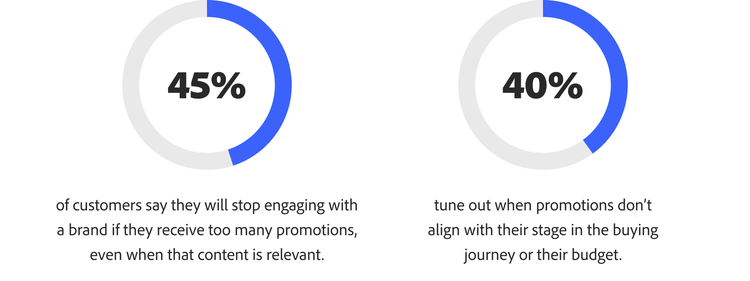
This is where the challenge to deliver intensifies. The same report claims that nearly 45% of customers say they will stop engaging with a brand if they receive too many promotions, even when that content is relevant. Half of customers disengage when personalized experiences feel off or poorly timed, and roughly 40% tune out when promotions don’t align with their stage in the buying journey or their budget.
This creates a delicate balancing act for marketers engaging with customers. Promotions must be relevant, but not overwhelming. Content must be personalized, but not intrusive. Great marketing comes from deep customer understanding.
People want experiential, engaging moments with your brand. They want a brand pairing with their favorite designer to be a relevant, experiential moment. Great examples of this are Marty Supreme and the table tennis-inspired capsule collections from niche cultural tastemakers or the viral 18-minute Zoom session with A24’s marketing team. Another customer trend is interactive, multichannel experiences and co-creation of content. Professional sports leagues like NFL, English Premier League, and MLB are all examples of the intersection of marketing, customer experience, and fan content co-creation. By equipping Live Content Correspondents to capture and publish real-time moments and giving fans AI-powered tools to create their own content, the NFL is collapsing the distance between marketing, storytelling, and experience. The result is a more immediate, participatory form of fandom built around live moments.
At the same time all this innovation is happening in marketing, creative, and content workstreams, marketers are beginning to tap into a new audience segment — agents.
Agents: A new audience emerges.
What if relevance, timing, and volume of content were not a concern for one audience segment? If the Moltbook use case taught us anything, agent audiences, just like human ones, are beginning to mirror culture. But agentic systems can digest data in milliseconds, and in the context of an even larger aggregate of data than humans, rifling through to find what is relevant to them. Marketing to agents and marketing to humans are not one and the same.
While fully autonomous agents that shop and complete tasks are emerging, agents are already actively being used to assess information and deliver aggregated answers to real-life customers. We are living in an era of marketing where more content, more data, and more journey pathways are imminent. But the decisioning is different. Marketing to agents requires providing accurate, structured information about your brand or product, not selling them on the brand or product. Marketers will need to find unique ways to show up for both audiences. This means zeroing in on the how and when to market to agent customers versus human customers.
There is early evidence that low-risk transactional or routine experiences are a good entry point. Our data revealed roughly half of customers would be comfortable having their personal agent work with a brand’s human representative. Far fewer would let their agent work with a brand’s AI agent, book travel, hand over personal information, or make final purchasing decisions. And their comfort is highest for routine, low-risk uses like live customer service, personalized promotions, and automated routine processes.
Marketing to agents is still coming into focus, but your business will need to shift from capturing the attention of this audience segment, to supporting the intent of the humans they assist. I’ll dive deeper into that opportunity in the next article in this series. But first I want to call out how to scale this vision and why AI‑powered customer experience orchestration is a defining capability of modern marketing.
Why experience orchestration is the real competitive advantage.
Great marketing still starts with a human spark, whether it's the campaign ethos, the creative concept, or the emotion behind the message.
What’s changed is what it takes to bring that idea to life, personalize it, and deliver it to millions of customers — even agent customers. A single campaign may require hundreds of assets, dozens of formats, multiple languages, and constant optimization across channels and regions. That operational burden can pull marketers away from the work they love as well as the work that actually drives results.
Most organizations don’t have a shortage of ingredients. They have customer data, content, and channels. But they need to scale. Customer experience orchestration connects insights, decisioning, and action into a continuous system of engagement instead of a collection of disconnected campaigns. It’s the shift from managing isolated moments to designing and optimizing end‑to‑end customer journeys with relevant content and using AI to help power that system so you can move at the speed and scale required.
AI becomes genuinely valuable when it’s used to scale data, customer engagement, and content. It allows brands to take a strong core idea and operationalize it across markets, formats, and audiences. AI enables teams to translate and deploy content, build and refine audience segments, and optimize performance based on real-time response signals, allowing marketers to focus on customer insight, message clarity, and experience design. When all of this works together, brands are more efficient and more authentic, evolving consistently across every audience segment, both human and agent.
Winning the next era of marketing.
We’re at a rare inflection point. AI is expanding what’s possible, while customers are demanding more relevance, more authenticity, and more participation. We’re also reaching a divergence in traditional audience segments that requires a new marketing framework that adapts to modern intelligence.
The brands that win won’t be the ones chasing every shiny new AI capability. They’ll be the ones that keep humans at the center of creativity, use AI to scale intelligence and execution, orchestrate experiences in one seamless workflow rather than optimizing within silos, and protect trust through governance and thoughtful leadership. And they’ll know exactly how and where to show up to meet their customers, a topic I’ll explore in my next article in this four-part series on the future of human-to-human, human-to-agent, and agent-to-agent marketing segments.
Watch my take on how AI is changing marketing, and how your brand can stay ahead. View it here.