What is a Gemba walk and how does it drive continuous improvement?
09-09-2026
When operational data tells you one thing and frontline reality tells you another, the gap between the two is where waste hides. A Gemba walk is the structured practice that closes that gap, and for Australian organisations managing dispersed teams across multiple states, it remains one of the most practical tools in the Lean management toolkit.
What is a Gemba walk?
Most leaders encounter a familiar frustration: dashboards show processes running to plan, yet customer complaints rise or delivery times drift. The disconnect usually lives in the details that reports cannot capture, undocumented workarounds, informal handoffs, or environmental constraints that no one thought to log.
A Gemba walk is a structured visit to the place where work actually happens, a factory floor, a warehouse, a hospital ward, or a service desk, so leaders observe processes first-hand rather than relying solely on second-hand data. The term "Gemba" (現場) is Japanese for "the real place"; in Lean management it refers to any location where value is created for the customer.
The practice becomes relevant when an organisation notices a gap between planned processes and actual outcomes. A logistics team in regional Queensland, for instance, might discover that pick-and-pack times diverge from system estimates because staff have developed an undocumented workaround to compensate for a poorly positioned scanner. Anyone responsible for process performance, operations managers, quality leads, team leaders, encounters the need for Gemba walks when dashboard data alone cannot explain variation.
Where did the Gemba walk originate and how has it evolved?
Many organisations treat the Gemba walk as a manufacturing-only technique, which limits its adoption in service-oriented sectors. Understanding its origins, and its modern trajectory, removes that barrier.
The practice originated in the Toyota Production System (TPS) in the 1950s. Taiichi Ohno, the architect of TPS, insisted that managers go to the shop floor rather than manage from offices. His reasoning was straightforward: decisions made at a desk rely on abstracted information, while decisions made at the point of work rely on observable fact.
Since then, the Gemba walk has extended well beyond manufacturing. Software teams use it to observe sprint ceremonies and identify handoff friction. Healthcare organisations reframe ward rounds as process observation walks. Government agencies, including Australian service delivery centres, apply it to counter-service workflows to understand why transaction times exceed targets.
This evolution matters because it demonstrates the practice is not industry-locked. Any Australian organisation with repeatable processes can apply it, from a Melbourne fintech to a Perth mining operation.
Why are Gemba walks important for operational performance?
Organisations that skip direct observation tend to accumulate invisible inefficiencies. A five-minute delay repeated across 200 daily transactions becomes a measurable cost that no dashboard flags until someone watches the process unfold in real time.
Gemba walks close the gap between documented processes and actual practice. They also build trust between frontline staff and leadership. Employees in multi-site Australian operations, retail chains spanning metro and regional areas, for example, report higher engagement when leaders are visibly present and curious rather than auditing from afar.
Beyond trust, the practice supports a culture of continuous improvement (kaizen) by making observation routine rather than reactive. Problems are found before they escalate into incidents, complaints, or costly rework. The cumulative effect is an organisation that self-corrects at the operational level rather than waiting for quarterly reviews to surface issues.
How do you conduct an effective Gemba walk?
Many leaders default to informal "management by walking around" without structure, which yields anecdotes rather than actionable insights. A Gemba walk requires a defined theme, prepared questions, and a follow-up mechanism.
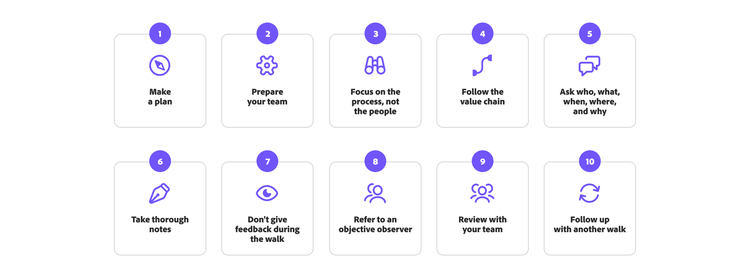
Step 1, choose a theme. Focus on one process or value stream per walk, such as order fulfilment accuracy or patient discharge workflow.
Step 2, prepare questions. Open-ended, non-judgemental questions work best: "What slows you down most in this step?" or "If you could change one thing about this handover, what would it be?"
Step 3, observe without intervening. Record observations and resist the urge to solve on the spot. Premature solutions undermine trust and bypass root-cause analysis.
Step 4, debrief and act. Share findings with the team, agree on one or two improvements, assign owners, and set a review date.
Consider a state government agency conducting a Gemba walk at a regional service centre. Staff are printing forms because the digital system times out after 90 seconds of inactivity. A five-minute IT configuration fix eliminates a 15-minute workaround per transaction, an improvement invisible to anyone who never watched the process.
What questions should you ask during a Gemba walk?
Poorly framed questions are the most common reason Gemba walks produce little of value. A closed question like "Is this process working well?" signals that the leader expects a positive answer and shuts down candid feedback.
Effective questions fall into three categories:
- Process understanding: "Can you walk me through what happens after the order is confirmed?"
- Pain-point discovery: "Where do you most often wait or redo work?"
- Improvement ideation: "What would make this step easier?"
Tailor questions to the walk's theme. A safety-focused Gemba walk in a warehouse asks about near-misses and ergonomic strain; a customer-experience walk in a bank branch asks about common customer frustrations.
Document answers immediately using a simple template or mobile checklist rather than relying on memory, especially when walking multiple sites across states.
How often should you schedule Gemba walks?
Organisations that start with enthusiasm but lack a cadence quickly let the practice lapse. There is no universal frequency, the right rhythm depends on organisational maturity, process volatility, and geographic spread.
- New to Gemba walks: Start weekly for the first quarter to build habit and trust, then move to fortnightly.
- Stable processes with experienced Lean teams: Monthly walks with ad-hoc walks triggered by anomalies in operational data.
- Multi-site organisations (e.g. a retailer with stores in every Australian state): Rotate walks across locations to avoid "head-office bias" where only nearby sites receive attention.
Consistency matters more than frequency. A monthly walk that always results in follow-up action is more valuable than a weekly walk with no debrief.
How can technology support your Gemba walk practice?
Insights from Gemba walks often stall because there is no system to track actions, assign owners, or measure whether improvements were implemented. This problem intensifies in organisations with multiple sites, findings captured in notebooks or email threads disappear within days.
A work-management platform turns walk observations into trackable tasks with deadlines, owners, and status visibility across the organisation. Adobe Workfront enables teams to capture findings as structured work items such as tasks or issues, link them to broader operational projects within portfolio hierarchies, and report on progress through dashboards, helping make the practice more scalable rather than ad-hoc.
The decision logic is straightforward: if your organisation conducts Gemba walks across fewer than three sites with a single team, a shared spreadsheet may suffice. If you operate across multiple states, departments, or value streams, a centralised work-management tool prevents findings from disappearing. Pairing Workfront with data analysis and visualisation tools helps surface the operational data that triggers targeted walks in the first place. And as your improvement data grows, maintaining robust data governance practices ensures that insights remain trustworthy and auditable across the organisation.
Ready to turn Gemba walk insights into measurable improvements? Explore how Adobe Workfront helps distributed teams track and act on operational findings, understanding the customer journey intelligence behind those findings is equally critical. Request a demo today.
Recommended for you
https://business.adobe.com/fragments/resources/cards/thank-you-collections/workfront