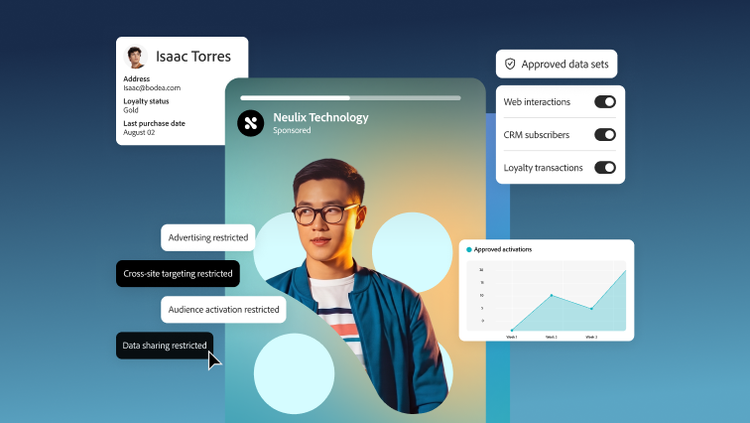
A data governance platform operationalises the policies, roles and standards defined in the governance programme. The right platform reduces manual enforcement overhead and makes compliance auditable without requiring human review of every access event.
Core capabilities to evaluate:
- Automated data discovery and classification that finds and categorises data assets without manual inventory.
- Policy enforcement at the data layer, not just at the application layer. Data usage policies describe the kinds of marketing actions that you are allowed to, or restricted from, performing on data.
- Lineage tracking across source systems, transformations and consumption points.
- Role-based access controls with time-bound permissions.
- Audit logging that produces regulator-ready reports without customised engineering.
For organisations managing experience data across marketing, analytics and customer service channels, governance must span the full data lifecycle, from consent collection and identity resolution through segmentation and activation. A platform that governs storage but not activation creates a compliance gap precisely where customer data is most exposed.
Adobe Experience Platform provides data governance capabilities built into the platform architecture rather than bolted on after the fact. Usage labels, policy enforcement and consent management apply at the schema level, meaning governance rules travel with the data regardless of which downstream application consumes it. This architectural distinction matters for regulated organisations operating at scale, because it eliminates the gap between where governance is defined and where data is actually used.
Evaluation criteria mapped to organisational conditions: a single-cloud, low-regulation environment may find catalogue and lineage tooling sufficient. A multi-cloud, multi-region, regulated industry should look for enforcement at the data layer, automated lineage and consent-aware activation. Experience-data-first organisations managing real-time customer profiles should prioritise platforms where governance is native to the data model, not a wrapper around it.