Most organisations map the customer journey they wish existed, not the one customers actually experience. The gap between those two versions is where budget gets misallocated, churn goes undiagnosed, and growth stalls. This guide breaks down the stages of a customer journey, explains why mapping fails without primary research, and shows how analytics connects fragmented touchpoints to revenue outcomes for Australian B2B and B2C teams.
What is a customer journey and how do you turn it into measurable growth?
What is a customer journey and who needs to understand it?
Organisations with more than one channel face a structural problem: the customer perceives a single relationship, but internally, each channel operates in its own silo. Every disconnected handoff, from app to store, from marketing email to service call, is a moment where the customer can leave without anyone noticing until it shows up as churn in a quarterly report.
A customer journey is the complete sequence of interactions a person has with a brand, from first awareness through post-purchase advocacy. It includes touchpoints the organisation does not control: comparison sites, peer recommendations, unlogged service calls, and internal buying-committee conversations.
Three roles encounter this most directly. Marketers need visibility into which channels influence stage progression. CX leaders diagnose where prospects stall or abandon. Revenue operations teams connect journey signals to pipeline forecasts and renewal predictions.
A key distinction matters here: the journey describes what the customer does; the experience describes how the customer feels at each step. Conflating them produces process maps that miss the emotional signals predicting churn or advocacy. Understanding what is a customer journey map and how to build one helps teams bridge this gap between process documentation and genuine insight.
Effective customer journey orchestration requires visibility across all these touchpoints so that each handoff reinforces rather than interrupts the relationship.
What are the stages of a customer journey and how do they differ by context?
Without a shared stage model, teams talk past each other, marketing optimises for awareness while sales assumes every lead is in the decision stage. Five stages form the standard model:
Stage
Customer question
Typical touchpoint
Success metric
Awareness
"I have a problem"
Search, social, referral
Reach and recognition
Consideration
"What are my options?"
Content, webinars, reviews
Engagement depth
Decision
"Which option is right?"
Demo, proposal, trial
Conversion rate
Retention
"Am I getting value?"
Onboarding, support, loyalty
Renewal / repeat rate
Advocacy
"Should I recommend this?"
NPS, referral program
Referral volume
B2B journeys in Australia, particularly in enterprise technology, professional services, and government procurement, extend the Decision stage dramatically. A Sydney-based SaaS vendor selling to a federal department may navigate separate security, architecture, and commercial evaluation tracks simultaneously, with six to ten stakeholders involved. Effective audience targeting at the Consideration stage must account for each stakeholder's distinct information needs.
B2C journeys in Australian retail compress Decision to minutes but expand Retention complexity: loyalty programs, subscription models, and omnichannel returns create post-purchase touchpoints that determine lifetime value.
The most underinvested stage across Australian organisations is Retention. Teams over-index on acquisition while post-purchase experience receives minimal orchestration, yet Retention is where the highest-value lifetime revenue is won or lost.
Why does customer journey mapping fail without primary research?
The core problem is seductive simplicity. A workshop with sticky notes produces a map in hours. But without primary data, interviews, session replay, CRM event data, and behavioural analytics, teams invest in fixing the wrong friction points.
Every actionable journey map must contain six elements:
- A defined actor (specific persona)
- A scenario (the goal the actor is trying to achieve)
- Journey stages
- Touchpoints per stage
- Emotional state indicators
- Ownership assignments
An Australian financial services firm mapping its client onboarding journey might discover that a significant proportion of new clients experience a communication gap between the relationship manager who closed the deal and the operations team who begins servicing the account. This friction point is invisible without mapping the handoff from the client's perspective, internal process diagrams show a clean transition, but the client experiences silence.
The antidote to assumption-based mapping is triangulating qualitative interviews with quantitative behavioural data, what customers say they do versus what the data shows they do. This triangulation separates a useful map from a workshop artefact. Adobe Journey Optimizer supports this by connecting insight to activation.
How does journey analytics connect fragmented touchpoints to revenue?
Organisations that cannot stitch the journey together default to last-touch attribution, which systematically undervalues upper-funnel and mid-funnel touchpoints. Budget flows toward channels that capture demand rather than create it, a misallocation that compounds over quarters until acquisition costs rise and pipeline quality declines.
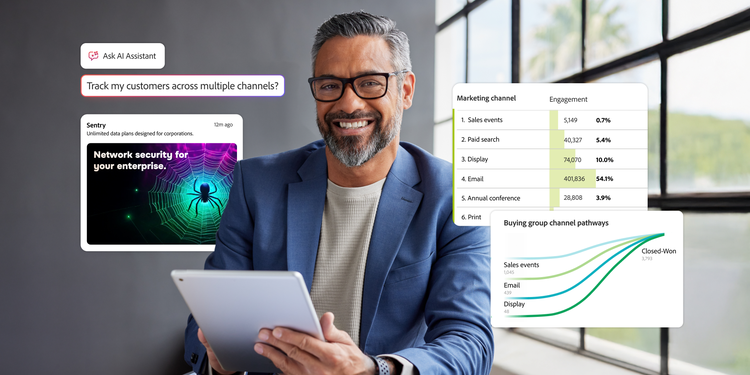
Analytics transforms journey mapping from a periodic research exercise into a continuous measurement system. Instead of reporting that "email has a 2% click rate," teams can identify that accounts exposed to a specific sequence, webinar, then email, then sales call, convert at materially higher rates than those receiving email alone. Sequence analysis reveals which paths produce revenue, not just which channels produce clicks.
Data feeding journey analytics must be clean, consented, and well-governed. For Australian organisations handling personal data, the Privacy Act 1988 and Australian Privacy Principles (APPs) apply directly. Organisations that skip data governance find their journey insights are built on incomplete or non-compliant foundations. Journey data typically flows into a centralised data lake where cross-channel events can be unified into a single customer view.
The business implication is direct: organisations that measure journeys in real time can reallocate budget quarterly based on evidence rather than opinion. The gap between mapping journeys and measuring them is the gap between opinion-driven and evidence-driven investment decisions.
Which journey investment fits your organisation's current maturity?
Choosing the wrong tool for your maturity level wastes budget and creates shelfware. The right investment depends on where you sit today:
If your organisation has fewer than three digital channels and a single buying persona: start with a manual journey map using interviews and CRM data. Invest in mapping methodology before analytics tooling.
If you operate across multiple divisions with complex buying committees and fragmented data systems: prioritise a unified analytics platform that can stitch account-level journeys across touchpoints without requiring a full data warehouse migration. Adobe Customer Journey Analytics supports this at enterprise scale.
If you already have journey maps but cannot measure their accuracy or tie them to revenue outcomes: the gap is analytics, not mapping. Look for solutions that connect behavioural data to commercial outcomes in real time.
If your organisation handles personal data across the journey (most do): ensure data governance is in place before scaling analytics. Privacy Act 1988 compliance is not optional, and insights built on non-compliant data carry both legal and strategic risk.
The principle is straightforward: mapping before measurement, measurement before optimisation. Skipping a layer produces tools without the data foundation to make them useful.
Explore how Adobe Customer Journey Analytics unifies cross-channel data into a single customer view. Request a demo to see account-level journey stitching in action.
Recommended for you
Title
Customer Journey: Stages, Mapping, and Analytics
CardDescription
Learn what a customer journey is, how to map its stages, and how analytics connects touchpoints to revenue. Practical guidance for Australian B2B and B2C teams.
cardDate
2026-09-09
cardImage

primaryTag
caas:content-type/blog
Tags
caas:content-type/blog, caas:products/customer-journey-analytics-b2b-edition, caas:topic/data-&-analytics, caas:blog-author/adobe-for-business-team