In the 2010s, investor John Doerr popularised a new approach for companies to reach their goals – OKRs (objectives and key results).
Beyond defining the destination and the roadmap to get there, OKRs align individual and team efforts with overarching business objectives – keeping everyone focused on the same thing: success.
When implemented correctly, OKRs help staff at every level of an organisation focus on what matters, drive performance and results, and maintain transparency and accountability throughout.
Below, we’ll walk through how OKRs work in more detail – and help you apply them to your business.
In this guide:
What is OKR?
Objectives and key results (OKRs) offer a simple yet powerful goal-setting framework that can be a key driver of growth and high performance across organisations.
OKRs help businesses clarify what they want to achieve (objectives) and how they’ll measure success (key results). Used effectively, they become a powerful tool for aligning and engaging everyone in the organisation around clear, measurable goals.
Designed to create clarity across an organisation and connect people at every level to your top business goals, OKRs are all about setting challenging, collaborative aims with definable outcomes.
- Think of the objective in OKRs as a ‘strategic theme’: a broad, overarching, qualitative headline of what needs to be achieved.
- The objective’s key results are similar to KPIs (Key Performance Indicators). Each key result can be either a metric or a measurable milestone.
As OKR pioneer John Doerr explained in an interview with the Harvard Business Review: ‘The objective is what I want to have accomplished. The key results are how I’m going to get it done. The objectives are typically longer-lived. They’re bold and aspirational. The key results are aggressive, but always measurable, time-bound, and limited in number.’
A brief history of OKRs
The history of OKRs reads like a who’s who of American corporate history.
- In 1954, business guru Peter Drucker – often considered the founder of modern management practice – laid the foundations for OKRs with his Management by Objectives (MBO) framework.
- MBOs, however, had their drawbacks – namely the focus on quantity, rather than quality.
- A few decades later, MBOs were adopted by Andy Grove, CEO of Intel, in Silicon Valley’s booming tech industry. It was Grove who shifted the focus to individual key results rather than overarching objectives, tailoring them specifically for Intel as Intel Management by Objectives (IMBOs).
- It was John Doerr, working under Grove at Intel at the time, who brought the OKRs we know today into the mainstream. As a key investor in Google, Doerr’s advocacy put OKRs on the radar of founders Larry Page and Sergey Brin in the late 1990s.
- Household names such as LinkedIn, Twitter (now X), and Uber followed suit – and Doerr cemented his legacy as the oracle of OKRs with his book Measure What Matters in 2010.
What are the benefits of OKRs?
As a management goal-setting system and methodology, OKRs are designed to focus everyone’s efforts on the most important priorities, connecting the work of employees to what truly matters at the organisation.
The widespread uptake of OKRs comes down to five key benefits, which John Doerr describes as the F.A.C.T.S.
Here’s how they break down:
- Focus. When a company sets clear, results-driven goals, employees have a defined point of focus. Rather than questioning the purpose of their efforts, they know precisely how their work supports the organisation’s mission. According to the What Matters site, it’s best to set up to three objectives at a time, with around three to five key results per objective. This is a practical way to keep your priorities in focus.
- Alignment. Setting clear, high-level objectives gives everyone across the organisation a shared sense of direction. When teams and departments are aligned, they can work together more effectively to accomplish established goals.
- Commitment. When everyone understands the company’s core ambition and their role in achieving it, they’re more engaged and committed to their responsibilities. Without clearly defined objectives, employee engagement and morale can suffer.
- Tracking. The OKR framework requires organisations to set intentions and identify associated key results at the same time. This makes it easier to track goals and measure the effectiveness of growth efforts.
- Stretching. When setting OKR key results, organisations can include one or two metrics to serve as stretch goals – those that may not be mission-critical but still warrant attention. These key results should, however, remain attainable and relevant to the company’s overall mission.
There’s also the added benefit of agility. Unlike many goal-setting methodologies, OKRs aren’t set in stone. Because they focus on short-term targets and broad objectives, they can adapt quickly to the changing needs of the business.
The OKR formula – defining objectives and key results
To define the approach in plain terms:
- Objectives are the goals you want to achieve. They should be straightforward and easy to act on. A clear objective removes confusion among team members and keeps everyone aligned towards a common goal.
- Key results are the metrics you use to track progress towards your objective. They need to be concrete and measurable – without this, you can’t accurately gauge how far you’ve come. For example, if your goal is to grow your business, key results might include increasing revenue to USD 2 million, launching a new product, or generating 25,000 new leads within a year.
John Doerr’s formula is a solid starting point:
‘I will accomplish “X” (objective) as measured by “Y” (key result).’
With this formula, objectives become your company goals for the quarter or year, measured by key results. To be effective, they need to be clear, ambitious, and motivating – so everyone across the organisation understands the primary goals and commits to them.
Once you’ve set your objectives and key results for a defined period – say, annually – the next step is aligning them with your business. For larger organisations, this is a genuine challenge, as different teams have different priorities and ways of working.
This is where '‘cascading OKRs’' come in – the process of breaking down larger, company-wide key results into smaller, team-specific ones. Generally, this follows a process like this:
- High-level OKRs are shared with department heads, managers, and other staff.
- Individuals take ownership of specific key results and determine the best approach to achieving them.
- Those key results then become objectives for the next level down – and so on, until the task is complete.
To address the perception that the process is too ‘top down’ or prescriptive, Doerr recommends that employees at all levels write their own key results – ensuring they have genuine input into the process and a real sense of ownership over it.
Types of OKRs and their applications
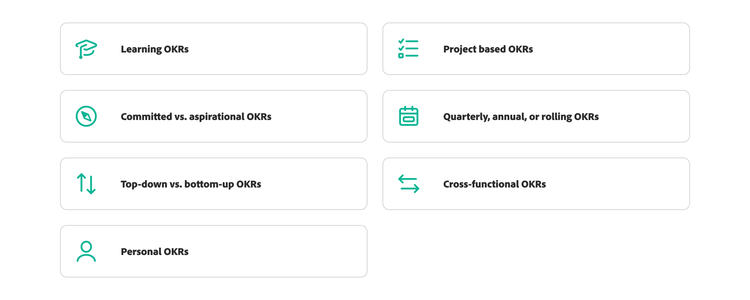
OKRs broadly fall into three core categories – learning, committed, and aspirational – along with a range of different types that shape how you apply OKRs within a business structure.
Let’s look at each one in more detail.
Learning OKRs
Learning OKRs focus on acquiring new knowledge or skills, with an emphasis on experimentation and continuous improvement rather than hitting pre-defined targets. They’re valuable for testing new approaches, which can in turn shape future OKRs.
Committed vs. aspirational OKRs
Committed OKRs are firm commitments, expected to meet a pre-defined metric by the end of the cycle. Aspirational OKRs, sometimes called ‘stretch goals’ or ‘moonshots’, set ambitious targets that push boundaries – even when full attainment isn’t guaranteed.
Top-down vs. bottom-up OKRs
Top-down OKRs align teams around overarching company goals. Bottom-up OKRs, on the other hand, are driven by teams and individuals at the ground level, encouraging creativity and ownership while still supporting the company’s broader strategy.
Personal OKRs
The OKR framework isn’t just for the workplace. Personal OKRs let individuals apply the same principles to their own goals, supporting self-improvement and keeping personal aspirations connected to professional objectives.
Project based OKRs
Project-based OKRs connect specific project goals to broader organisational objectives, ensuring individual projects contribute to the company’s overall strategic direction.
Quarterly, annual, or rolling OKRs
OKR timeframes are flexible and adapt to organisational needs. Quarterly OKRs sharpen short-term focus, annual OKRs set long-term direction, and rolling OKRs support continuous review and adaptation.
Cross-functional OKRs
Cross-functional OKRs bring multiple departments or teams together around a shared objective, breaking down silos and building alignment and cooperation across the organisation.
OKR examples
OKRs look different across every business. Here are a few examples from various industries to spark ideas for your own OKRs:
Sales team objective: launch a new customer community
Key results:
- Create a customer community strategy based on best practices.
- Publish 60 articles during the quarter and get more than 6,000 page visits.
- Get 30% of our customers to participate in the community.
Community management objective: make our community known by industry experts and thought leaders
Key results:
- Reach out to 12 industry experts and thought leaders in Q1.
- Interview them and publish the interview articles on our community site.
- Research and publish an industry report and infographics for the community.
CEO objective: grow our business
Key results:
- Grow revenue to USD 3M.
- Launch the new product.
- Reduce churn to <5% annually through customer success.
PR and analyst objective: build strong relationships
Key results:
- Complete two analyst briefings in Q1.
- Submit analyst report applications.
- Feature two analysts on our webinars.
- Host two analyst calls – provide the new product launch update.
Partner marketing objective: create a community of partners and resellers (MQLs)
Key results:
- Publish five new partner-focused whitepapers by Q1.
- Launch seven webinars to educate our partners.
- Run a five-city Lunch & Learn event for partners.
Top company objective: grow our corporate global business
Key results:
- Hit the company global sales target of USD 100 million in sales.
- Achieve 100% year-to-year sales growth in the EMEA geography.
- Increase the company’s average deal size by 30% (with upsells).
- Reduce churn to less than 5% annually (via customer success).
Demand gen objective: optimise our customer acquisition
Key results:
- Improve our new marketing automation process.
- Reduce customer acquisition costs by 20% in Q3.
- Build a new top-down and bottom-up Excel model to analyse the ROI.
Find out more about OKR templates.
What is the difference between OKR and KPI?
OKRs and KPIs (key performance indicators) are related, but there are important differences between them.
- OKRs are an overarching goal-setting framework. As covered above, each OKR comprises both an objective and a set of key results.
- KPIs define the factors required for success in an organisation. A common example is ‘increase sales by 50% by Q2’.
Crucially, KPIs sit within OKRs. Their concrete, actionable metrics make them a natural fit within key results.
Implement and manage OKRs effectively
To implement OKRs successfully, you’ll need a commitment to continuous improvement and a structured approach.
Let’s work through each stage step by step – from setting objectives and defining key results, to review, adjustment, and beyond.
Setting effective objectives
Starting with a clear, impactful objective is the foundation of any strong OKR.
Objectives should be:
- Clear and concise. Use plain, straightforward language – avoid jargon and ambiguity. Everyone in your organisation, regardless of role, department, or level of seniority, should be able to understand your OKRs. A confusing or poorly written objective leads to problems down the line.
- Ambitious yet achievable. Objectives should be challenging enough to push your teams and individuals to improve. But they also need to be realistic – overambition can sometimes undermine motivation. The sweet spot is a ‘stretch goal’ that stretches capabilities without being out of reach.
- Aligned with company strategy. Objectives must directly support the company’s overall strategic direction. This ensures everyone’s efforts contribute to the organisation’s long-term vision. Without this alignment, OKRs become fragmented and lose their effectiveness.
- Limited in number. To stay focused and avoid overloading teams, keep objectives to a manageable number each quarter. Three to five is the recommended range, concentrating resources and attention on the highest-priority work.
Three examples of well-written objectives
- "Increase customer satisfaction by 15%."
- "Launch three new product features based on customer feedback."
- "Expand market share by 10% in the target region."
Defining measurable key results
Key results (KRs) are the measurable steps that show progress towards achieving an objective. Effective KRs typically follow the SMART formula:
- Specific: Clearly define what needs to be achieved, leaving no room for ambiguity.
- Measurable: Include quantifiable metrics that enable clear progress tracking. This might cover numerical targets (e.g. revenue increase, customer acquisition), percentages (e.g. market share growth, customer satisfaction), or completion rates (e.g. project milestones).
- Achievable: While ambitious, KRs should be realistic and attainable within the given timeframe.
- Relevant: Each KR must directly contribute to achieving its associated objective.
- Time-bound: Set clear deadlines for each KR to ensure accountability and provide a framework for tracking progress.
Examples of quantitative and qualitative key results
- Quantitative: ‘Increase website traffic by 20%.’ ‘Generate USD 1 million in new revenue.’ ‘Reduce customer churn by 5%.’
- Qualitative: ‘Complete a comprehensive market analysis.’ ‘Launch a successful marketing campaign.’ ‘Improve the customer onboarding process.’
Each KR should have a clearly designated owner responsible for tracking progress and maintaining accountability. That person updates the KR’s progress and reports on its status.
Establishing a cadence for OKR reviews
Regular check-ins and progress reviews are key to maintaining momentum and making timely adjustments. This involves:
- Frequency: OKRs are typically set quarterly, but regular check-ins – whether weekly or fortnightly – are essential for monitoring progress, spotting roadblocks, and keeping teams supported.
- Effective meetings: Check-in meetings should be focused and efficient, giving teams the chance to discuss progress, work through challenges, and adjust their approach together when needed.
- Feedback and adjustment: Regular reviews create opportunities to incorporate feedback, pinpoint areas for improvement, and adjust OKRs so they stay relevant and achievable. This iterative approach is key to maximising the effectiveness of the OKR system.
Throughout the quarter, conduct regular check-ins with your team to track measured progress. Defining your OKRs in line with the company’s top priorities ensures you’re working towards the right goals.
Visibility, alignment, and progress tracking are crucial to OKR success. A system like Adobe Workfront keeps your OKRs strategically aligned with the work being done, accelerating delivery on goals and driving results.
OKRs vs. other goal-setting methodologies
If OKRs aren’t the right fit for you or your organisation, there are plenty of other goal-setting approaches worth considering.
OKRs vs. MBOs (Management by Objectives)
The key difference between OKRs and MBOs comes down to scope. OKRs emphasise challenging, aspirational goals with measurable outcomes that affect the entire business. MBOs, by contrast, focus on setting and managing more specific goals tied to individual performance.
MBOs are also less adaptable to changing circumstances, while OKRs are straightforward to adjust. Much of this flexibility comes down to cadence – OKRs emphasise quarterly goals and regular check-ins, while MBOs tend to be annual.
OKRs vs. SMART Goals
Both OKRs and SMART goals include specific, measurable elements, but their emphasis differs. OKRs prioritise aspirational, qualitative objectives backed by measurable key results, encouraging ambition and alignment.
SMART goals, on the other hand, focus on specific, attainable, and trackable targets, without the same holistic approach.
OKRs vs. KPIs (key performance indicators)
KPIs are metrics used to track performance against pre-defined targets. While some KPIs can serve as key results within an OKR framework, the two are not interchangeable.
KPIs primarily measure performance and operational efficiency. OKRs take a broader view, driving strategic change through ambitious outcomes.
OKRs vs. balanced scorecard
The balanced scorecard offers a broad strategic planning and performance management framework, covering financial, customer, internal process, and learning and growth perspectives. OKRs are compatible with the balanced scorecard but offer a more focused, actionable approach to goal setting and tracking within a defined timeframe.
The balanced scorecard offers a holistic view of organisational performance, while OKRs focus on achieving specific, measurable objectives.
Common OKR mistakes and how to avoid them
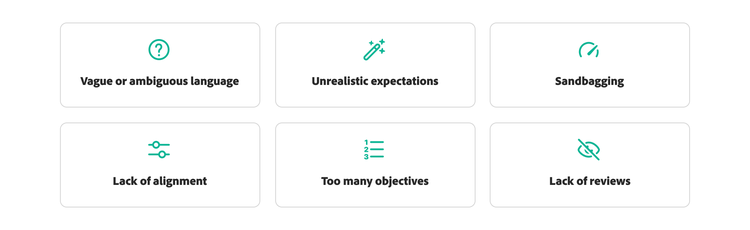
Here are a few common pitfalls to watch out for when using OKRs.
- Vague or ambiguous language. Steer clear of subjective terms or unclear phrasing. Quantifiable, measurable goals are essential for tracking progress.
- Unrealistic expectations. Setting overly ambitious goals can lead to demotivation and ultimately hold back progress.
- ‘Sandbagging.’ On the other hand, this is when teams under-promise and overdeliver to avoid pressure. However, this can create capacity planning issues and a lack of ambition.
- Lack of alignment. Objectives that don’t align with overall company strategy lead to wasted effort and a loss of focus.
- Too many objectives. Managing too many objectives at once can scatter focus and undermine the effectiveness of your OKR system.
- Lack of reviews. When objectives and key results go untracked, you risk missing your annual targets. Regular check-ins are essential.
Getting started with OKRs
When applied effectively, the OKR system can enable more effective, efficient, and high-performance business operations – creating clarity and accountability for everyone in the company.
Adobe Workfront has everything you need to create and track OKRs effectively. Find out more today and get started with your organisation.
Recommended for you
https://business.adobe.com/fragments/resources/cards/thank-you-collections/workfront