Using generative AI to adapt brand narratives for every customer stage.

Your brand narrative guides every campaign and audience interaction, shaping the stories you tell and helping ensure each one reinforces your unique identity. A consistent narrative makes your brand more memorable and trustworthy because people are naturally drawn to what feels familiar. Consistency doesn’t mean repeating the same message everywhere. As buyers move from awareness to consideration and decision, the questions they ask and the proof they seek evolve. Your brand storytelling should also change with them, while staying grounded in a familiar narrative.

Today, B2B buyers want to navigate their journey independently, with 67% preferring a rep-free experience. Brands need to deliver the right content at the right moment to influence decisions and build lasting connections. What enables this is effective storytelling that transforms a single brand narrative into experiences that resonate with buyers at each stage.

In this context, generative AI presents both opportunities and risks. While it enables marketing teams to produce content variations at extraordinary speed and scale, it can lead to narrative drift. As digital channels multiply, one of the biggest opportunities is to adapt the core narrative for countless touchpoints without losing the brand's essence.

To understand how generative AI can be used to adapt content without compromising narrative integrity, let's explore the following key areas:

What is brand storytelling across the content marketing funnel?

Brand storytelling across the content marketing funnel is the practice of maintaining a consistent brand narrative throughout the customer journey, while tailoring the message to match buyer intent at each stage. In the awareness stage, storytelling is broad, emotional and designed to build connection. During consideration, it becomes more detailed and evidence-driven, helping buyers evaluate their options. At conversion, it focuses on value and trust to drive action. After purchase, it reinforces the customer's decision and fosters long-term loyalty.

To tell a compelling story, it is important to understand the elements that make it effective.

  • Brand story: The foundational narrative that communicates who you are and what you stand for. It remains stable over time.
  • Brand storytelling: How the brand story comes to life through content, campaigns, experiences and customer interactions.
  • Brand messaging: The language system that supports the story, including key messages, claims, proof points and calls to action (CTAs).
  • Brand consistency: The set of guardrails that keeps the story recognisable and coherent across touchpoints.

How the brand story changes across the funnel.

In digital marketing, the best brand stories feel consistent and not repetitive. They meet audiences where they are, adapting to different questions and priorities across different stages of the customer journey.

1. Awareness storytelling: Start with what matters to your audience.

At the awareness stage, buyers want to know, “Why should I care?”

Storytelling helps them to recognise a problem, opportunity or belief that naturally ties to the brand narrative. Rather than selling, the goal is to build relevance, spark interest and create an emotional connection. The message should focus on customer challenges, shared values, category insights and memorable ideas that make the audience stop and think.

2. Consideration storytelling: Turn your story into customer value.

At this stage, buyers ask, “Why is this brand's approach the right one?”

As they compare options, explore solutions and look for reasons to trust one approach over another, storytelling makes the brand promise tangible. The message should focus on differentiation, customer needs, use cases, product education and evidence that supports the brand's claims. Personalisation also becomes increasingly important.

3. Conversion storytelling: Make the next step feel obvious.

At this point, buyers ask, “Why should I act now?”

Conversion storytelling helps them move forward with confidence. The message becomes more direct, specific and action-orientated, while staying connected to the brand promise established earlier in the journey. It should focus on clear benefits and customer proof, while proactively addressing common objections around cost, risk, trust, complexity or implementation to encourage action.

4. Post-purchase storytelling: Continue the story after conversion.

When someone becomes a customer, the question changes to, “Did I make the right choice?”

Storytelling should not end with a click, demo or purchase. After conversion, the story shifts from persuasion to reinforcement, helping customers realise value, gain confidence and strengthen their connection to the brand. The message should move from "why we are the right choice" to "how we can help you more."

Stage
Storytelling job
Message style
Content format
CTA style
Awareness
Create recognition and emotional connection.
Broad, human and memorable
Thought leadership, brand videos, educational content, research reports and social campaigns

Learn more,

explore and

discover

Consideration
Build trust and demonstrate differentiation.
Educational, detailed and solution-focused
Case studies, buying guides, webinars, solution pages, product pages, comparison content and customer stories

Compare,

evaluate and

find out how it works

Conversion
Reduce friction and inspire action.
Direct, specific and confidence-building
Demo pages, trial experiences, pricing pages, ROI calculators and offer-focused campaigns

Request a demo, start a trial and

contact sales

Post-purchase
Reinforce value and encourage advocacy.
Supportive, empowering and success-orientated
Onboarding content, customer success, communications, adoption campaigns, renewal messaging, community stories and advocacy programmes
Share, renew and advocate

The goal is to reveal different dimensions of the same narrative as buyer intent evolves, helping them to understand, trust, act on and ultimately advocate for your brand.

How to create a shared messaging foundation before adapting the narrative.

Maintaining a unified brand narrative across storytelling efforts starts with alignment. Before creating content, teams need a clear messaging foundation that gives everyone a shared understanding of the brand. It acts as a single source of truth. Building this foundation requires cross-functional alignment and a clear process that includes:

  1. Gathering insights from customer research, market trends, competitive analysis and internal stakeholders.
  2. Defining the strategy by clarifying the positioning, value proposition, target audiences and business goals.
  3. Establishing the approved narrative through messaging pillars, proof points, audience-specific messages, CTAs, voice, tone and visual direction.
  4. Defining guardrails based on brand guidelines, compliance requirements and content dos and don'ts.

This messaging foundation should be documented and centralised in a shared hub for easy reference. It will also help teams distinguish between:

  • Brand voice: The distinctive personality and communication style that make the brand instantly recognisable.
  • Brand tone: The way that voice is adapted to a specific context, whether informative, empathetic, authoritative, direct or supportive.

In brand storytelling, generative AI should not invent the story. The story should come from people who understand the brand. AI's role is to take that strategic foundation and adapt it into relevant content for different audiences, channels, formats and moments across the marketing funnel.

How generative AI helps scale funnel storytelling.

Generative AI can be a powerful storytelling partner. With the right prompts and guardrails, it transforms a single approved narrative into multiple content variations. It adapts both copy and visuals to suit each stage of the customer journey by adjusting:

  • Copy length and format for social posts, emails, landing pages, ads and video scripts.
  • Tone and CTA language to spark curiosity, encourage consideration or drive action.
  • Audience focus and messaging emphasis based on the needs and motivations of each segment.
  • Proof points and supporting evidence aligned to where customers are in their journey.
  • Channel-specific adaptations while maintaining consistency across touchpoints.
  • Visual concepts and creative direction to reflect the mindset of each funnel stage.
  • Layout and design approaches optimised for different formats and platforms.
  • Video and motion concepts to bring the story to life in engaging ways.

The key to brand storytelling is ensuring that every copy and creative variation feels as though it comes from the same brand, regardless of the message.

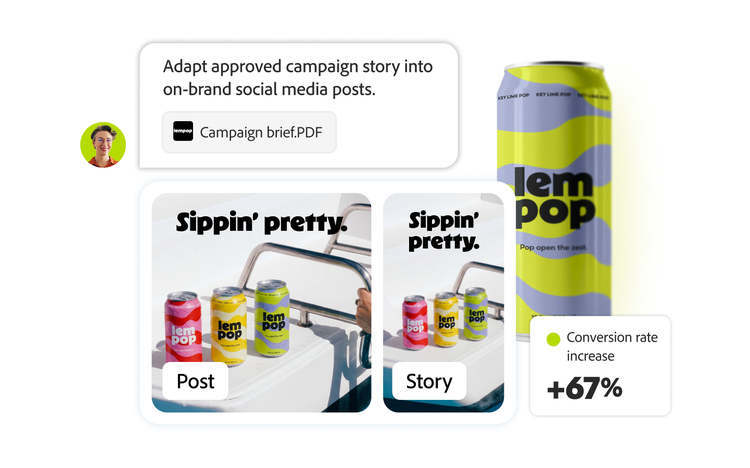
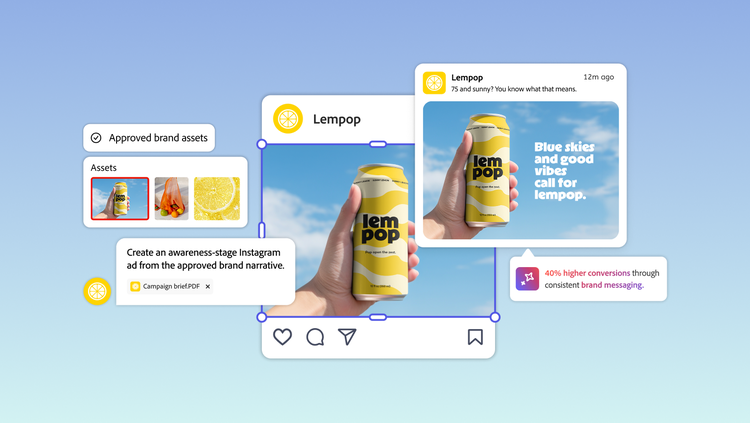
Illustration of a brand story tailored to different digital content formats.

How content variation can become narrative drift.

Generative AI makes it easy to create asset variations, but consistency depends on a shared story. Narrative drift occurs when content adaptations move away from the original brand narrative. New messages, themes or creative directions start to appear and campaigns communicate several conflicting stories, creating fragmented customer experiences.

In practice, narrative drift can look like:

  • Different ads that emphasise distinct product values — one highlighting innovation, the other focusing on simplicity.
  • Channels that promote competing themes — social content focused on collaboration and email content focused on productivity.
  • Visual styles that lack consistency make campaign assets feel disconnected from one another.

Narrative drift often starts when AI prompts, models or workflows lack clear brand context and governance. As a result, even small variations in messaging and creative execution can gradually pull the content away from the brand narrative.

How to adapt a brand story without creating narrative drift.

To adapt a brand story across the content marketing funnel, the focus should be on evolving the delivery. The core theme remains familiar, while the format, messaging and creative treatment change to meet customer expectations.

Here are six key steps to adapting a brand story without creating narrative drift:

1. Build from approved messaging pillars.

Start with three to five messaging pillars that support your core brand narrative. Think of them as themes that consistently appear across every campaign, channel and audience touchpoint. The pillars should remain stable, even when the content changes. What changes is the emphasis. Someone discovering your brand for the first time may respond to a different pillar than someone evaluating solutions or getting ready to buy.

2. Match each stage to the right proof and CTA.

While the core story remains the same, the proof and CTA should evolve across the funnel. Awareness-stage audiences need insights to understand the problem. During consideration, they look for evidence that the solution can deliver value. At conversion, stronger proof points and risk-reduction mechanisms become more important. After purchase, the focus shifts to realised value and long-term outcomes.

Like the proof points, CTAs should evolve from low-commitment to high-intent actions. They should guide customers from exploration to conversion and ultimately to loyalty and advocacy.

3. Establish guardrails for AI-assisted storytelling.

Generative AI can only adapt a brand story effectively when clear boundaries are already in place. Without clear guardrails, content may drift from the brand's established voice, include unauthorised messaging or dilute its visual identity. The role of AI is to adapt and scale the story, rather than reinvent it.

These guardrails should define what every output must follow, including the brand narrative, messaging pillars and brand voice. They should also specify how tone, audience focus, proof points and CTAs should change across funnel stages. In addition, they should outline approved claims, visual and creative standards and the review process for AI-generated content before publishing.

4. Use AI prompts that reference the source of truth.

AI-generated content is only as effective as the prompts behind it. Pairing prompts with consistent brand messaging helps ensure every asset reflects the same core narrative. A simple prompt structure could look like this:

Copy-generation prompt example
Visual-generation prompt example
Using the approved brand narrative, messaging pillars, target audience, proof points, brand voice and CTA guidelines, create copy variations for the awareness, consideration and conversion stages of a B2B cloud security campaign. Maintain the same core brand story across variations while adapting the messaging emphasis, proof points and call to action to each stage of the customer journey.
Using the approved brand guidelines, campaign narrative, target audience, campaign objective and visual identity standards, create visual concept variations for the awareness, consideration and conversion stages of a B2B cloud security campaign. Maintain the same core brand story across variations while adapting the visual storytelling, imagery, messaging emphasis and design approach to align with each stage of the customer journey.

Referencing a defined source of truth helps AI generate variations that feel consistent rather than disconnected.

5. Review for narrative drift before publishing.

Human oversight remains essential in brand storytelling. Before publishing any asset, take a final step back to ensure it still reinforces the core brand story.

Review the content against a simple set of questions:

  • Does it reinforce the approved brand narrative?
  • Are all claims approved and supported?
  • Does the content match the intent of the funnel stage?
  • Is the brand voice still recognisable?
  • Do the visuals support the same message as the copy?

A thorough review process can prevent small inconsistencies from becoming larger narrative problems over time.

6. Avoid the most common causes of narrative drift.

Narrative drift often occurs due to subtle deviations that accumulate into larger inconsistencies over time. Common causes include:

  • Treating every funnel stage as a separate campaign.
  • Letting AI generate content without approved strategic inputs.
  • Mistaking personalisation for rewriting the brand story.
  • Ending storytelling at the point of conversion.
  • Allowing copy and visuals to communicate different messages.

To avoid narrative drift, it's important to ensure that execution changes to fit the context while the underlying story remains unchanged.

As channels and customer expectations continue to evolve, brands need to adapt. When used thoughtfully, generative AI can help teams adjust efficiently while expanding creative possibilities.

Building a scalable full-funnel story.

For enterprise teams, full-funnel storytelling is becoming increasingly complex as channels, audiences and content demands continue to grow. In the age of AI, scaling content is the first step, but maintaining a strong, recognisable brand identity across all of them can be challenging. The key is to treat generative AI as a catalyst, not a navigator, using it to adapt and amplify a story rather than define it.

This is where a strong messaging framework matters. By anchoring generative AI to clear messaging pillars, narrative guardrails and brand standards, teams can scale content variations across the funnel without losing consistency. The goal is to ensure that every touchpoint feels relevant and unmistakably connected to the same brand.

Explore how Adobe GenStudio empowers your team to deliver on-brand, funnel-specific content at scale.

Let’s talk about what Adobe can do for your business.

Get started