Conversational search combines large language models (LLMs), natural language processing (NLP), natural language understanding (NLU), and machine learning to interpret user queries as complete thoughts rather than isolated keywords. This allows search engines to understand context, map intent, and generate responses that directly address what the user is trying to accomplish.
What makes this different from traditional search is that the system is doing interpretive work at every stage. This happens across four connected layers.
- Query interpretation: NLP processes the full structure of a query, including its phrasing, patterns, and nuances, to extract meaning rather than match terms. A question like “What’s the best project management tool for a remote team under 20 people?” is read as a complete thought, with the constraints and context the user has specified factored into the response.
- Context retention: The system maintains memory across an interaction, so follow-up questions don’t need to restate everything. When a user asks, “How does it handle resource planning?” the system knows what “it” means and answers accordingly.
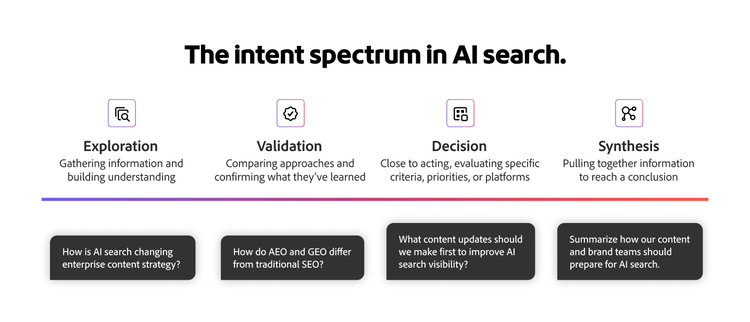
- Intent mapping: NLU goes beyond language structure to interpret what the user is trying to do, distinguishing between someone researching a category, comparing options, or deciding, even when the phrasing is similar.
- Response generation: Natural language generation (NLG) allows the system to produce a direct, coherent answer. It draws on the query interpretation, context, and intent mapping that preceded it and constructs a contextual response.
What is natural language processing?
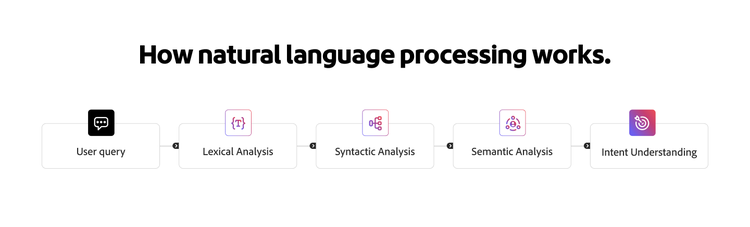
Natural language processing, or NLP, is the branch of AI that helps computers process, interpret, and generate human language. Where traditional software requires structured, predictable inputs, NLP allows systems to work with language as people use it, with all its ambiguity, context-dependence, and variation in phrasing.
It does this by breaking language into smaller parts, analyzing sentence structure, identifying entities and relationships, and using context to infer meaning. In conversational search, NLP makes intent-based interpretation possible at scale.
When a user asks, “What content management tools work well for global teams?” the system looks beyond individual terms and understands the type of solution the user is researching, their organization size, and the likely need for capabilities such as localization, governance, and workflow management.
That capability connects directly to how AI systems respond to user intent. Because NLP helps a system understand what a user is trying to accomplish, it can synthesize a response that addresses the actual need.
How do AI search engines understand user intent?
AI search engines understand user intent by analyzing language patterns, context, historical data, and semantic relationships. Rather than matching a query to a page, they determine what the user is trying to accomplish and what kind of response would move them closer to that goal.
AI systems build that picture through several types of signals, starting with semantic understanding. Rather than matching exact keywords, they interpret meaning, which means a query about “reducing customer churn” and one about “improving retention rates” are recognized as pointing to the same goal even though the phrasing is different.
Layered on top are behavior and context signals. Depending on the platform and data available, AI crawlers may draw on previous searches, engagement patterns, and interaction history to interpret a new query. Entity relationships add the ability to map connections between concepts, so a query about campaign performance tools naturally pulls in related ideas like attribution, reporting, and segmentation.
All of this is underpinned by continuous learning. AI search models continuously refine how they interpret intent across different query types, industries, and conversational contexts to understand the gap between what someone typed and what they really need. That gap is exactly where content strategy needs to operate.