
Financial services organisations are navigating a fundamental shift in how they engage customers. Trust, once anchored in brand reputation and regulatory compliance, is now shaped by the quality of digital experiences, how well institutions protect data, deliver relevance and respond in real time.
At the same time, expectations continue to rise. Adobe research shows that 74% of financial services executives say customers expect personalised interactions, yet only 36% of the customer journey is currently personalised. Consumers are also clear about what matters most, with 90% rating data privacy as critical, but only 58% feeling their data is handled securely.
This gap between expectation and delivery is where many institutions are focusing their transformation efforts. They need to deliver personalised experiences responsibly, meeting strict regulatory requirements while maintaining full confidence in how sensitive customer data is managed.
Across banking, insurance and investment services, leading organisations are using Adobe to unify data, strengthen governance and deliver customer-first experiences that are both personalised and trusted.
Delivering personalisation while protecting trust.
The ability to personalise at scale depends on a strong data foundation that connects customer insights across channels while maintaining strict controls over how that data is used. Yet many institutions are still building toward this capability. Adobe research shows that only 8% of financial institutions have fully integrated and accessible customer data. Without that foundation, personalisation and AI initiatives remain difficult to scale in a compliant way.
Techcombank offers a clear example of how to achieve this balance. Operating in Vietnam — one of the fastest-growing digital economies — the bank needed to deliver personalised, omnichannel engagement to a rapidly expanding customer base.
By using Adobe Experience Manager, Adobe Real-Time Customer Data Platform and Adobe Journey Optimizer, Techcombank can collect insights quickly and activate communications across channels while maintaining governance over customer data. This approach has enabled the bank to scale its engagement strategy significantly.
Techcombank is also exploring generative AI capabilities, including Adobe Firefly, to enhance customer experiences further. This reflects a broader trend across the industry, where 56% of financial services firms are prioritising generative AI to improve client interactions.
Reducing risk while improving digital experiences.
Regulatory complexity and operational risk remain defining challenges for financial services organisations. Many are still dealing with fragmented systems and legacy platforms that make it difficult to maintain consistency, governance, and speed. While 79% of consumers want consistent experiences across physical and digital channels, only 47% feel brands are delivering on that promise.
To tackle this issue, IAG — one of Australia and New Zealand’s largest general insurers — focused on improving how it delivers accurate, timely information to customers while maintaining compliance. Years of acquisitions had left the insurer managing 15 separate websites across multiple systems, increasing complexity and making it harder to keep content consistent and up to date.
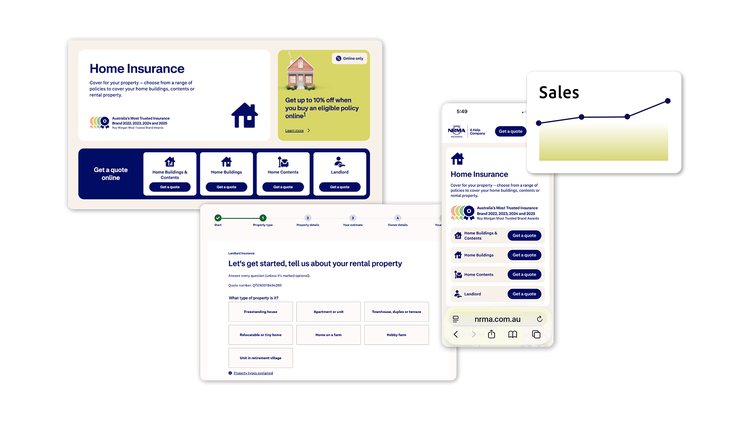
By implementing Adobe Experience Manager Sites and Adobe Experience Manager Assets, IAG consolidated its digital ecosystem on a single platform. This simplified governance and enabled teams to publish updates more quickly, delivering timely, relevant information to customers while meeting regulatory requirements.
“Adobe has been central to our transformation,” says Kim Bui, Head of Digital at IAG. “It’s helped us eliminate complexity, reduce risk and deliver secure, high-performing digital experiences at speed and at scale.”
Turning digital channels into engagement engines.
As expectations evolve, digital channels have become central to how financial institutions build relationships and deliver value.
Bankwest’s move to a digital-only bank reflects this change. The organisation redesigned its website and mobile app as engagement platforms to better support customers in managing their financial lives.
Using Adobe Experience Manager Sites, Adobe Analytics, Adobe Target and Adobe Journey Optimizer, Bankwest delivers personalised, connected experiences across channels. Since launching its new digital experience, website traffic has increased by 350%.
“We’ve shifted the website from being a library of FAQs to an engagement tool,” says Jodene Murphy, General Manager of Customer Marketing and Communications at Bankwest. “Every touchpoint showcases the seamless, uncomplicated experience that defines Bankwest.”
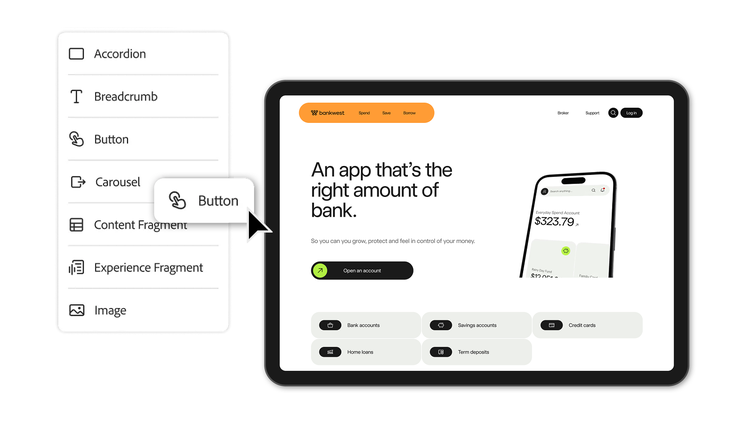
Bankwest is also exploring generative AI within Adobe applications to further improve operational efficiency and enhance customer engagement.
Building secure digital foundations for modern investing.
In investment services, trust is closely tied to performance, reliability and security. Customers expect fast, seamless access to information and services, without compromising the safety of their data.
Motilal Oswal Financial Services modernised its digital presence to meet these expectations. By unifying six business websites on Adobe Experience Manager Sites as a Cloud Service (supported by Edge Delivery Services), the company created a consistent, high-performance digital foundation.
The platform’s built-in web application firewall provides protection against common threats, helping safeguard sensitive customer interactions while maintaining speed and reliability.
“It’s been a blessing,” says Vipul Nirwani, Head of Digital Products at Motilal Oswal. “Adobe manages the firewall so our teams can focus on growth instead of firefighting.”
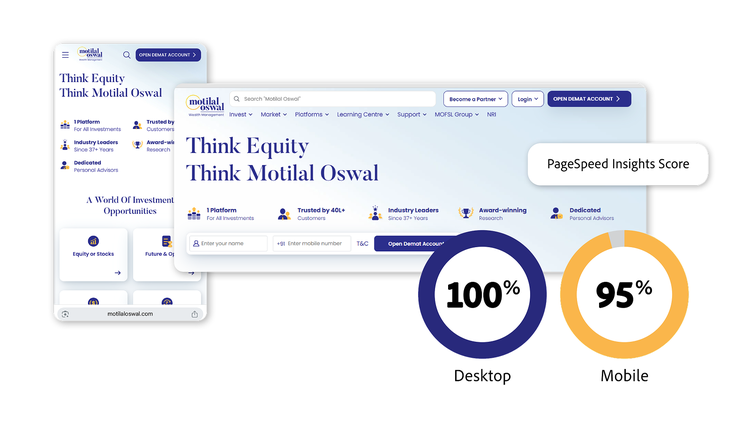
With this foundation in place, the firm is now exploring generative AI tools such as Adobe Firefly and GenAI for Experience Manager Sites to accelerate content creation and experimentation.
“Firefly and GenAI can help us create more options, test them faster and focus on what works, boosting both conversions and SEO performance,” Nirwani says.
This aligns with a broader industry shift. Generative AI is already increasing content production output by 46% while reducing cost per asset by 26%, enabling institutions to scale engagement more efficiently.
Scaling personalised journeys across millions of customers.
Delivering personalisation at scale requires continuous testing, optimisation and the ability to respond dynamically to customer behaviour. However, this level of responsiveness is still out of reach for many firms, with only 33% able to update offers in real time based on customer behaviour.
Axis Bank is one of the few creating tailored experiences across its website and mobile app. By analysing behavioural signals and adapting content in real time using Adobe Target, the bank delivers offers aligned with customer needs.
For example, a young professional exploring loans might see a banner highlighting personal loan rates, while a retiree is shown savings-focused offers. These contextual interactions help customers find what is most relevant to them.
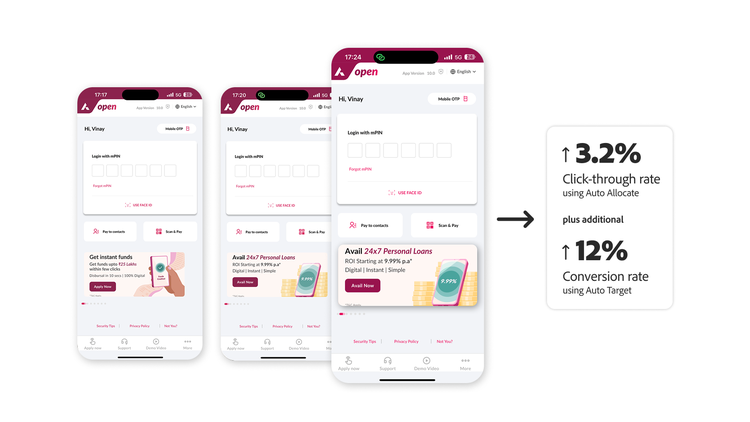
As a result, Axis Bank achieved a 25% increase in lead capture through A/B and multivariate testing and a 12% to 18% revenue uplift through personalised engagement.
Machine learning capabilities within Adobe Target further refine these experiences, automatically identifying and delivering the most effective content for each audience segment.
AI, governance and the next phase of engagement.
AI is becoming central to how financial services organisations scale personalisation and content creation. In a regulated industry, this requires strong governance.
According to Adobe research, 81% of firms are building governance frameworks to manage the increasing adoption of generative AI. This is a clear indicator of their focus on balancing speed and scale with control and accountability.
Institutions are already using AI to produce content faster, improve decision-making and strengthen both operational efficiency and customer engagement. The opportunity lies in applying AI thoughtfully, embedding it into workflows, aligning it with compliance requirements and using it to support human decision-making.
Customer-first engagement built on trust.
Across the industry, a consistent pattern is emerging. Financial institutions are moving beyond isolated digital initiatives toward integrated strategies that combine data, AI and governance.
Adobe helps organisations build the foundations to support this pivot, unifying customer data, enabling real-time insights, strengthening security and scaling content and personalisation through AI.
As expectations continue to evolve, the institutions that succeed will be those that treat trust, personalisation and innovation as interconnected priorities. By aligning these elements, they can deliver experiences that are compliant, secure and responsive to every customer interaction.
John Mackenney is Director of Adobe's Digital Strategy Group in the Asia Pacific and Japan. He advises senior leaders of Adobe’s enterprise customers on customer experience transformation and digital innovation strategies. John brings together a wealth of knowledge in industry development and practical implementation experience to help customers devise comprehensive transformation programs.