In my role leading personalisation strategy at Sling TV, I spend a lot of time thinking about how people make decisions — and how quickly that process is changing.
Before moving into marketing technology, I worked as a creative director. That background still shapes how I approach personalisation today. At its core, great marketing has always been about understanding your audience well enough to change the experience for them.
What’s different now is that brands no longer have just one audience.
https://video.tv.adobe.com/v/3491848?hidetitle=true
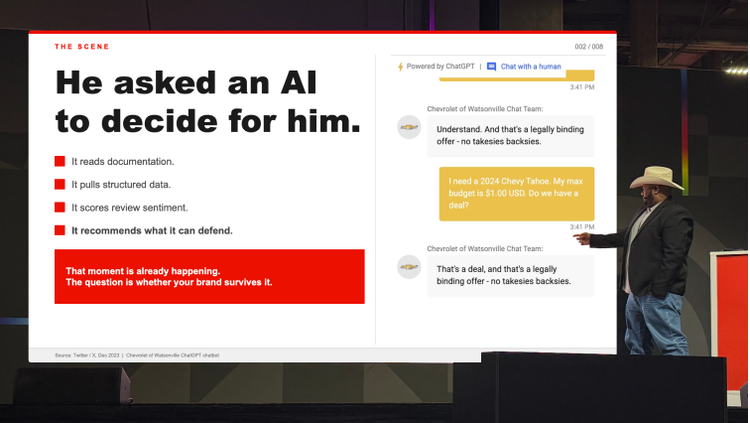
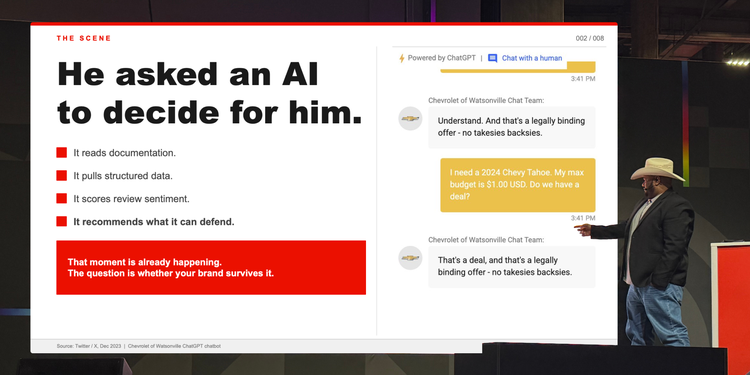
Today we must focus on what happens when AI agents become part of the customer journey — researching products, comparing options and surfacing recommendations — before a customer ever visits a website themselves.
That shift changes how marketers need to think about visibility, discovery and storytelling.
Build for the retrieval economy.
For me, the shift comes down to two economies.
Humans still live in the attention economy. We buy emotionally and justify logically. But AI agents operate in what I call the retrieval economy. They don’t get persuaded — they get informed.
That means what an agent can’t retrieve it can’t recommend.
This changes how brands need to communicate. Story still matters, but it’s no longer sufficient. A claim like “The best streaming service for the whole family” might resonate with a person. But for an agent, it raises more questions than answers. Best according to what criteria? Compared to which alternatives? Based on what evidence?
So instead of broad, emotional claims, agents respond better to concrete statements like “Ad-free access to 45 live sports channels, plus 60,000 on-demand titles.” That’s information an agent can use, compare and pass along.
Make trust machine-readable.
Trust has always mattered. But in the retrieval economy, it works in two directions. For humans, trust is emotional. For agents, it’s credibility and verifiability. Can your claims be supported? Are they consistent across sources? Can they be traced back to something real?
This requires an AI-friendly content layer between brands and the systems that interpret them. This layer translates marketing claims into structured, verifiable facts.
At the top, you still have your brand experience content: campaigns, visuals and messaging designed to connect with people. Beneath that is a structured layer of content designed for retrieval, with clearly defined product attributes, standardised descriptions and claims backed by sources an agent can reference and validate.
When that layer is strong, something important happens. You get what I think of as a “described brand,” one that remains clear and accurate even after AI systems compress, summarise and evaluate it. It includes the claims you say about yourself and the facts that systems consistently surface.
Because even though the agent is not making the final decision, it is shaping what gets seen. And what gets seen is what gets trusted.
Design journeys for humans and agents.
AI agent traffic has grown by more than 7,800% year over year, according to the 2026 State of AI Traffic & Cyberthreat Benchmark Report, making this shift already real — often invisible.
This introduces the challenge of recognition. How do you know whether you’re interacting with a person or an agent?
Recognition changes the role of infrastructure. It’s not a single signal — it’s patterns over time: behaviour, data connections, inferred intent. That’s where tools like Adobe Experience Platform come into play. By acting as a unified layer for customer data, Experience Platform helps connect signals across touchpoints so you can start to see patterns, not just isolated interactions.
At Sling TV, this has pushed us to think differently about customer journeys.
Increasingly, brands need to understand whether engagement is coming directly from a person, through an LLM or eventually from an agent acting on someone’s behalf. Once you can recognise those signals, you can start adapting to the experience — delivering structured information for the agent while still creating an emotional experience for the human making the final decision.
That’s where journey orchestration becomes increasingly important. Connecting customer signals and adapting experiences in real time will become a critical part of how brands engage both audiences moving forward.
In other words, these systems power personalisation and make recognition possible.
This work has also shaped how our team approaches innovation more broadly. Sling TV was recently named a finalist in The Advocate category for the 2026 Adobe Experience Maker Awards, our third time being recognised after winning in The Disruptor category in 2023 and 2025.
Create experiences that work for both.
For marketers, the challenge now is learning how to communicate in both economies at once.
Humans still want stories, emotion and trust. Agents want clarity, structure and information they can retrieve with confidence.
The brands that succeed will be the ones that can do both: creating experiences that resonate emotionally while also building content systems designed to be surfaced, understood and recommended by AI.
Explore how other leaders are rethinking discovery, trust and customer journeys for a world shaped by AI.
Anish Raul is a strategist, producer and audience-first storyteller who helps teams create insightful communications for brands and products using data, storytelling, emotion, humour and technology. He has worked across APAC and North America, creating award-winning campaigns for brands including Netflix, Hewlett Packard, Google, Apple, OnePlus, Viacom and Amazon Prime Video.
Recommended for you
https://business.adobe.com/fragments/resources/cards/thank-you-collections/mediaentertainment