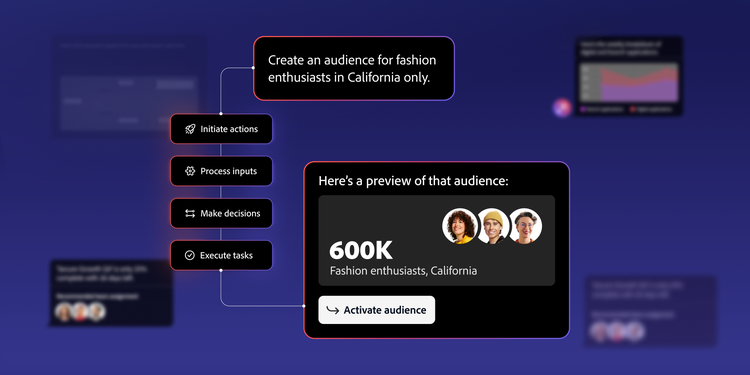
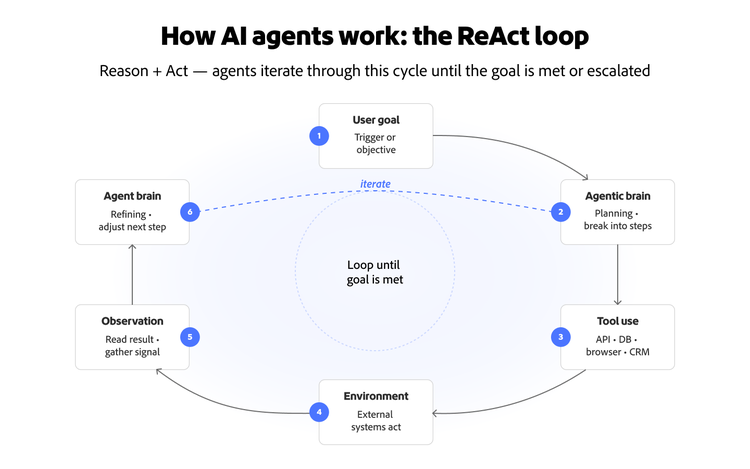
Many enterprise systems use multiple agents working together in a “manager and worker” model. In this set-up, specialised agents handle tasks like research, drafting and validation, while a co-ordinating agent manages the workflow.
What industries use AI agents the most?
AI agents are delivering value across industries with high volumes of repeatable workflows. Common use cases include:
- Financial services: Fraud detection, transaction monitoring and automated customer support
- Healthcare: Scheduling, intake automation and documentation workflows
- Retail: Product discovery, returns processing and personalised recommendations
Regulated industries like financial services and healthcare are also among the most active in evaluating agent deployments, though governance and compliance requirements shape how and where agents are introduced.
How AI agents drive value across marketing and customer experience.
For marketing and CX teams, AI agents create measurable value across five operational areas:
- Customer service and support automation. Agents handle tier-one triage, routeing and self-service flows that deflect routine tickets, reserving human attention for complex cases.
- Workflow and operations automation. Agents automate approvals, content and asset handoffs and compliance checks, replacing manual workflows with continuous automated processes across the enterprise.
- Data and analytics. Agents can support automated reporting, anomaly detection and forecasting, turning dashboards from passive views into active recommendations.
- Creative and content operations. Agents generate, adapt and improve content across channels at a pace humans cannot match alone — a cornerstone of generative AI content management.
- Journey and campaign orchestration. Agents sequence cross-channel actions, select next-best actions and make personalisation decisions in real time.
The future of AI search will blur LLMs, agents and the content agents consume.
Agents go further than LLMs to dynamically direct their own tool use to reach a goal. The three shifts below reflect that more autonomous model.
- From language models to action-driven systems. AI models are evolving from generating text to completing tasks and interacting with software.
- Multi-agent standardisation. Emerging protocols and trust frameworks are making it possible for agents from different vendors to work together safely. This matters because no enterprise will run on a single vendor's agents alone. Interoperability across agents will become a core procurement question.
- The agent-to-agent economy. Increasingly, agents will consume content and APIs on behalf of humans. A shopping agent, not a shopper, will read your product page. A research agent, not a reader, will parse your thought leadership. This is why AI search visibility is no longer a side concern; your content strategy has to serve two readers at once.
The implication is that brands need infrastructure that not only deploys agents but also ensures that they and external agents visiting your properties, operate on structured, trustworthy content. Adobe’s Digital Trends report highlights this shift through survey-based research and customer insights as enterprise adoption accelerates.
Adobe's AI agents align to common enterprise workflow needs.
Adobe's approach to agentic AI centres on purpose-built agents designed to support common enterprise workflows across support, data, content and journey orchestration, with additional workflow and experience-focused agents emerging across Adobe applications.
Adoption tends to accelerate when agents are introduced with clear guardrails (defined inputs, scoped permissions and approval checkpoints) so teams can expand autonomy incrementally as confidence grows.
Product support AI service agents.
Adobe’s Product Support Agent helps customers streamline troubleshooting and support case management by providing conversational guidance to troubleshoot Adobe products using trusted knowledge sources, such as troubleshooting articles authored by Adobe Support, product tutorials and legal documentation and streamlining ticket creation and status tracking (See the Adobe Customer Success webinar on AI agents in Adobe Experience Platform for an overview and examples.)
Workflow automation AI agents.
Workflow optimisation agents help teams automate planning and execution tasks, such as project set-up, workflow monitoring and operational co-ordination in tools like Adobe Workfront.
Typical agent-powered workflows: