Marketing for humans and agents: Why trust is the new front door.
05-19-2026
Lumen is building its business around a bold promise: to become the trusted network for AI.
But delivering on that promise isn’t just about infrastructure — it’s about visibility, credibility and how the brand shows up in AI-driven experiences. And this is especially important in a world where AI is increasingly shaping how customers discover, evaluate and choose.
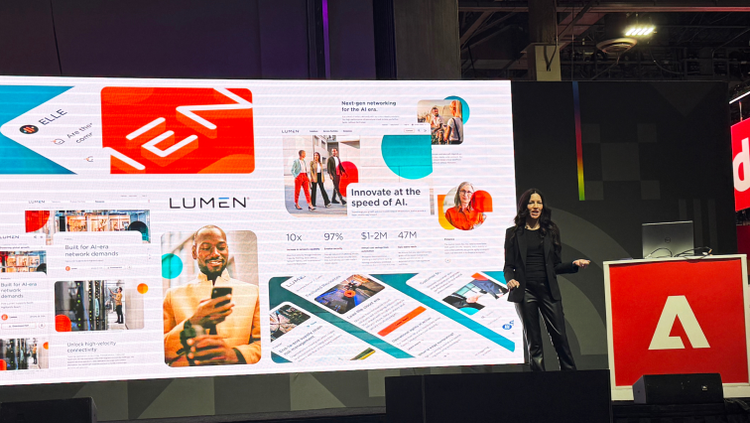
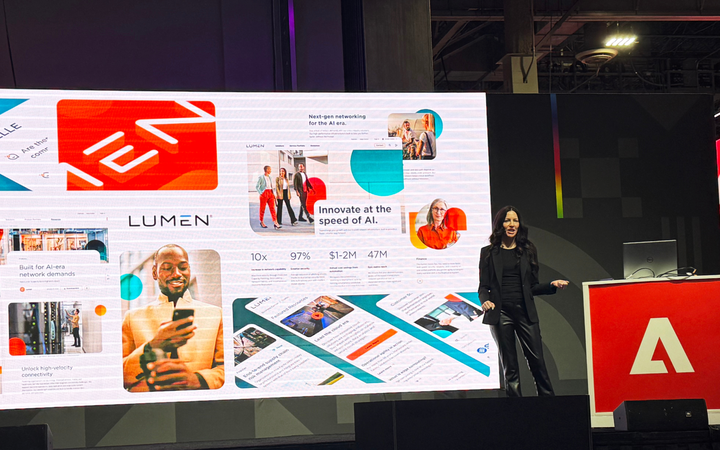
That’s the shift my team is navigating. And at Adobe Summit, I shared three lessons that are changing how we approach marketing in the age of AI-driven discovery.
Lesson 1: The front door has moved.
A decade ago, search engines became the front door for brand discovery. Today, that front door is shifting again — to LLMs, copilots and AI agents.
In many cases, the first interaction with a brand now happens before a user ever clicks a link. It’s shaped by systems that summarise, recommend and interpret content on their behalf.
That changes the stakes. First impressions are no longer owned — they’re generated.
For Lumen, this raised a critical question: How is AI describing our brand today? That question changed how we think about brand visibility entirely.
The implication is practical and immediate. Winning brands are already optimising for how they appear in AI-generated answers. At Lumen, we’re focused on understanding how and why people engage with our content — so we can understand how AI surfaces information so we can show up more clearly and consistently within it.
Action: Start by auditing how AI describes your brand. If you don’t like the answer, begin fixing the inputs behind it.
Lesson 2: We speak to a dual audience.
Every piece of content now has two audiences.
Humans still care about relevance, emotion, and trust. AI agents look for structure, clarity, and verifiable signals. That shifts the role of marketing — from persuasion to proof brands need to become trusted sources of information — grounded in accuracy, consistency, and usefulness.
At Lumen, that shift pushed us to rethink not just messaging but the systems behind it. We focused on five core principles:
- Start with questions, not keywords. We map our expertise to the questions customers are actually asking AI so that people don’t just find Lumen — they find an answer.
- Make content easy to interpret. Structure and intent matter as much as message.
- Measure AI visibility. Using Adobe Brand Visibility, formerly Adobe LLM Optimizer, we track how often and where Lumen shows up in AI-driven results.
- Speak the customer’s language. We align content to how people naturally describe their needs, creating a shared set of prompts that reflect how customers naturally describe their needs.
- Stay consistent. Authority builds through repetition across sources. With a stronger brand voice, we’ve bridged content gaps and improved discoverability across Lumen’s digital channels.
Result: That consistency has helped close content gaps, improve discoverability across Lumen’s digital channels and strengthen how the brand appears in AI-generated results.
Lesson 3: AI isn’t a black box; it’s a pattern.
There’s a great deal we don’t know about how AI systems work. But they’re not entirely opaque either. Emerging patterns suggest AI agents consistently respond better to content that is:
- Clear and structured
- Consistent across sources
- Frequently updated
That’s not certainty — but it is direction.
What is certain: credibility now compounds faster than ever. The upside is speed. The risk is falling behind just as quickly.
The shift is already underway. The brands that succeed won’t just optimise for visibility. They’ll build systems of trust designed to be understood by both people and the AI shaping discovery around them.
Because in this new environment, credibility compounds quickly.
So does invisibility.
Action: Prioritise clarity, consistency and freshness across your content ecosystem — or risk becoming invisible.
Explore more ideas from Adobe Summit on how AI is reshaping discovery, trust, and marketing strategy in our full wrap-up blog.
Moria leads brand and digital experiences for Lumen Technologies, a Fortune 500 networking service provider and the trusted network for leading AI and cloud providers. Her team leverages AI and neuroscience to design more impactful brand experiences across owned, earned and paid media. In 2024, her team drove a nearly 180% increase in organic brand awareness. Right now, she’s leading an organisational transformation to harness the power of AI to deliver personalised content at scale.
Recommended for you
https://business.adobe.com/fragments/resources/cards/thank-you-collections/generative-ai