In part one of this series, we established that the CMS has evolved. The audience it serves has doubled. In part two, we established that your web experience is now the most strategic asset your brand owns, and that the system producing it wasn't built for two audiences with fundamentally different requirements.
This blog, the last one in this series, answers the question: What does the right content system for earning engagement from every audience look like?
The answer is a system built on a governed content foundation that serves both audiences, producing experiences designed for humans and content designed for AI systems, all pulling from the same source of truth.
Why can’t point solutions solve this problem?
When a new requirement emerges, the instinct is to add on an agentic tool, layer on an SEO optimizer, or drop another agentic solution on top of your existing CMS. That instinct is understandable, but it’s wrong because the problem isn’t at the tool layer, it’s at the foundation.
Every seam between a point solution and the underlying system is a governance gap. More tools mean more silos, handoffs, teams, and latency between what you intend and what gets published. You cannot retrofit a content architecture problem from the outside. The structure that makes experiences work for humans and content work for AI agents must exist from the moment content is created, not added afterward.
More fundamentally, point solutions lack enterprise context. They don't know your content graph. They don't know your governance rules, approval workflows, compliance requirements, or brand voice.
Forrester put it plainly: Existing content and digital asset management technology are the foundation for the knowledge graphs and agentic layers that activate intelligent content. Machines generate and optimize at scale, but they require humans to establish the governance guardrails that define accuracy, tone, compliance, and engagement requirements.
What is the agentic CMS?
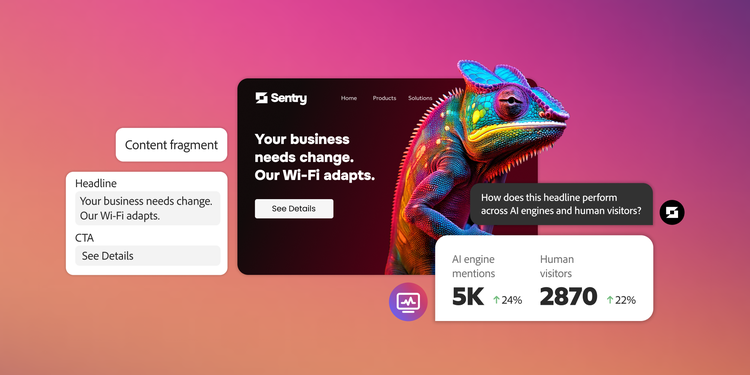
The agentic CMS is a system built specifically to address the problem we've been describing throughout this series. It’s not a rebrand of an existing platform, but a new foundation designed to simultaneously produce experiences that earn human engagement and content structured for AI evaluation, from a single governed source of truth.
It has several layers, each doing a distinct job.
The foundation is Adobe Experience Manager Sites — content is structured at creation, governed at publication, assembled into experiences, and delivered at the performance levels both audiences require. This is where brand truth lives. It's not a repository, nor is it a content supply chain tool that manages individual assets. It's the governed foundation on which experiences are built and the source from which everything else draws.
Above it lies a team of purpose-built agents that operate with full enterprise context. They know your content, governance rules, brand standards, and user data. They don't approximate, but act with the specificity that only comes from being native to the system and your brand. They collapse weeks of content production into hours, surface governance issues before they become publishing mistakes, and ensure the content underneath every experience is structured, accurate, and current for both audiences.
Above the agents are optimization tools that close the feedback loop between what you publish and how it performs — across human search, AI discovery surfaces, and owned brand experiences. Not periodic audits, but continuous optimization driven by real-time signals.
This architecture matters more now than it ever has. Gartner estimates that by 2028, a third of all user experiences will shift from native applications to agentic front ends, and 90% of B2B buying will be intermediated by AI agents, pushing over $15 trillion of B2B spend through AI agent exchanges. Products designed with composable, API-first architectures, Gartner notes, will establish a significant competitive moat.
Here's what that foundation delivers for the brands already running on Adobe Experience Manager Sites:
- Earned AI visibility. The content underlying every experience is structured, authoritative, and machine-readable by design, not retrofitted. When AI systems evaluate your category, your content qualifies for citation and surfacing.
- Consistent human experiences. Every experience your human audiences encounter draws from the same governed source — coherent, on-brand, and assembled correctly, regardless of channel, region, or surface.
- Operational velocity. Agents embedded in the system reduce the handoffs, manual effort, and time between brief and published experience. The work that used to take weeks is now done in hours, and the content underneath is ready from the moment it's created.
- Governed intelligence. Agents that act within your enterprise rules, not around them, amplifying your team's judgment, not replacing it.
Adobe Digital Insights data shows that AI-referred visitors already convert 31% more than visitors from paid search, email, or organic, and AI-driven revenue per visit surged 254% during the 2025 holiday season alone. The brands on a governed content foundation are capturing that conversion. The brands on fragmented stacks are watching it go to competitors, and the gap widens over time.
The window is open, but it won’t stay that way.
AI systems are forming habits about which experiences and brands are worth citing. Those habits are hard to break once set. The brands that establish structurally sound content foundations right now are the ones AI systems will default to, in your category, for your customers, and in answers your prospects are already reading before they ever reach you.
Forrester's research on the future of digital content is unambiguous on the direction. It states that the next frontier will shift from content creation and production efficiency to demonstrating authority and impact in AI-generated results. The hard part, Forrester notes, will be linking visibility, engagement, and brand presence in AI answers to measurable business outcomes. The brands that build the foundation now will have the data to make that link. The ones that wait will be starting from zero in a market that has already moved on.
Your experiences are already being evaluated by humans who want to feel your brand, and by AI systems grading the content underneath them. The question is whether the foundation was built to pass both tests.
The agentic CMS isn't a future state. It's available now. And the brands already on it aren't waiting for the market to catch up. If you want to learn how Adobe can help make your brand more discoverable to human and AI audiences, explore our agentic CMS solution.
Tina Ngo is a Principal Product Marketing Manager at Adobe, where she leads go-to-market strategy for Adobe Experience Manager and the agent portfolio. She specializes in building category-defining narratives at the intersection of enterprise content, AI discoverability, and agentic technology, translating complex platform capabilities into stories that resonate with customers and drive business outcomes. She holds a Bachelor of Arts in Economics from the University of California San Diego and a Master of Business Administration in Marketing from Santa Clara University.