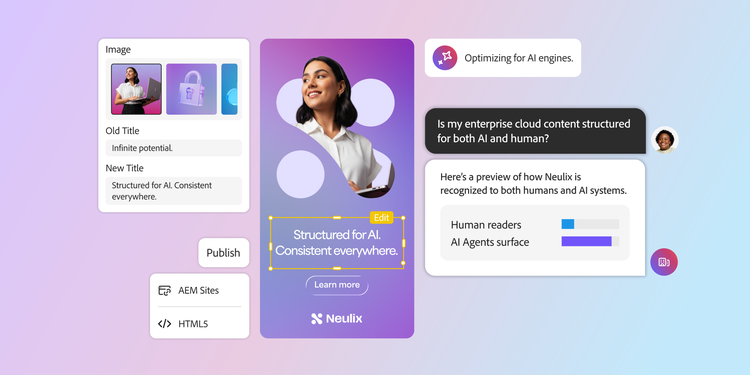
In part one of this series, we established that the audience your web experience has to serve has doubled. You have people who want to feel your brand, and now you have AI agents who want to evaluate it. Same experiences, but two different engagement criteria.
That sets up the more important question: What does it actually mean for your business when the same experiences have to earn engagement from two audiences at once?
Here's what most teams get wrong: They think about content as individual assets — a blog post, a PDF, or a product page. But what both audiences are actually evaluating is the full web experience — a collection of structured, governed content assembled into something coherent. The quality of that experience depends entirely on the quality of all the content underneath it, making the website the most strategically valuable asset your brand owns.
Forrester’s research directly confirms this shift. It says that organizations that continue creating content only for humans, and not also for the machines that now mediate digital experiences, will increasingly lose visibility, relevance, and performance. Four out of five B2B organizations are already adopting or implementing generative AI for content use cases, yet digital leaders report that the impact on business outcomes remains elusive. The reason, Forrester notes, is that most businesses remain stuck in legacy content processes built on fragmented repositories and manual workflows, not on the governed foundation that both audiences require.
The web experience now does multiple jobs simultaneously.
Think about what your content is actually responsible for today.
First, your content earns your brand's position with AI systems. This is the shift most marketing leaders still haven't fully absorbed. Every experience you've published — every page, every product description, every piece of structured content assembled underneath it — is shaping how AI models understand your products, category, and competitive position right now. That understanding determines whether your brand gets retrieved, cited, and included in AI-generated answers at all.
When someone asks an AI assistant about your product or solution, the answer they get is assembled from content that is already published, structured, and indexed. You don't get to submit a brief or correction after the fact. Structured, authoritative, and consistent content strengthens how your brand is understood by these systems and whether it qualifies for surfacing. Unstructured, inconsistent, or outdated content gets misrepresented or ignored entirely. A beautiful page built on fragmented content fails this test every time.
Adobe Digital Insights data shows that this is not theoretical. AI-driven referral traffic grew 35x across retail in the 11 months from July 2024 to May 2025. Shoppers arriving from AI sources spent 35% more time on site and viewed 10% more pages per visit than traffic from any other channel. The experience they arrived at was shaped entirely by whether the content underneath it qualified.
Second, your content carries your brand identity consistently across every experience. Your tone, voice, personality, and authority are all expressed through the experiences customers interact with every day. For people, that consistency is everything. Humans don't evaluate your brand the way an AI system does. They notice when something is off, like when the homepage says one thing, and the email says another, or when the product page sounds like it was written by a different company entirely. Every touchpoint should reinforce who you are. And to do that, all your experiences depend on the content underneath being consistent, accurate, and governed. A fragmented content foundation produces fragmented experiences. Both audiences notice, but in completely different ways. People experience inconsistency, while AI systems experience uncertainty.
A content foundation with multiple experiences built on top must earn its place with AI systems and express your brand, all at the same time.
The bar isn’t just rising—now it’s split into two.
Here's what makes this a genuinely new problem. For humans, the bar for experience quality keeps rising. More immersive, personalized, and emotionally resonant. Your team feels this pressure every day.
For AI agents, the evaluation criteria are completely different and indifferent to everything you've been optimizing for on the human side. Agents don't care how beautiful your site is. They care whether your experience is:
- Authoritative — signaling trustworthiness through consistency, not just claims
- Accurate — factually correct and current because agents reproduce what they find, with your brand's name on it
- Machine-readable — accessible to non-human systems, not hidden behind JavaScript rendering or login walls
- Semantically rich — tagged with enough context that agents know what the content is about, not just what it says
- Governed — produced under rules that ensure what agents read actually reflects what your brand intends to say
- Fresh — continuously updated so agents aren't surfacing yesterday's pricing, discontinued products, or superseded claims
- Consistent — saying the same thing about your brand regardless of which page or channel an agent lands on
Most enterprise experiences fail several of these criteria at the content level right now, not because teams aren't trying, but because the system that produces the content underneath those experiences was never asked to meet them.
The gap is already costing you.
When content isn't structured for AI readability, AI systems fill the gaps with whatever they can piece together, whether it's accurate or not. Your brand is being described to potential customers before they ever reach you — before they ever have an experience with you — and you didn't write the description.
When your content isn't consistently authoritative across surfaces, AI systems produce contradictory outputs about your brand. Your own properties disagree with each other. The AI reflects that disagreement back to the market.
When competitors have invested in content that passes the agentic test, and yours hasn't, they're being cited in your category while you remain invisible.
The system must change — not just the content.
You can't earn engagement from two audiences with a system built for one. The experiences your human audience encounters and the content your AI audience evaluates both draw from the same foundation. That foundation has to be right from the moment content is created — governed, structured, and consistent. Editing individual assets doesn't fix it. Adding more tools doesn't fix it. Visibility now depends on a unified content foundation that supports both human engagement and machine understanding simultaneously.
Forrester's State of AI Survey, 2025 found that three-quarters of AI decision-makers say their enterprise has invested more than $300,000 in generative AI to date, yet governance and risk remain the second most cited barrier to adoption among North American AI leaders. Investment without a governed content foundation creates this gap. The brands closing it aren't spending more. They're building differently.
That system exists. In part three of this series, we'll show you what the system looks like and what it delivers.
Explore Adobe’s agentic CMS to learn more about how it can power your brand’s experiences for both human and AI audiences.