Relevant customer engagement depends on connected context.
As the customer engagement market consolidates and AI takes on more responsibility, marketers face a more consequential choice. It’s not simply which capabilities a vendor offers, but how well those capabilities work together. For customer engagement, a broader set of tools isn’t the same as a connected foundation.
With customers moving between apps, stores, search, and now, AI tools, it's critical for brands to quickly and seamlessly connect real-time customer data, behaviors, channel context, content, business rules, journey history, decisioning, and measurement.
When these inputs live across separate systems, even well-integrated ones, valuable context is often lost across workflows. Data and signals are outdated. Decisions are based on an incomplete or inaccurate understanding. Journeys and campaigns can conflict. Governance can be mishandled.
Connecting products does not automatically provide a shared understanding of each customer. The real test is whether data models, identity, and governance can preserve that understanding as work moves between systems.
This is why the foundation behind customer engagement matters.
Customer engagement, connected by design.
Adobe has taken a different approach to customer engagement. We’ve built capabilities related to data, journeys, analytics, agentic workflows, governance, and decisioning on a single foundation — Adobe Experience Platform, a composable, extensible architecture designed for enterprise customer experience (CX). Data informs audiences. Audiences and real-time signals inform decisions. Decisions shape customer journeys, campaigns, content, and experiences. Performance insights feed the next cycle of optimization.
Adobe Experience Platform brings real-time journeys and planned campaigns into the same engagement system — one where Adobe Real-Time CDP builds unified profiles and audiences, Adobe Journey Optimizer decides and delivers across channels, and Adobe Customer Journey Analytics measures the impact, all based on the same data. Audience activation, orchestration, decisioning, delivery, analysis, and optimization can be seamlessly and accurately executed without having to re-establish context at every stage.
Adobe Journey Optimizer and Adobe Journey Optimizer B2B Edition can build and execute trusted, integrated experiences in real time because they share the same technology base. Data is harmonized, signals connect in real time, and insights are drawn from behaviors, channels, and more. This seamless context is critical for accuracy and real-time decisioning, whether by people or AI.
ServiceNow, a B2B Adobe customer, understands first-hand how disconnected inputs become magnified by AI. “Fragmentation in your content becomes fragmentation in how AI represents your brand,” says Jenny Tobener, its global VP of digital. Jenny’s team invests in systems that assemble the right experience at the right moment, with people encoding their expertise for AI to draw from.
According to the 2026 Adobe AI and Digital Trends in Customer Engagement, only 39% of organizations have a shared customer data platform that can support agentic AI at scale.1 So the question is no longer just what AI and agents can do. It’s what data, context, content, and systems they can work across, within the boundaries that people and teams define.
Connected engagement at enterprise scale.
Intuit demonstrates the benefits of this connected loop at a massive scale for 40 million TurboTax customers. Real-Time CDP brings signals together from its customers across the filing journey, and Journey Optimizer responds when customers pause, return, or encounter friction, with reminders such as importing a W-2. “What matters now is how data connects. Not just what a customer did, but why they did it, what it means in context, and what they’re likely to need next,” says Intuit’s Anoop Sreenivasan. Intuit and Adobe teams scaled the capacity of Experience Platform by 60x to support up to 90,000 transactions per second at peak. In early TurboTax social use cases, creative production time fell 98%, from two days to 20 minutes.
At that scale, a connected architecture isn’t an abstract benefit. It’s essential for delivering timely, reliable engagement that accounts for every signal.
Put connected context to work with AI built for customer experience.
A connected foundation becomes even more important as AI evolves from answering questions to executing workflows independently.
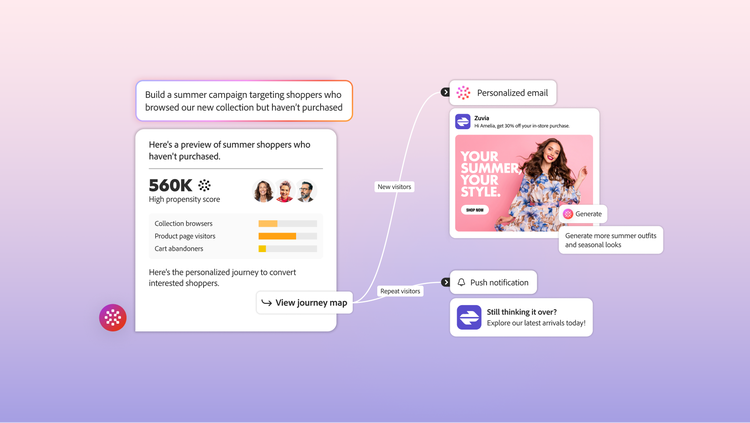
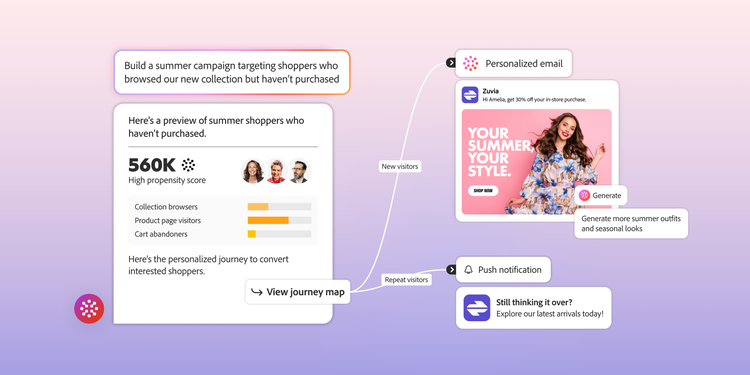
Adobe CX Enterprise Coworker offers a governed layer of agentic intelligence for autonomous workflows that executes across teams and applications. Natively connected to your full CX workflow and grounded in your business context and existing governance, Coworker gives teams advanced AI they can implement on day one, allowing them to move from goal to action in minutes.
From audience building and journey creation to content personalization and advanced analytics, Coworker connects skills to execute complex workflows independently — all with built-in human checkpoints and approvals. It can instantly identify overlapping journeys or under-engaged audiences, diagnose changes in performance, personalize content, and build audiences and journeys based on business goals — workflows that typically take days or weeks. Across early Coworker deloyment programs, some customers were able to achieve 70% faster offer design and approval cycles, 60% fewer data onboarding delays, and 60% faster campaign launches.
Coworker can be activated in your AI Platform of choice through a headless architecture so that teams can work with Coworker from within Microsoft 365 Copilot, Claude, or ChatGPT. Its role-based access, approvals, and audit trails span brands, regions, and channels.
Evaluate the foundation, not the features.
When evaluating customer engagement solutions, look beyond the features and ask the difficult questions:
- Can customer context travel across the full engagement lifecycle? Data, audiences, content, decisions, journeys, delivery, and measurement should work from a connected context.
- Can real-time journeys and planned campaigns work together? Every interaction should contribute to building coordinated engagement.
- Is the AI grounded and governed? The AI within the solution should be able to act using enterprise context while respecting consent, permissions, approvals, and human control.
- Can the foundation support evolving B2C and B2B relationships? It should support new channels and applications that plug into a contextually connected foundation.
Easier switching with in-app guidance and automated onboarding.
When contracts renew or roadmaps shift, the question marketing teams often ask is how much work it will take to switch. Onboarding in Journey Optimizer is a guided experience inside the product, not a separate service engagement. Teams can connect to their current platform or upload templates and journey screenshots, automatically convert personalization scripting, and bring content blocks along as reusable fragments. Imported journeys appear on a canvas for review, and nothing moves until the team approves them.
For example, an Adobe implementation partner, Softcrylic, estimates that migrating Eloqua email templates to Journey Optimizer is about 70% automated. The goal isn’t just a one-to-one copy. It’s to retire what isn't working and reach value faster.
The next generation of customer engagement won’t be defined by one channel, feature, or AI-powered tool. It will be defined by how effectively intelligence becomes coordinated action across the customer relationship.
Adobe supports planned campaigns and end-to-end customer journeys through a single foundation purpose-built for experience, and Adobe CX Enterprise Coworker helps put that foundation to work, making personalized engagement at scale easier and more coordinated than ever.
Explore Adobe’s AI-powered customer engagement solution and learn how Adobe Journey Optimizer turns customer intelligence into action.