

60x
scaled Experience Platform capacity for tax season
90K
transactions per second supported during peak filing periods
98%
reduction in creative production time

“We are deeply passionate about solving our customers’ problems, and trying to solve them requires relentless innovation. Adobe is the right partner for us because of our shared commitment rooted in the same principles of customer obsession and responsible use of AI."
Anoop Sreenivasan
Vice President of Go-To-Market Technologies, Intuit
Every year, millions of people turn to Intuit to navigate some of the most important financial decisions they’ll make — whether filing taxes with TurboTax, running a business with QuickBooks, managing credit with Credit Karma, or growing customer relationships with Mailchimp. During these times, confidence is critical. Customers expect guidance that is tailored to their financial moment, responsive, and grounded in trust.
Delivering that level of confidence at Intuit’s scale requires more than personalized campaigns. It requires a system that understands customer context, connects signals across touchpoints in real time, and turns these into meaningful action.
To meet that need, Intuit has built an AI-powered marketing foundation on Adobe Experience Platform — enabling teams to unify customer context, orchestrate journeys more intelligently, and deliver adaptive and trustworthy experiences at enterprise scale. The result is a more agile, insight-driven approach to engagement, where teams can move faster while maintaining the consistency and control required for financial services — and stay focused on solving customer problems.
Intuit’s approach is already delivering measurable impact:
- Scaled platform capacity by 60x to meet customer demand during tax season, supporting up to 90,000 transactions per second during peak filing periods.
- Reduced creative production time by 98% (from 2 days to 20 mins), accelerating delivery of timely, high-impact campaigns.
“We are deeply passionate about solving our customers’ problems, and trying to solve them requires relentless innovation,” says Anoop Sreenivasan, Vice President of Go-To-Market Technologies at Intuit. “Adobe is the right partner for us because of our shared commitment rooted in the same principles of customer obsession and responsible use of AI.”
Connecting customer context.
As Intuit’s ecosystem has grown, so has the complexity of delivering consistent, personalized experiences — requiring coordination across a sophisticated mix of tools, channels, data sources, workflows, and governance. The opportunity is no longer just speed — it’s alignment. Every team needs to work from a shared, trusted understanding of the customer, so insights become relevant experiences when customers need them most.
That shift toward shared context is reshaping how Intuit approaches marketing operations. Steve Setzer, Director of Product Management at Intuit, explains that business context — including brand standards, workflows, governance requirements, and customer intelligence — needs to be available directly inside the systems that marketers use every day. This allows teams to collaborate from shared intelligence rather than translating context across separate tools.
To enable this, Intuit uses Adobe Experience Platform applications, including Adobe Real-Time CDP, Adobe Journey Optimizer, and Adobe Customer Journey Analytics, to unify customer data, orchestrate journeys, and activate insights in real time.
That connected foundation is especially critical during tax season when demand spikes around key filing moments. In preparation for this surge, Intuit worked closely with Adobe Customer Solutions to scale Experience Platform capacity for peak volume.
“In order to support the volume of users for tax season, we needed to increase the transactions per second that Experience Platform supported,” Sreenivasan says. “Adobe and Intuit teams quickly worked together and scaled the platform by 60 times to support tax peak — with the ability to support up to 90,000 transactions per second.”
The collaboration extends beyond infrastructure. On Tax Day, the partnership becomes part of the operating rhythm, with Intuit and Adobe teams working side by side to monitor performance and resolve issues in real time — all focused on delivering a seamless experience.
“When you walk into the room, it’s not easy to differentiate who’s from Adobe and who’s from Intuit,” Sreenivasan says. “It’s just a cohesive group of smart people coming together to solve complex problems.”
This collaboration also reshapes how Intuit teams work day to day. Across marketing, product, data operations, and analytics, teams can operate from shared intelligence rather than disconnected workflows.
“With Adobe’s AI platform, teams aren’t boxed into one workflow,” Setzer says. “Marketing can build audiences while data ops can dig deeper into the same intelligence. When teams align early on how that data will be used, you get shared workflows and a clearer onboarding path.”
That interoperability is especially important in an environment where trust, governance, and security are foundational requirements. Adobe Experience Platform supports that responsibility with built-in controls for access and consent, helping teams govern customer data consistently across experiences and channels.
“Trust is paramount in our business,” Setzer says. “We deal with extremely sensitive financial information, and every customer experience depends on protecting that trust.”
“With Adobe’s AI platform, teams aren’t boxed into one workflow. Marketing can build audiences while data ops can dig deeper into the same intelligence. When teams align early on how that data will be used, you get shared workflows and a clearer onboarding path."
Steve Setzer
Director of Product Management, Intuit

Customer obsession, at enterprise scale.
Delivering for Intuit’s more than 100 million customers means meeting a wide range of needs across its portfolio of brands and products. At this scale, customer obsession depends on understanding where each person is in their journey, what guidance will help them move forward — and doing so in a way that earns and maintains their trust.
“One of the key values of our company is customer obsession. We are deeply passionate about solving our customers’ problems,” says Sreenivasan.
That commitment also shapes how Intuit approaches data and decisioning. “What matters now is how data connects,” he says. “Not just what a customer did, but why they did it, what it means in context, and what they’re likely to need next.”
This connected context helps Intuit better understand customer intent and respond with experiences that adapt to individuals’ behavior, timing, and needs. For TurboTax, that understanding is activated through Real-Time CDP — which brings together data and signals to dynamically inform every step of the filing journey, helping customers stay on track even when they pause, return later, or encounter friction at key moments, such as transitioning from federal to state returns.
Journey Optimizer then enables Intuit to respond to those real-time signals, delivering timely, relevant guidance, including reminders to import W-2 forms, prompts to continue filing, or personalized messages that encourage customers to pick up where they left off.
Turning insight into action faster.
At Intuit, the ability to act on insights quickly is especially important during periods of high engagement, when customer needs and expectations can shift in real time.
That urgency is something Mansi Singhal, Vice President of Growth Tech at Intuit, sees every season. “Once people are done with taxes, they won’t come back to our TurboTax website until next year. We have very little time to act on insights,” Singhal says. “What sets Adobe Customer Journey Analytics apart is its real-time nature, how fast we can act on it, and how granular we can get with the data.”
Speed alone, however, only matters if insights can be translated into meaningful experiences. Customer Journey Analytics helps Singhal’s team understand what customers need in the moment, while Journey Optimizer enables teams to act on those insights across the journey.
Delivering in those moments also requires content that is ready to test, tailor, and activate. To support that need, GenStudio for Performance Marketing enables TurboTax marketers to move from performance signals to on-brand campaign variations in minutes, not days — bringing content creation, brand governance, and performance insights into a single workflow.
In early use cases at TurboTax, the social team reduced creative production time by 98% — from two days to 20 minutes — while doubling testing capacity from six variants to 12.
“GenStudio for Performance Marketing puts creative in the hands of the marketer, so they can iterate quickly,” Setzer says. “And because insights sit right next to the assets, teams can see what’s working best and adjust quickly.”
Redesigning marketing workflows with AI.
Scaling these capabilities requires a human-governed, AI-powered operating model that helps teams move faster while maintaining the security, control, and trust required for financial services.
By integrating Adobe’s agentic AI capabilities within its ecosystem, Intuit is exploring how specialized AI agents can support marketers inside the workflows they already use — focusing on improving data quality and insights, streamlining audience assembly, and scaling personalized email creation.
Adobe CX Enterprise Coworker, the new evolution of Adobe’s agent orchestration engine, enables Adobe and Intuit agents to collaborate within shared workflows, using common business context and customer intelligence to inform execution.
“As these agentic systems become more capable and specialized, the real opportunity shifts to orchestration — how you bring them together to deliver meaningful, connected experiences,” explains Sreenivasan.
This model is already shaping how Intuit marketers work day to day. Within Intuit’s Marketing Studio, teams can invoke Coworker to perform agentic tasks and workflows in Adobe solutions such as audience discovery, journey orchestration, and activation without switching tools. Coworker helps marketers identify and activate high-value audiences within Intuit’s environment, while Intuit’s experimentation agent can inform testing strategies using shared data and performance insights.
Rather than asking teams to move between systems or manually translate context, the agents help carry that context forward — with marketers guiding priorities, inputs, and outcomes.
Setzer describes this evolution as a move toward embedded interoperability, where Adobe’s orchestration capabilities can operate directly within Intuit’s environment while maintaining continuity across data, workflows, and governance.
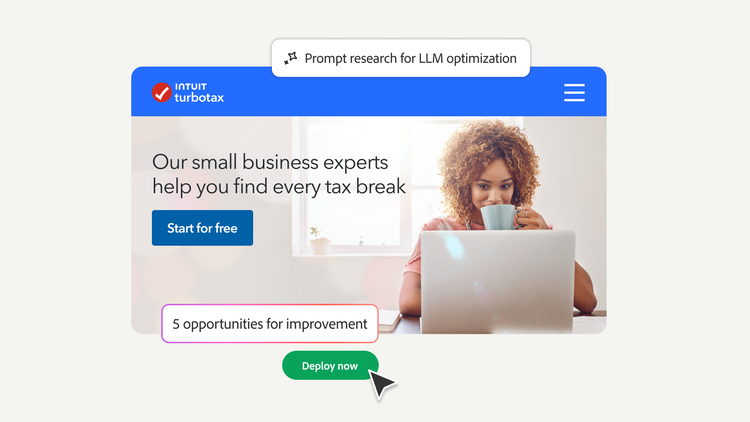
As customers increasingly turn to AI-assisted discovery, Intuit is also exploring how its guidance appears in large language model (LLM) environments. With Adobe Brand Visibility, Intuit gains better visibility into quality and relevance signals — helping ensure that when people seek financial guidance, they encounter accurate, trusted information.
Across these interactions, Adobe CX Enterprise Coworker and Brand Visibility will help Intuit maintain a consistent brand voice and guardrails — whether experiences are human-led, agent-assisted, or AI-driven.
As these systems become more context-aware and interoperable, Intuit sees marketing evolving from manually orchestrated campaigns to always-on systems that continuously learn and improve in real time — while humans guide strategy, creativity, and trust at every step.
“We’re just starting to get a real feel for what marketing looks like in an agentic world,” Setzer says. “What we’re building now is a glimpse of what’s next.”
Recommended for you
title
How Intuit builds customer confidence at scale.
cardDescription
Intuit uses Adobe AI and Adobe Experience Platform to orchestrate intelligent customer experiences.
cardDate
2026-09-18
cardImage

badgeImage
primaryTag
caas:content-type/customer-story
Tags
caas:content-type/customer-story, caas:industry/financial-services, caas:products/adobe-real-time-cdp, caas:products/adobe-journey-optimizer, caas:products/cx-enterprise-coworker, caas:products/genstudio, caas:products/customer-journey-analytics, caas:products/brand-visibility