When I think about the intensity of tax season for TurboTax, I often compare it to the Super Bowl — the time to shine, where creativity and content velocity are put to the ultimate test. Alongside Audrey Timpe, who manages brand social and community for Intuit’s communications team, I had the privilege of sharing this journey at Adobe MAX, highlighting how Adobe is transforming the content supply chain and empowering customers like TurboTax to operate at scale.
Generative AI in action — real-time insights and on-demand creative for TurboTax.

The challenge Intuit faced — delivering at massive scale.
Every year during tax season, Intuit faced a 16-week content production sprint, where the communications teams produced more than 800 unique creative assets solely for TurboTax’s paid social campaigns. This need for content came from different teams and partnerships across the organization, with no sign of slowing down. With new products, new audiences across a growing number of social media platforms, and quicker ad fatigue, the demand for content was skyrocketing. Over the past five years, the team pushed to produce more and more content, but they couldn't come close to meeting ever-growing content demands.
Volume wasn’t the only challenge the team faced. As consumer expectations for personalized content exploded, consumer attention spans were shrinking, causing ads to fatigue faster than ever. This meant Intuit also needed to increase the velocity of content production. The gap between content demand and what Intuit’s team could deliver was widening. Collaboration between teams — like marketing and creative, communications, and analytics — was critical, and they needed to work faster, be more agile, and be more consistent to keep pace.
The old way — bottlenecks and manual work.
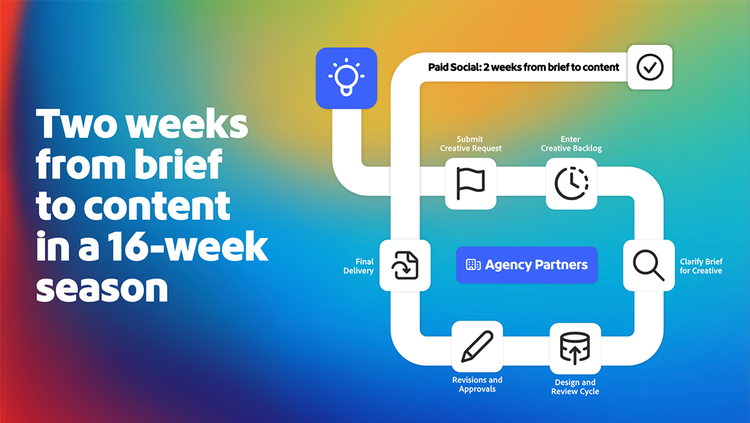
Before generative AI, the Intuit team’s workflow was manual and resource intensive. It could take two weeks just to move from a creative brief to campaign-ready assets. Considering that the annual sprint spans only 16 weeks, this process could consume an eighth of a season. The team would go through multiple rounds of revisions, wait for external agencies to report on performance, and often scramble to refresh assets mid-campaign. Other bottlenecks, such as performance reporting and post-launch ad refresh, compounded the issues. This inefficient process limited the team’s ability to scale and respond in real time, but it also gave them a starting point for incorporating generative AI.
The turning point — embracing generative AI.
The team’s first foray into incorporating generative AI into workflows leveraged multiple tools for brainstorming, copy generation, image generation, and compilation. This resulted in team members putting in extra effort to ensure brand fidelity. When the creative was put to the market test, it didn't drive the click-through rates the team was looking for, but it did contribute the necessary information to quickly regroup for a second pilot — this time, with only one tool.
Introducing Adobe GenStudio for Performance Marketing was a game changer. Suddenly, the Intuit team could automate ad assembly, copy generation, performance reporting, and ad refreshes. These workflows, which Intuit identified as “generative AI hot spots,” were main areas of focus for AI-powered process improvement. What used to take two weeks now takes as little as four hours — a 98% reduction in workflow time. Intuit’s social team can generate, iterate, and refine creative variations quickly, freeing both their team and their agency partners to focus on strategy and storytelling. When looking at the end-to-end campaign view, the season shows a dramatic change from about ten weeks down to nearly three weeks, highlighting the transformational power of generative AI in workflow improvement.

Real results for TurboTax paid social.
In addition to the efficiency gains Intuit experienced, the team had a 38% increase in CTR for the treatment group powered by GenStudio for Performance Marketing compared to the control, as well as a 90% copy acceptance rate, and a product recommendation score of nine out of ten — meaning, their team found it extremely useful. Intuit was launching more on-brand creative variations than ever, improving campaign effectiveness, getting to market faster, and keeping consumers engaged before fatigue could set in. When a refresh was needed, the Intuit team could spin up new ads the very same day. Now, with GenStudio for Performance Marketing, the process is self-serve. The team has real-time insights, on-demand creative refreshes, and a workflow that truly scales with the brand’s ambitions. The communications team is optimizing performance marketing in ways they never could before.
Finding the right solution and going from pilot to scale is easier said than done. It has taken hard work and a centralized generative AI transformation team at Intuit. The first test failed, but the team didn’t give up. They succeeded the second time around with GenStudio for Performance Marketing and are now scaling the product across the company, beyond the TurboTax brand to others across Intuit, such as Credit Karma, QuickBooks, and Mailchimp.
Looking ahead.
Intuit is just getting started. The future holds even more innovation — video ad assembly, agentic workflows, cross-channel insights, and deeper creative integrations. This 2026 tax season, GenStudio for Performance Marketing is helping Intuit close the content gap. I’m excited to see how these advancements will continue to elevate Intuit’s work and drive even greater results for TurboTax and beyond.
This session was a testament to what’s possible when creativity meets technology. I’m grateful for the opportunity to share Intuit’s story and hope it inspires others to reimagine what their teams can achieve.
Read more about the new features and agents Adobe has recently launched in our MAX release blog post.
Watch the session, Peak Performance: Where Creativity Meets Content Velocity.
Danielle de Granville is a senior product marketing manager at Adobe, where she leads go-to-market strategy for Adobe GenStudio for Performance Marketing. She helps creative and marketing teams ship more content better and faster with a little help from AI — without losing what makes their brands relatable. Danielle brings a human-centered approach to product marketing, grounded in design thinking and user research. She partners closely with product, design, and engineering teams to shape positioning, messaging, and launch strategy for AI-powered tools used by global brands. Her background spans advertising, gaming, and productivity software — from branded content and agency work, to platform and performance marketing at Minecraft, and product-led growth at Calendly. Danielle holds an MBA from the Kellogg School of Management and an MS in Design Innovation from Northwestern University’s McCormick School of Engineering.
Recommended for you
Title
How TurboTax harnessed the power of generative AI.
CardDescription
Explore how generative AI was instrumental in closing the content gap during Intuit teams’ sixteen-week season — and how it shortened it.
cardDate
2026-02-20
cardImage

primaryTag
caas:content-type/blog
Tags
caas:content-type/blog, caas:products/genstudio, caas:topic/content-management, caas:industry/financial-services