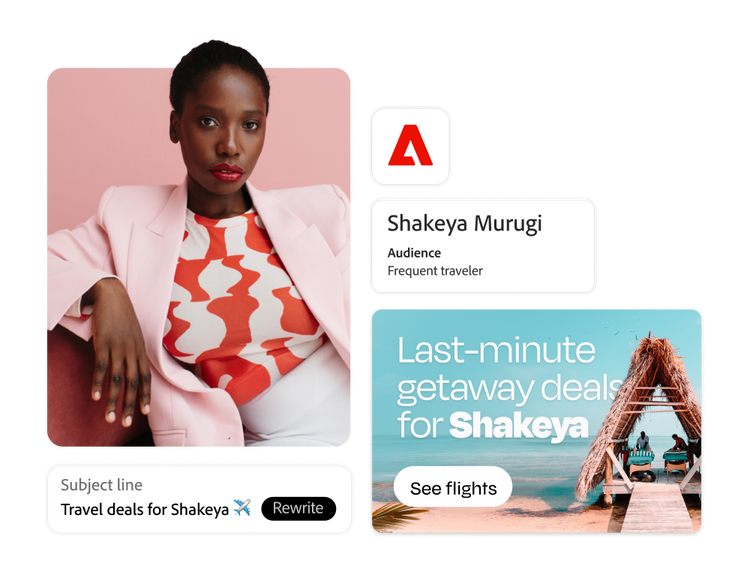
The gap that holds great brands back.
Behind every great brand experience is a team of marketers with a clear vision, a message, and a target audience. But too often, by the time that vision reaches the customer, something has been lost.
A segment wasn’t refreshed in time. The content couldn’t be adapted fast enough. The data lived in a warehouse that marketing couldn’t easily access or activate within necessary systems without filing a ticket. Often the ticket wasn’t picked up in time and the moment the marketer has been envisioning is lost.
This is the gap between marketing and data teams — and it’s not a technology problem in the conventional sense. The data is there. The creative talent is there. The brand vision is there.
What’s missing is a platform that lets all three work together in real time, with the governance IT and data teams require, and the agility marketing demands.
Adobe has been helping customers to solve this customer experience orchestration challenge for years, leaning on our deep understanding of marketing, creativity and customer data.
This isn’t just a data platform with marketing features added on. It’s built to connect data, content, and activation so teams can create customer experiences from one system.
The world’s most iconic brands don’t simply collect data. They turn it into moments that feel personal, on-brand, and relevant. Adobe solutions, such as Adobe Experience Platform, make that possible at enterprise scale with in-the-moment speed, giving marketing teams the power of enterprise data without relying on data engineers.
One platform, two languages: Data and brand.
The fundamental challenge of bridging data teams and marketing is that both teams speak different languages.
Data teams speak in schemas, governance policies, and access controls. Marketing speaks in audiences, journeys, and moments. Most platforms force one team to learn the other’s language. Adobe does something different: it translates between them.
Adobe CX Enterprise and its Adobe Experience Platform are built so that data teams can define the data models, governance rules, consent policies, and identity frameworks that the enterprise requires, and marketing teams can work freely within those boundaries, using interfaces designed for their craft.
For example, a campaign manager building an audience in Adobe Real-Time CDP is querying the same governed data as the data engineering team. They’re just doing it through a visual builder instead of a SQL terminal.
That’s the bridge. Not a connector between two separate systems, but rather a single, interoperable, platform with a shared data foundation that both teams can trust, and intuitive purpose-built interfaces for each.
While working with external platforms, such as a data warehouse is critical, the research shows that warehouses alone do not solve all use cases.
In a recent survey of 150 customer data platform executives and practitioners, confidence in data warehouses was strongest for foundational tasks: 91% for ingesting data and 79% for aggregating and preparing it. Confidence dropped for more activation-oriented use cases, falling to 68% for updating a customer profile and serving the next-best experience in real time, and to 64% for informing AI agents with real-time customer context.
Connecting marketing, IT, content, and data has long been central to Adobe’s approach.
Only now are technology, data companies, and others making similar pivots and shifts, providing clear validation of our long-term strategy.
What Adobe can offer.
Adobe connects the signal from your data to the delivery of your marketing and customer experiences across all touchpoints, from agentic, to web, to email, to social, and more — with the content, context and intelligence layer that makes every experience impactful.