From data management to actionable context: Customer data platforms' next chapter.
There's a quiet transformation happening inside enterprise teams. Not the kind that makes headlines, but the kind that shows up in the data — in the gap between what practitioners say is working today and what everyone agrees will matter in three years.
We surveyed 150 customer data platform (CDP) executives and practitioners across enterprises, and what emerged was a story about a category in the middle of a complete reinvention. The market is moving beyond the three-letter acronym and beginning to define what’s required to support the agentic era. This definition outlines context, intelligence, and ensuring there is an enterprise data layer that can help to manage, fuel, and effectively work with agentic channels and models.
Here's what the data revealed.
Learning 1: The CDP of today is not the CDP of tomorrow.
Ask CDP buyers and users what's most critical right now, and they'll tell you: harmonized customer profiles. Nearly 80% rank it as a top-three priority — the foundational work of cleaning, unifying, and organizing customer data. While this critical work may not be visible to customers, it is felt deeply by them in their experiences with brands at every step.
Now ask them what they expect to matter most in three years. The answer is almost shockingly different.
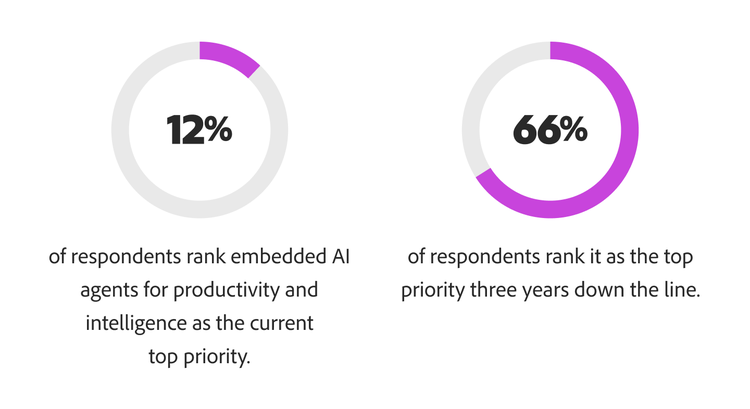
Embedded AI agents for productivity and intelligence — currently ranked as the top priority by just 12% of respondents — rockets to first place at 66%. Practitioners are driving this expectation even more aggressively than executives (78% vs. 55%), suggesting that the people closest to the data see the shift coming faster than leadership does.
The use case evolution tells the same story. Today, the primary job of a CDP is cross-channel personalization (39%). In five years, the dominant use case — by a wide margin — will be managing data for AI agents, models, and applications (71%, up from just 15% today). Again, practitioners lead the charge, with 81% pointing to AI data management as the future primary use case versus 61% of executives.
The message is clear: CDPs' core job description is being rewritten in real time.
Learning 2: CDPs will bridge the gap between engagement and intelligence.
For years, the conversation about CDPs was framed around personalization and audience activation. That framing is now too small.
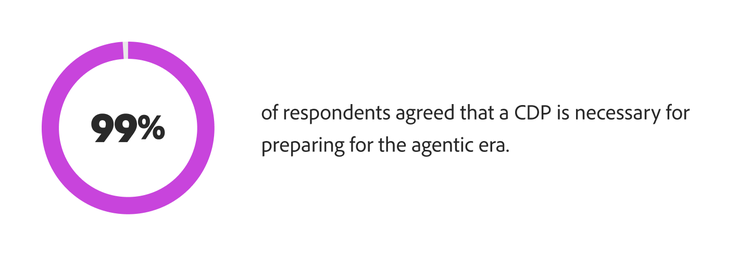
Nearly every respondent in our study (99%) agreed that a CDP is necessary for preparing for the agentic era. The platform is evolving from an enabler of personalized experiences into something closer to a layer of actionable intelligence and context: the critical connector between your system of engagement and your system of data.
That future is coming faster than most realize — and the appetite for it is already here. Executives are ready — 71% now want autonomous agents. Fast forward three years, and the bullishness on agents becomes even more apparent. 92% of respondents want autonomous agent capability in their CDP — a number that's almost unanimous. Practitioners actually skew slightly higher than executives in their three-year expectations (97% vs. 87%).
The practitioners see the big picture. The emerging capabilities they expect CDPs to support in the next two to three years reinforce just how agentic the roadmap has become:
- Unstructured data management: 76%
- Latest privacy/regulatory compliance: 75%
- Autonomous agents (no human assistance): 73%
- Goal-based agents (humans in the loop): 71%
- Integration with emerging AI protocols like MCP, A2A: 55%
Learning 3: CDPs are complementary to data warehouses — not replaceable by them.
One of the more persistent narratives in enterprise data circles is that the modern data warehouse has led to the question of whether a CDP is truly necessary. This research suggests that view is not only premature — it misunderstands what the real challenge is.
Warehouses are exceptional at what they are built for — acting as a source of truth for enterprise data, running analytical workloads, and performing operational data processing.
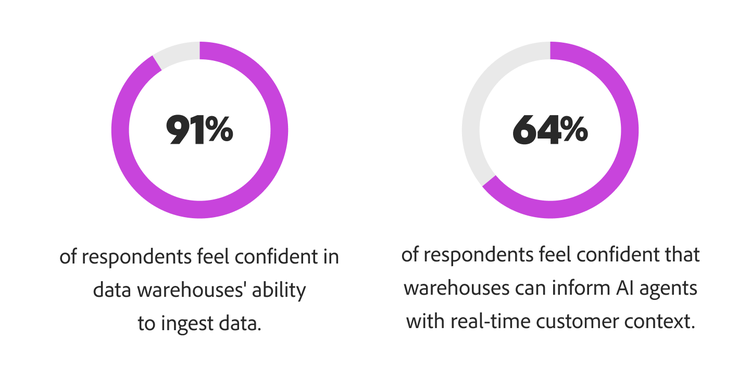
When it comes to data warehouses, those surveyed noted that confidence is high when it comes to ingesting data (91% confident) and aggregating and preparing data (79% confident).
But push into the more advanced, AI-ready, real-time, activation-focused scenarios and the confidence drops on what warehouses can do on their own:
Updating a customer profile and serving the next-best experience in real time: Confidence falls to 68% — and the gap between executives (81% confident) and practitioners (55% confident) signals a meaningful disconnect between what leaders believe the warehouse can do and what the people using it actually experience.
Informing AI agents with real-time customer context: Confidence drops further to 64%. The executive-vs-practitioner divide here is the starkest in the entire study — 86% of executives are confident their warehouse can handle it; only 41% of practitioners agree.
That gap isn't a technical footnote. It's a strategic risk. When the people architecting AI and real-time personalization workflows don't trust the underlying data infrastructure to keep up, the agentic future risks stalling at the foundation.
The takeaway: Warehouses and CDPs aren't competitors. The real-time, personalization-ready, agent-ready capabilities that define the next era of customer engagement require both to work together. This isn't an either/or conversation. It's an and/also one.
Learning 4: Executives are bullish. Practitioners are building. Both are right.
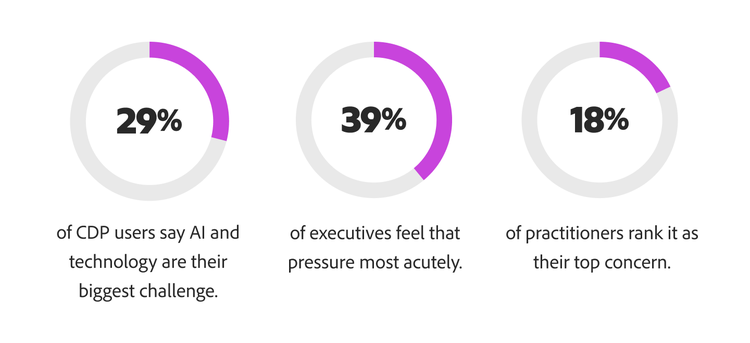
Among CDP users today, AI and technology ranked as the topmost challenging aspect of their careers, cited by 29% overall — the need to invest in new applications, test them, trust them, and safely integrate them into workflows. But the breakdown by role reveals something important: Executives feel the pressure more acutely (39%) than practitioners do (18%).
This seems counterintuitive at first. Shouldn't the people closest to the tools feel the most pressure? But read it differently and it makes sense. Executives are accountable for the AI strategy — the direction, the investment, and the ROI narrative. Practitioners, meanwhile, are in the trenches figuring out what actually works and the processes behind it.
The result is a consistent pattern across the data: Executives are faster to say that AI is ready. Practitioners are busy making that a reality.
Neither group is wrong. They're operating from different vantage points with different stakes. For teams building AI-powered CDP capabilities, this duality is a design brief: Give executives the vision, give practitioners the controls.
Learning 5: Connecting paid and owned isn't a nice-to-have — it is core infrastructure.
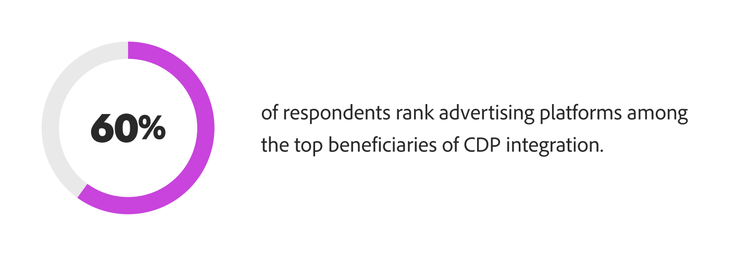
One of the most practically significant findings from this study is where the value of CDPs shows up in the media and channel ecosystem. When respondents were asked which platforms benefit most from CDP integration, 60% listed advertising platforms in their top three responses.
That number reframes what a CDP is for. It's not just a tool for email personalization or website segmentation — it's the connective tissue between first-party data and paid media. Between what you know about your customer and where you reach them next.
As third-party data becomes less available and signal loss in paid channels continues to mount, the ability to activate owned data in advertising environments — with precision, privacy compliance, and real-time responsiveness — becomes a fundamental competitive differentiator.
CDPs are increasingly becoming the infrastructure that makes this possible.
The future is now with Adobe.
At Adobe, we’re already moving beyond the bounds of the three-letter acronym. We’re empowering brands to harness customer experience for intelligent activation. Organizations are looking to make customer experience data useful, actionable, and valuable. Adobe provides differentiated real-time ingestion, activation, and processing at scale with embedded visibility and governance that serve as the action layer of context, behavior, and experiences. But the mandate goes beyond that. To engage customers and meet each moment thoughtfully, the experience and content must be exactly right. Adobe Engagement Intelligence alters the customer journey and experience in real time based on organizational goals and inbound signals. Adobe Brand Intelligence helps ensure that the content used to inform this experience is distinctively yours — true to brand standards, consistent, and embedded within your content supply chain where it can be used by humans and agents alike. Finally, Adobe is also boosting your team with Adobe CX Enterprise Coworker, which can thoughtfully and safely handle execution, coordination, and behind the scenes operations, unburdening your team of manual effort and making more time for the strategy behind customer experience at scale.
The bottom line.
The CDP category is not standing still. It is being reshaped — by AI, by agents, by the limitations of warehouses operating alone, and by a workforce that is simultaneously excited about the future and working hard to get the fundamentals right. It’s the end of the three-letter acronym as we’ve known it, but the beginning of a new reality made for the agentic era.
The platforms that will matter in three years are the ones being built as an intelligence layer: real-time, AI-ready, agent-compatible, and deeply integrated with both the data systems and the activation channels that drive enterprise marketing outcomes.
The CDP of yesterday was managing customer data. The CDP of today and tomorrow is something bigger: the connective tissue, with semantic context, meaning, and intelligence that powers enterprises in the agentic era.
Based on findings from the Advanis CDP Study 2026, a survey of 150 CDP users conducted between March 18 and April 8, 2026. Research sponsored by Adobe and conducted by Advanis.