Enterprise teams review information from multiple sources before making a decision or taking action. Service teams use customer records, product images, call recordings, and device data to resolve issues, while marketing teams combine customer data, written briefs, images, and video to develop campaigns. They rely on each input to add context and understand what is happening. When traditional AI systems process these inputs separately, teams can miss context that helps them resolve issues, make informed decisions, or determine the next best action.
Multimodal AI helps close that gap by bringing together relevant inputs and context. It processes, interprets, and generates information across formats, helping enterprises uncover richer insights and automate workflows that rely on multiple sources. Teams can use multimodal AI for more complex business tasks and create value across the enterprise. In this article, we’ll cover:
What is multimodal AI?
Multimodal AI is an AI system or model that processes multiple types of information, including text, images, audio, video, numerical data, and sensor inputs. Each form is called a modality, which refers to the way information is represented or communicated. Multimodal AI can:
- Receive multiple types of information, such as text, images, audio, or video.
- Connect information across these inputs to understand how they relate.
- Produce outputs in one or more formats, such as text, images, audio, or video.
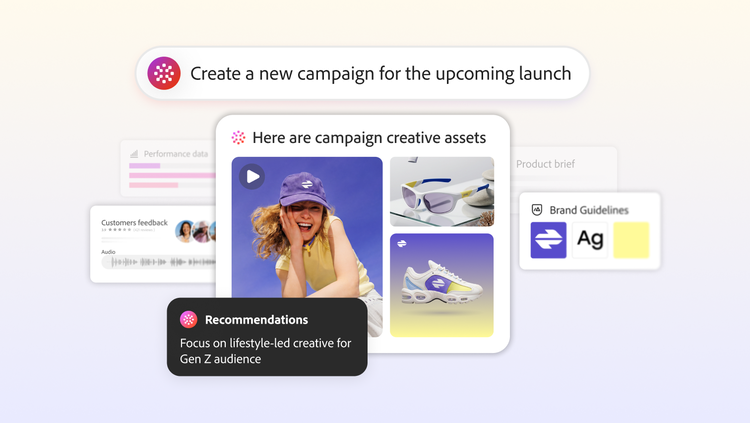
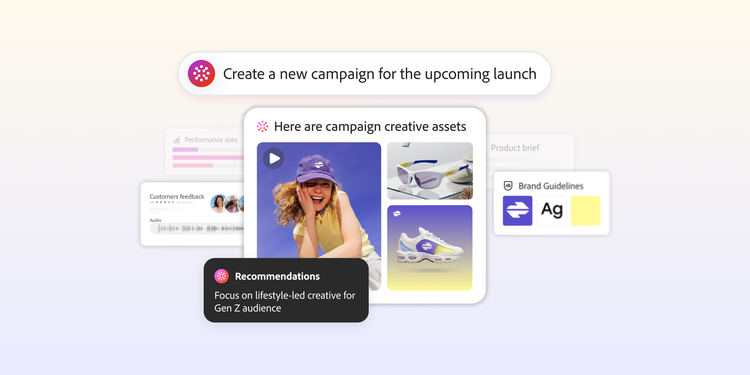
For example, a marketing team could use multimodal AI to develop a new campaign using a product brief, brand guidelines, existing campaign images, customer insights, and performance data. The system can then process information from these inputs to generate new creative assets and recommendations that reflect the brand, campaign goals, and available customer insights. These outputs should always be verified by human teams. However, the unimodal AI system primarily works with one type of data and would not interpret these different forms of information in the same way.
Multimodal AI and generative AI can work together, but they serve different purposes. Multimodal AI allows a system to understand and connect information across formats, such as text, images, audio, and video. Generative AI creates new content. When used together, a system can generate an output using contextual relevance. For example, multimodal generative AI can use text and images to recommend a product, turn a written prompt into an image and copy, or interpret video and speech to provide a response.
How does multimodal AI work?
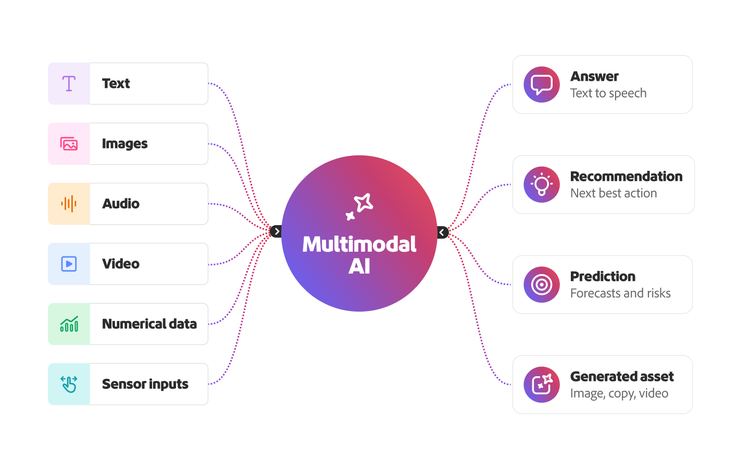
A multimodal AI system first converts the information it receives into a form the model can analyze and compare. It then identifies relationships across the inputs. For example, it processes an image and a document to understand a product or audio and video inputs to understand a conversation and what is happening around it. These relationships give the model the context to interpret the inputs together rather than separately.
The model then combines what it has learned from the inputs to provide an answer, a recommendation, a prediction, or a new asset. For example, it uses text and images to recommend a product or turn a written prompt into an image with accompanying copy. An AI assistant interprets what is happening in a video together with a spoken question, then responds via text or speech. It’s not just about processing multiple formats, but understanding how the inputs relate and using that context to produce a strong output.
Enterprise use cases for multimodal AI.
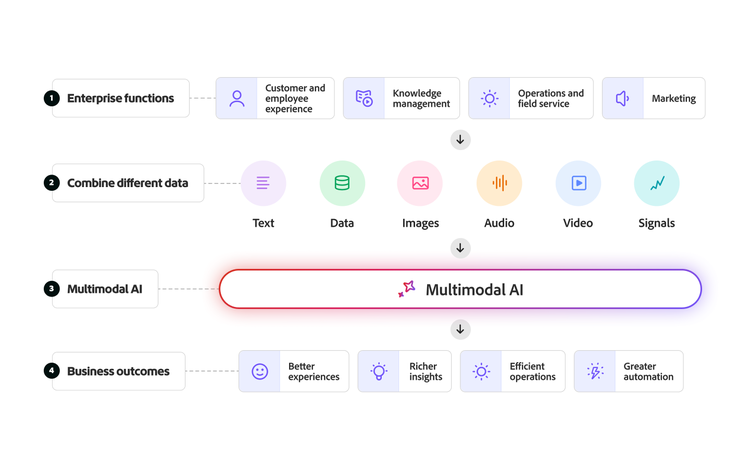
Multimodal AI makes fragmented enterprise information more useful across a range of business functions. The following use cases demonstrate how teams can apply it across different business functions:
-
Customer and employee experiences. Multimodal AI can give customer-facing teams more context to understand and respond to individual needs. A customer service system, for example, analyzes spoken requests or chat messages together with screenshots, product images, previous conversations, and account information to better understand an issue. It helps improve overall customer experience. Sales teams use call recordings, presentations, emails, and CRM data to identify customer needs and recommend next steps.
The same approach supports employee enablement by using multimodal AI assistants to find answers across documents, diagrams, training videos, and recorded meetings. And by letting people interact through text, voice, images, or video, these interfaces make digital experiences more interactive and give users more ways to access information. This is applicable and beneficial for many industries.
-
Document, media, and knowledge analysis. Most organizations store valuable information across contracts, forms, scanned records, charts, photographs, audio files, and video. Multimodal AI provides users with context across these formats. This makes it easier to find information that might otherwise remain fragmented. For example, employees can search for information without knowing where or how it is stored. Multimodal AI allows employees to find a product shown in an image or use a written question to locate a relevant part of a video. Multimodal AI also analyzes spoken discussions, presentation slides, and visual demonstrations to create a more complete meeting summary. Media organizations can use multimodal AI to organize, moderate, summarize, and find content across large media libraries. It is a great way to achieve seamless document management.
-
Operations, product development, and field service. Manufacturers rely on camera footage, sensor data, maintenance records, and technician notes to identify defects or equipment problems. Multimodal AI systems connect this information to help teams spot issues and determine what needs attention. For example, unusual sensor readings paired with camera footage help teams investigate a potential equipment problem. Field service teams can use equipment, images, and spoken descriptions to find relevant repair instructions. Product teams could also use multimodal AI systems to analyze customer feedback, product photos, support calls, usage data, and testing results to identify areas for improvement. Retail and logistics teams can use images, video, inventory data, and operational records to improve monitoring and decision-making.
-
Marketing and creative workflows. Marketing teams depend on audience insights, written briefs, creative assets, video, and performance data throughout the campaign process. With multimodal AI, teams can use these different sources to inform campaign strategies. They can search asset libraries, generate content variations, and adapt assets across formats. They can also keep copy and visuals aligned throughout the creative process. Creative generation is an important application, but it is just one way these capabilities support marketing and creative workflows.
What are the benefits of multimodal AI?
For enterprises, multimodal AI holds great value as it processes and relates information across different formats to build a more complete understanding and support better decisions and workflows. It offers a range of benefits, including:
- Better context. Text, images, or data alone may not provide an AI system with enough context to understand a situation. An image clarifies a written description, while account data or sensor readings reveal details the image does not show. Using these inputs together can reduce blind spots and provide more context for recommendations, classification, search results, and operational decisions. However, more context does not guarantee greater accuracy. Results still depend on the quality, relevance, and alignment of the data the system is trained on.
- Faster access to unstructured information. Business information is often spread across recordings, videos, images, diagrams, and complex documents. Finding and analyzing the right information across these formats takes time. Multimodal AI helps employees find and interpret relevant information without manually reviewing each source. This can speed up operations across customer service, research, compliance, content, and knowledge management.
- An increase in natural interactions and productive workflows. You can show the AI system a problem with an image, describe it by voice, and provide supporting documents in the same interaction. This gives teams more natural ways to work with AI without turning every request into text. Multimodal capabilities can also connect steps across a workflow and reduce manual handoffs between tools and teams. For customer-facing experiences, this flexibility supports teams to deliver more personalized and interactive experiences.
Putting these benefits into practice to deliver business value also requires careful planning and management across the enterprise.
What to consider when adopting multimodal AI.
As multimodal AI brings more types of information together, it brings a set of enterprise challenges. It requires teams to manage data quality, security, and connections between inputs.
Key considerations include:
- Data quality and alignment. Information from different sources may be incomplete, inconsistent, or difficult to connect. This may cause AI systems to link the wrong information or miss details that matter. Enterprise teams should test how systems perform when inputs mismatch, information is missing, or one source is more relevant than another. They should evaluate whether the system uses different inputs together to produce the right result, rather than testing each input separately.
- Privacy, security, and responsible use. Images, recordings, biometric information, documents, and customer communication may contain sensitive or protected information. Organizations need clear controls for those who can access this data, how it is stored and used, and how they manage consent and intellectual property. Multimodal AI also may carry biases or errors from the source data into its outputs. For sensitive applications or decisions with significant consequences, human review is important.
- Integration and business readiness. Each enterprise requires different AI capabilities based on how it operates. Enterprises should start by defining the problem they want to solve, then identify the inputs they need and how they will measure success. From there, teams need to determine where human judgment remains important and what changes are required to integrate multimodal AI with existing systems and data sources. The adoption roadmap should also include computing requirements, ongoing monitoring, employee training, costs, and governance.
These considerations make a clear implementation strategy essential for enterprise-wide adoption. The challenge is not just connecting different types of information, but managing them responsibly across systems, workflows, and teams.
How does multimodal AI help AI agents?
Enterprises now use AI agents that can make decisions and act. To do this effectively, agents need more than text-based instructions. They use documents, images, videos, conversations, and operational data to understand a task and determine the next step. Multimodal AI brings these inputs together, so agents interpret the situation and act with more context.
Multimodal AI agents bring together two capabilities:
- Multimodal understanding: The ability to understand information across different formats and identify how it relates.
- Agentic capabilities: The ability to reason, make decisions, use tools, and complete tasks based on a goal.
With these capabilities, AI agents move beyond just answering questions. They support workflows that require understanding, decision-making, and action. For example:
- Customer service agents can analyze customer conversations, account information, screenshots, and product documentation to understand an issue and recommend or complete the next steps.
- Creative workflow agents can use briefs, brand guidelines, existing assets, and performance insights to help teams develop and optimize content.
- Knowledge management agents can search and synthesize information across documents, recordings, images, and videos to provide more complete answers.
As agents work with more business information and take on more tasks, enterprises also need to consider how those actions are managed. Strong data connections, governance, and human oversight help keep outputs accurate, secure, and aligned with business goals.
Using multimodal generative AI to improve enterprise creative production.
Creative and marketing teams rely on a range of information and data to develop content. A written brief sets the direction, while brand standards, design systems, existing assets, images, and video provide the context needed to bring it to life. Customized, brand-specific models use these inputs to help teams create consistent, on-brand content across formats while fitting into established creative production workflows.
Adobe works with organizations that have complex media and content requirements to build commercially safe, finely tuned generative AI models grounded in their proprietary content, brand assets, and creative direction. Designed for enterprise creative production, Adobe Firefly Foundry helps teams generate high-fidelity, on-brand content across image, video, audio, vector, and 3D workflows. Adobe experts partner with enterprise teams to shape models and use cases aligned with their organization’s creative goals.
Explore how your teams can build generative AI models with Adobe Firefly Foundry to scale on-brand content creation across media formats.
Recommended for you
https://business.adobe.com/fragments/resources/cards/thank-you-collections/firefly