Testing AI Models for Hallucinations, Bias, and Brand Risk

How to test AI models for hallucinations, bias, and brand risk.

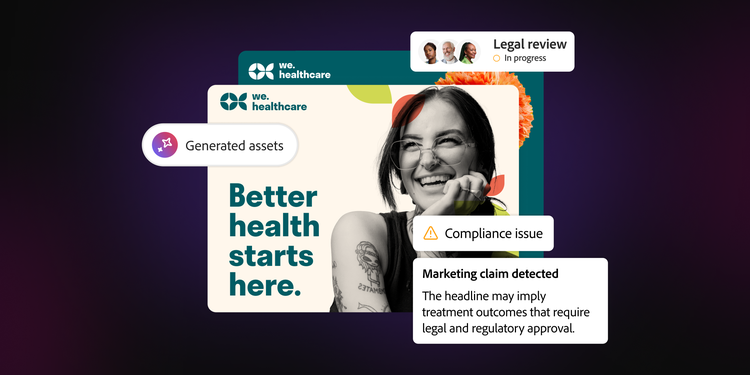
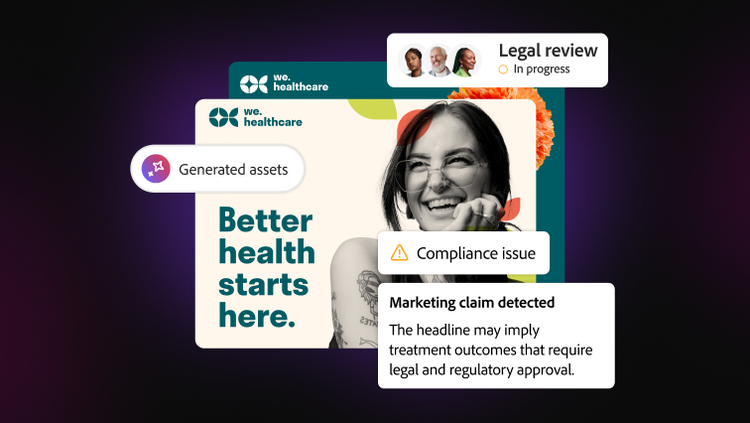
An AI‑generated healthcare marketing graphic flagged with compliance issues and undergoing legal review.

Generative AI can now help enterprise teams produce content across every channel, audience, and market faster than was previously possible. As AI adoption accelerates, enterprises scaling content face the same problem: incorrect information when AI outputs aren’t verified by human teams. According to Adobe's 2026 Digital Trends Report, 60% of organizations surveyed say AI-powered service and support will define breakthrough CX over the next two to three years.

AI-generated content can ultimately create hallucinations and drift from brand standards. A false claim can become the answer, which is then attributed to your brand that you no longer control. Testing AI models before using them at scale is the first line of defense.

AI hallucinations are instances where large language models (LLMs) generate information that sounds confident but is factually wrong.

For brands, testing AI models is essential. Accurate, on-brand, and ethically sound content requires review processes and feedback loops built into the workflow from the start. This requires a multi-layered validation framework, one that catches AI hallucinations, algorithmic bias, and brand inconsistencies early.

This article will cover:

Why does AI model testing matter for enterprise use?

When agentic AI systems orchestrate content from ideation through execution with minimal human intervention, an error isn't a one-off. Unreviewed AI output with a bias or hallucination can spread across campaign touchpoints before anyone catches it. If the AI system is not tested thoroughly, it risks spreading misinformation, which could lead to compliance violations and brand damage.

Even one factual error can quickly become a systemic risk, negatively impacting customer trust. This is why thorough AI model testing to identify hallucinations, surface potential bias, and support for brand and quality standards is especially important for enterprise teams operating in these environments.

What are AI hallucinations?

In digital marketing workflows, AI models can potentially generate marketing content with hallucinated information such as non-existent product features or distorted logos in images. The stakes get even higher in agentic workflows, where AI is making decisions and unchecked errors can be passed on to customers directly through automated campaigns. If one hallucinated claim doesn't get reviewed, it gets acted on, passed to the next agent, and embedded in every deliverable that follows.

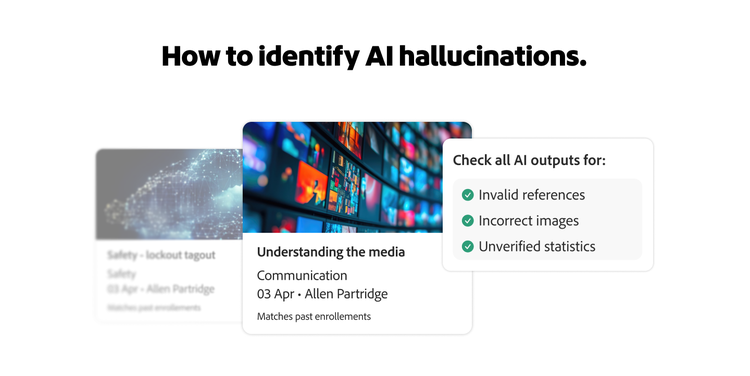
A graphic showing how to test AI-generated outputs for hallucinations.

Why do AI models hallucinate?

AI models aren’t only retrieving facts, they’re also predicting what comes next based on patterns learned during training and configuration. Here’s what leads many AI models to hallucinate:

  • Gaps in data: Training data that is outdated, incomplete, or inaccurate from the start.
  • Preference for linguistic fluency: Models optimized to sound coherent will confidently produce a well-structured sentence that isn’t true.

An AI model is only as reliable as the data behind it, which is why enterprises need a verified, centralized knowledge base that is updated frequently. Combine this with a knowledge graph that maps relationships across entities and data sources. If product messaging changes and the model data isn't updated, then AI will confidently produce content based on what's no longer true and may even flag accurate content as incorrect. For instance, if a brand hasn’t updated its product messaging in the data repositories, an AI tool may wrongly identify newly generated content as outdated.

Maintaining that source of truth isn't a one-time setup. It requires regular audits to retire outdated information, add new product data, and reflect any messaging or positioning shifts across the business.

Enterprises can include two-level testing to minimize AI hallucinations with:

  1. Retrieval-augmented generation (RAG) validation: Well-designed RAG frameworks can require AI outputs to be grounded in approved sources. Every claim must be traced back to a citation in the enterprise knowledge base. Since autonomous AI agents act on their own, testing works by querying the model and auditing whether responses are genuinely anchored to source material, or fabricated.
  2. Expert review: No automated system catches everything. Human oversight is needed. Subject matter experts, product managers, and legal reviewers should audit AI outputs often. This way, teams will be able to flag incorrect information, factual errors, and wrong references before publishing.

Done well, this two-layer testing may minimize the frequency and impact of AI hallucinations. However, enterprises also need to spot bias in AI-generated content, which further impacts brand image.

Bias in AI: How to test against hidden risks in content production.

Bias in content could be based on gender, race, or ethnicity. Since it won’t be flagged as a factual error, it is difficult to spot. AI-generated images lacking diversity or marketing campaigns that use gender stereotypes might seem low-risk, but they can affect how customers perceive the brand.

For example, you ask an AI image generator to depict a surgeon and observe that the output is images that default to people of a particular gender or ethnicity. The model is not reacting to the prompt alone, it is also reflecting its learning from the training data. This kind of output could alienate the brand’s target audience.

Similarly, an AI tool that suggests aggressive “cost-cutting” language in a customer-facing message might seem neutral, but lacks nuance the context requires. If implemented by a brand without an internal check, it risks substantial reputational damage.

That's why it’s important to catch bias and undertones early, before it becomes a pattern. Marketers can test for bias in AI-generated content by:

  • Auditing AI models: Implement auditing processes to test if your AI model, by default, leans to a certain demographic when generating outputs for professional roles or lifestyle scenarios.
  • Human oversight: Involve marketers, product managers, and subject matter experts in content reviews. It will help spot biased nuances, specific to a region, religion, gender, or ethnicity within AI-generated content.

When you test your systems constantly, you’ll be able to get feedback, and train your AI model for better outputs.

How to test brand risks in AI outputs: A step-by-step guide.

Enterprise AI content should reflect brand voice, tone, and creative expression. Inconsistent or incorrect messages can damage brand reputation and trust among consumers.

Here are practical steps to test AI models for brand risk:

Step 1: Cross-reference every AI output with an approved brand style guide.

Check every output against your brand style guide, including tone of voice, nomenclature preferences, product naming, and banned phrases. A slightly wrong product name or off-brand word choice reads as a minor slip in isolation. However, when it’s multiplied across hundreds of AI-generated assets, it becomes a consistency problem that's expensive and time-consuming to fix.

For teams, this checkpoint should be non-negotiable in daily operations. When the brand style guide is updated, positioning shifts, product names change, or messaging is retired, AI models need to be updated accordingly.

Step 2: Stress-test with different prompts to identify brand risk issues.

Test your AI models across unusual scenarios, culturally sensitive topics, and prompts that sit outside your core use cases. These are the conditions that’ll most likely surface brand risk before customers encounter it. This matters especially in agent-to-agent marketing workflows, where multiple AI agents are making content decisions in sequence. Even one bad output can hurt a brand’s image.

Accurate, on-brand content is also a prerequisite for visibility in AI-powered search. All your marketing content should be validated and optimized before it surfaces in search, not after.

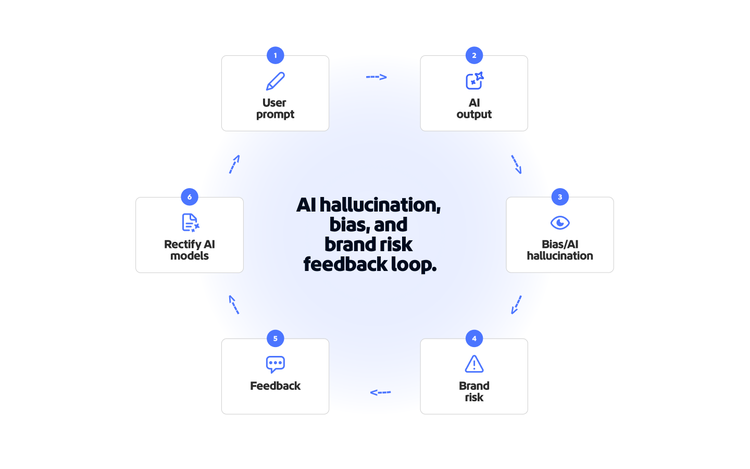
A circular workflow diagram showing how AI outputs are evaluated for bias, hallucination, and brand risk to drive continuous improvement.

Step 3: Keep humans-in-the-loop for review processes.

According to Adobe’s AI Inflection Point report, 69% of organizations use real-time monitoring tools, which are significantly more effective when combined with human judgement. AI-generated images or content that is biased or tone-deaf often require human judgement to evaluate fully. Include subject matter and legal experts in your review processes. Track every hallucination, off-brand term, or biased message to improve your AI model. Every review cycle is an opportunity to narrow the gap between what an AI model generates and what brands really want.

If enterprises scale AI-generated content, human judgment and continuous feedback are what will keep your brand more consistent and reliable over time.

Brands that combine human oversight with AI can help enterprises uphold brand standards as content volume grows. Adobe offers tools designed to support that process, helping marketing teams move quickly while maintaining visibility over brand voice and content governance workflows.

For example, Governance Agent in Adobe Experience Manager helps teams review AI-generated content against imported brand guidelines. It can flag potential issues related to tone, terminology, claims, imagery, and rights-based governance checks before publication, while keeping human review in the workflow. This approach helps marketing teams retain control over publishing decisions while delivering relevant, consistent experiences more efficiently.

Build a smarter AI content strategy at scale.

Testing AI models is a necessary operational discipline. Enterprises that get it right understand that AI quality is directly linked to system design. It’s about designing a system that — consistently, at scale, across every channel — catches errors before they cause damage. What AI systems produce is only as good as the guardrails, review processes, and feedback loops that guide them.

Disclaimer: This article is intended for informational purposes only and does not constitute legal, regulatory, or compliance advice. Organizations in regulated industries should consult qualified legal counsel to determine applicable requirements for AI-generated content.

Let’s talk about what Adobe can do for your business.

Get started

I'm the Adobe Assistant. How can I help you today?

1