Enterprise creative teams are under increasing pressure to produce more content, at a faster pace, across more channels. According to Adobe Research, 71% of the 1,600 respondents expect the demand for content to grow 5x by 2027. As timelines shrink and campaigns need to expand, many enterprises are looking at AI to support creative production at scale.
For creative teams, that shift can raise understandable concerns about job security, originality, and the role of human artistry. But generative AI for creative teams is not simply about replacing creative work. When integrated thoughtfully, AI can support ideation, content creation, and asset production, giving creatives more time to focus on strategy, storytelling, brand judgment, and refinement.
This post covers:
Generative AI changes how teams produce content.
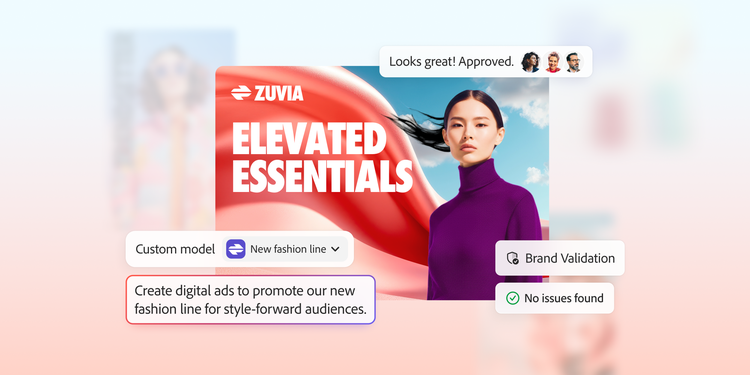
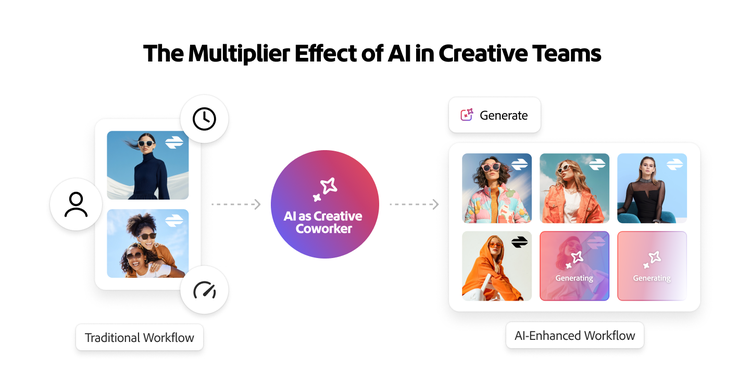
AI is reshaping creative workflows across the content production process, creating a more connected and efficient way of working. During ideation, teams can use intelligent tools to quickly generate initial concepts, explore visual directions, and build mood boards in minutes. Creative teams can use AI as a starting point by generating images, video elements, and layout variations. Creative teams can iterate more rapidly and produce multiple campaign variations where they once created only a handful. However, AI can produce outputs that are inaccurate or off-brand, so creative professionals and brand stakeholders need to validate initial assets before they move further into production.
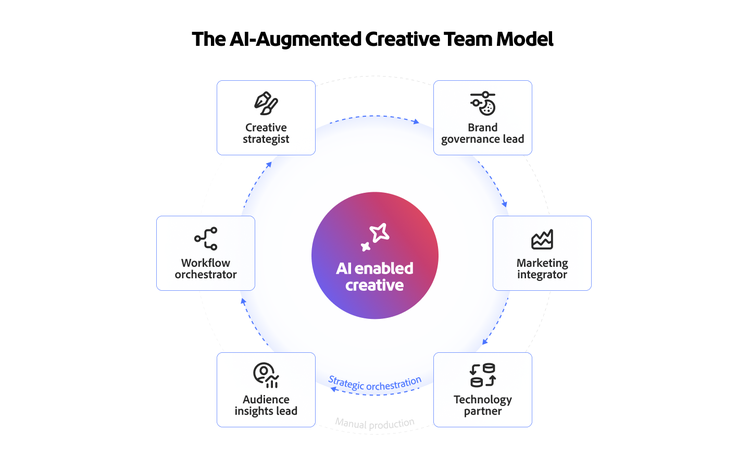
As AI becomes embedded in the content production process, it also changes how creative teams collaborate with the broader organization. Creative, marketing, and information technology (IT) teams must work more closely together to fully realize the benefits of AI. Creative teams contribute brand judgment and executional expertise. Marketing teams connect creative output to campaign objectives and audience insights. IT ensures that the necessary tools, workflows, governance, and security frameworks are in place to support AI at scale.
These shifts are leading to new, more flexible team structures. Instead of relying on rigid production hierarchies, enterprises are moving toward agile, system-driven approaches to content creation and management. Teams can scale output up or down based on campaign needs, supported by AI-driven workflows that streamline routine production tasks. Over time, the content supply chain evolves from a series of disconnected handoffs into a more integrated system, where AI handles repetitive processes and human teams focus on strategic direction and creative decision-making.
How can AI help creative teams?
AI can benefit creative teams by increasing production speed, reducing repetitive work, supporting more creative variation, and allowing more time for strategy and refinement. For enterprise teams, these gains matter because creative demand often exceeds the time and resources available through traditional production workflows.
Adobe for Business found that 24% of creatives, out of 3,000 surveyed, have already implemented generative AI in the creative process and ideation. When used effectively, AI tools can help brands create region-specific, audience-specific, and channel-specific variations of campaign assets. With more creative approaches to test, teams can make more informed decisions about which assets to refine, expand, or retire based on real-time results.
AI prompts in graphic design and other creative disciplines are most effective when they support faster exploration, not when they replace creative judgment. Designers can use prompts to generate initial concepts, layout options, and campaign variations that serve as starting points for refinement. This reduces the mechanical production work that often slows creative teams down, giving them more time to focus on creative direction, brand alignment, and final execution.
One of the most valuable benefits is the time creative teams can reclaim for long-term campaign strategy, a/b testing new CX/UX practices, or conducting research with other experts in the field on how trends in creative industries have changed in the last few years. When generative AI supports repetitive or production-heavy tasks, teams can spend more time on long-term creative strategy, deeper market research, and thoughtful campaign expansion. Instead of rushing to meet production deadlines, creatives can focus on what differentiates exceptional work from adequate output and how brand messaging can better resonate with customers.
AI can also make it easier for teams to expand into new formats and channels. Teams that once struggled to keep up with static image production may be able to explore video variations, animated content, podcast-related assets, or additional campaign formats. Channel expansion to platforms like YouTube becomes more feasible when AI supports parts of the production workload while human teams continue to guide strategy, quality, and brand guidelines.
How AI changes a creative's role.
AI is changing creative roles by shifting more production-heavy work into AI-supported workflows, giving creative professionals more room to focus on judgment, strategy, and direction. Production designers who once spent much of their time on repetitive execution can increasingly guide AI-generated variations, refine concepts, and ensure that creative output aligns with brand standards.
Automated tasks for creative professionals often include resizing, versioning, layout exploration, first-draft generation, and routine production cycles. These tasks still require review, but they no longer need to consume as much of the creative team’s time.
Humans remain essential for strategy, originality, storytelling, creative direction, and brand integrity. Automated creativity cannot replace the judgment required to understand audience needs, craft compelling narratives, or ensure that every asset reinforces brand positioning. The strongest AI-supported workflows treat AI as a collaborative partner, while keeping human teams responsible for the final creative decisions.
Balancing AI efficiency with brand consistency.
Ensuring generative AI tools have responsible adoption and use policies helps ensure that efficiency gains do not come at the expense of brand integrity. Enterprises must establish clear human oversight requirements before scaling AI across creative workflows.
Brand-configured models represent one approach to maintaining consistency. When AI systems are configured with brand-specific assets, guidelines, and examples, their output more closely aligns with established visual identity and messaging standards. Some brands develop standardized prompt libraries that encode creative guidelines, ensuring that anyone using AI tools produces on-brand results. This approach helps democratize creativity across teams while maintaining quality standards. However, AI model quality is dependent on continual brand asset updates. Outdated information, product messaging, visual guidelines, or copy guidelines can negatively impact AI output.
Human oversight loops should be built into AI-enabled workflows from the start. Experienced creative professionals need clear review points where they can evaluate assets based on brand guidelines, identify subtle inconsistencies, and approve assets before they move into production or distribution.
The outcome of this balanced approach is faster content production without compromising visual identity, tone, or messaging. Enterprises that enable more team members to produce content must simultaneously establish guardrails that protect the brand. When done well, this balance allows brands to scale output while maintaining the consistency that potential customers and audiences expect.
What are best practices for scaling AI?
Scaling AI in creative workflows requires a thoughtful, measured approach. PwC's AI Business Survey notes that organizations that succeed typically begin with heavy experimentation, investing significant time in testing different tools, workflows, and use cases before committing to enterprise-wide implementation.
- Task identification: Teams must determine which tasks AI can support effectively, such as generating initial concepts, producing asset variations, or resizing content for different channels. They also need to identify the work that still requires human creatives, including strategic planning, brand interpretation, and final quality assurance.
- Feedback loops: Creative teams should establish reliable methods for sharing what is effective and what is not. When designers, marketers, and AI tool developers can evaluate outputs together, they can refine workflows, improve prompt strategies, provide feedback to improve backend performance, and increase the quality and relevance of AI-generated creative over time.
- Interoperability and governance: Teams need to integrate AI tools with existing systems for asset management, project tracking, and content distribution. Governance frameworks should also address intellectual property, usage rights, approval workflows, and brand review standards before AI-generated assets move into broader production.
Structured access for non-designers — Generative AI for creative teams can also help marketing coordinators, product managers, and other non-designers create basic assets within approved systems. This can expand creative capacity, but it should be balanced with clear guidelines around what can be self-served and what requires professional creative oversight.
Together, these practices help creative departments move from isolated AI experiments to a more connected content workflows. Instead of treating AI as a standalone tool for individual tasks, teams can embed it into a broader system for planning, producing, reviewing, approving, and distributing creative assets. Instead of treating AI as a standalone tool for individual tasks, teams can embed it into a broader system for planning, producing, reviewing, approving, and distributing creative assets.
Establishing an efficient content supply chain requires balancing creative direction, AI-automated production, and human enhancement at every stage. The most effective enterprises build feedback and refinement into their workflows, continuously optimizing based on results, governance needs, and evolving AI capabilities.
The future of creative work with AI.
Creative work, when paired with AI, changes how individual creatives and teams operate. AI, when tested and configured effectively, adds measurable value to creative teams while transforming individual roles and team structures. Creative teams will anticipate needs, identify opportunities, and drive strategic initiatives that use enhanced production capabilities.
The creative professionals who thrive in this environment will be those who view AI as an amplifier of their capabilities rather than a threat to their relevance. By focusing on strategy, originality, and human connection, creative teams can deliver work that no AI system can replicate and produce at scale.
Explore Adobe Firefly's generative AI capabilities to prepare your creative teams for a higher demand for content from your customers.
Recommended for you
https://business.adobe.com/fragments/resources/cards/thank-you-collections/firefly