A scalable content supply chain relies on several foundational capabilities: modular content structures that allow reuse across channels, AI workflows that automate repetitive content production tasks, and governance systems that enforce compliance and brand standards at scale. Adobe Experience Manager provides the enterprise content management foundation for modular, reusable content and multichannel delivery. Adobe Workfront orchestrates the planning, approvals, and collaboration that keep production moving. And Adobe GenStudio for Performance Marketing powers AI-driven content generation, variation, and campaign content optimization across the end-to-end supply chain. When these solutions work together, teams can accelerate time to market, enable personalization across global audiences, and reduce per-asset production costs.
As production scales, one additional challenge emerges: ensuring that content created at volume is correctly interpreted by search engines, generative answer platforms, and AI assistants. Adobe Brand Visibility complements these workflows by clarifying how large language models surface enterprise content. Together, structured workflow design, integrated tooling, and AI validation allow enterprises to scale confidently — turning content operations into a reliable engine for growth, discoverability, and global brand consistency.
The scale vs. sanity problem.
Enterprise marketing teams are under constant pressure to produce more content, across multiple channels, regions, and formats, without a proportional increase in headcount or budget. From global campaigns and localized landing pages to social media assets and long-form thought leadership, the volume of required output continues to grow. The result is often a production environment where creativity competes with operational constraints, and teams struggle to maintain consistency and quality.
Tension between scale and sustainability has become one of the central challenges in modern enterprise content management. When organizations attempt to scale content creation using manual, linear production models, bottlenecks emerge quickly. Approvals slow down launches, assets are duplicated across teams, and campaign velocity suffers. In practice, scaling content creation requires more than additional tools or headcount — it requires a deliberate system.
Content creation workflow is the solution to this problem. A well-designed workflow acts as the operational engine that enables organizations to manage complexity, accelerate production, and maintain governance across distributed teams. When workflow design is intentional and supported by strong content management practices, enterprises can scale content creation without sacrificing brand integrity or operational sanity.
How companies can manage content creation at scale.
Companies scale content creation by centralizing strategy, automating production with AI, and enforcing governance programmatically. Rather than relying on ad hoc production processes, modern enterprises implement structured systems that enable content to move efficiently from planning to creation, optimization, and distribution.
At scale, effective business content management relies on four core capabilities.
Orchestrating workflows across teams and campaigns.
As content volume grows, coordination becomes as important as creation. Creative teams, marketers, legal reviewers, and regional stakeholders all contribute to the content lifecycle, and without a structured process, handoffs become bottlenecks.
Adobe Workfront provides the workflow orchestration layer that connects strategy to execution. It enables teams to centralize planning, manage assignments and approvals, track progress across campaigns, and maintain visibility into resource allocation. By replacing disconnected email threads and spreadsheets with a unified work management platform, organizations ensure that every asset moves through the right steps, from brief to review to publication, without delays or duplication.
When Workfront is integrated with Experience Manager, the connection between planning and production becomes seamless. Teams can initiate content requests, route assets through approval workflows, and publish directly from a coordinated system. This integration ensures that scaling production does not come at the cost of operational clarity or accountability.
Automating content generation and variation with AI.
AI enables scale in two distinct ways across the content supply chain: high-volume production and marketer-led activation. When repetitive production tasks accumulate, creative teams can lose significant time to resizing assets, generating metadata, drafting alt text, and recreating variations for different channels and formats.
At the production layer, Adobe GenStudio for Performance Marketing helps teams create on-brand campaign content and variations at scale. Using AI-driven workflows, teams can produce and adapt content for channels such as display, paid social, and email, while supporting localization and reuse across campaigns. This approach reduces manual bottlenecks and increases production throughput.
At the activation layer, GenStudio for Performance Marketing supports marketer-led content creation and variation for email, paid media, and campaign execution. Marketers can generate and adapt content for specific products, personas, markets, and channels without depending on creative or production teams for every iteration. This helps teams move faster while maintaining brand consistency and governance.
Together, these capabilities improve production velocity and operational efficiency. Generated content can be stored and managed through Adobe Experience Manager Assets. At the same time, planning, review, and workflow coordination can be connected through Workfront — helping create a more unified system for AI-powered creation, governance, and activation.
Structuring content for reuse and AI discovery.
Scale becomes achievable when content is created once and reused many times. Traditional marketing assets, such as PDFs or static documents, limit reuse because they package information into fixed formats. As organizations grow, this creates duplication, version conflicts, and difficulty locating high-value material.
A more scalable model uses modular content structures. Instead of publishing entire assets as indivisible files, content is broken into smaller components such as headlines, blurbs, data points, and product descriptions. Each component is semantically tagged and stored within an enterprise content management environment. Structure enables teams to reassemble content dynamically for different formats and channels.
Adobe Experience Manager Sites and Assets serve as the foundation for this modular approach. Experience Manager enables teams to create content fragments, experience fragments, and reusable components that can be assembled and delivered across web, mobile, email, and emerging channels — all from a single source of truth. A product insight developed for a white paper can appear on a landing page, a campaign email, or a social post without being rewritten. Modular structure also improves discoverability for both internal teams and automated systems, helping organizations address challenges like content findability and customer self-service.
When content is structured semantically and managed programmatically within Experience Manager, it becomes easier for AI systems to interpret meaning, connect related assets, and deliver the right information to the right audience.
Enforcing governance and compliance at scale.
Scaling content production also increases risks. Enterprises operating across multiple markets must ensure that messaging complies with industry regulations, local legal requirements, and brand guidelines. Manual review processes cannot keep pace with high-volume production environments. Without automated governance, organizations risk publishing outdated claims, non-compliant language, or assets with expired usage rights. To address this challenge, modern content workflow management systems incorporate automated guardrails that continuously scan assets for compliance issues, outdated terminology, or brand inconsistencies.
Experience Manager provides the governance infrastructure, managing permissions, version control, and brand-approved asset libraries. At the same time, Workfront enforces approval processes and compliance checkpoints that prevent non-compliant content from reaching publication. By embedding governance across both platforms, companies reduce operational risk while maintaining production speed. Legal and compliance teams remain involved in policy creation and exception handling, but automated systems manage the routine oversight required for such large-scale operations.
How to optimize content creation processes with AI-driven workflows.
Teams optimize content creation processes by combining clear workflow structures with automation, embedded optimization guidance, and continuous performance feedback. When these elements are integrated across your CMS, work management, and content production tools, systems handle scale and consistency while humans focus on strategic decision-making.
Workflow automation across the content lifecycle.
Automation improves content processes by standardizing how assets move from ideation to publication. Every step, including planning, creation, review, optimization, and distribution, follows a defined pathway. Workfront automates task assignments, approval routing, and deadline management, ensuring production moves forward without the overhead of manual coordination. Within Experience Manager, automated publishing workflows and metadata standardization reduce manual handoffs and enforce consistent content structures. Teams no longer rely on email threads or disconnected spreadsheets to manage approvals or revisions.
As content volume increases, the combination of orchestration capabilities in Workfront and content management infrastructure in Experience Manager allows organizations to maintain speed to market without sacrificing structure. The result is a scalable content management workflow that supports both efficiency and quality.
Embedded optimization guidance within workflows.
In many organizations, optimization occurs after content has already been produced. SEO specialists or analysts review assets late in the process, forcing teams to revise content retroactively. A more effective model embeds optimization directly within the workflow. Systems can recommend internal links, identify missing entities, highlight metadata gaps, or suggest structural improvements as content is being created.
Integrated guidance helps teams continuously improve their discoverability without interrupting production. For example, GenStudio for Performance Marketing can surface AI-driven recommendations for content structure, messaging clarity, and audience alignment during the creation process — rather than after the fact. By embedding optimization guidance into the workflow, enterprises transform quality assurance from a reactive process into a proactive capability.
Continuous feedback and iteration.
Effective content scaling requires ongoing learning. Enterprises must connect performance insights directly back to the creation process so that teams can refine their strategies over time. Feedback loops allow organizations to evaluate which content performs best across search, AI-driven discovery, and generative answer platforms. These insights inform future production priorities and help teams identify opportunities for improvement.
The reporting dashboards and workflow visibility capabilities in Workfront enable teams to track operational performance, identifying bottlenecks, measuring time-to-publish, and evaluating resource utilization. Meanwhile, content performance data from Experience Manager and connected analytics platforms reveals how assets perform in the market. When performance data is integrated into the workflow, optimization becomes a continuous cycle rather than a one-time effort. Over time, this iterative model strengthens both operational efficiency and content effectiveness across the broader digital marketing ecosystem.
Designing workflows for modern discovery: Search, answers, and AI.
Modern discovery environments have fundamentally changed how audiences find and consume content. Search engines, answer engines, and generative AI systems now interpret and synthesize information before presenting it to users. For enterprises, this means that content must be structured not only for human readers but also for machine interpretation. Designing workflows that support this reality is critical to maintaining visibility and authority across emerging discovery platforms.
More importantly, this shift does not replace traditional content management principles. Instead, it reinforces them. While planning, governance, and structured production remain essential, workflows must also ensure that content can be interpreted accurately by both people and AI systems.
From keywords to meaningful content structure.
Historically, digital marketing teams optimized content around keywords and ranking signals. While these elements remain relevant, modern discovery increasingly relies on entities, relationships, and contextual meaning. As a result, workflows must support semantic clarity.
Content should connect related concepts, reference authoritative sources, and maintain internal linking structures that reinforce topical expertise. The content fragment and experience fragment capabilities in Experience Manager support this approach by enabling teams to organize content around entities and concepts rather than isolated keywords. When assets are structured semantically within Experience Manager, they become easier for AI systems to interpret and synthesize.
Scaling without diluting quality.
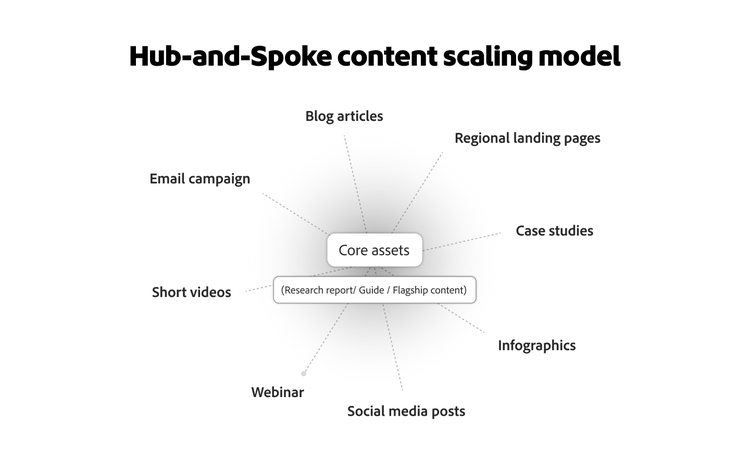
A common concern in content scaling is that increased volume may dilute quality. Enterprises address this risk through a hub-and-spoke content model. In this model, authoritative “core assets”, such as research reports, comprehensive guides, or flagship thought leadership pieces, serve as foundational sources of insight. From these core assets, teams derive shorter formats such as blog posts, social media snippets, newsletters, and regional adaptations.
AI-assisted workflows can accelerate this derivative content creation by generating on-brand variations from core assets, while Experience Manager manages the relationships between source material and derivative formats. Workfront ensures that each derivative asset follows the appropriate review and approval pathway. This approach ensures consistency across channels while enabling efficient reuse of high-quality material. Many successful digital marketing campaign examples follow this model, allowing organizations to extend the impact of a single strategic asset across multiple platforms.
Supporting GEO as a workflow outcome, not a separate effort.
Generative Engine Optimization (GEO) is the process of optimizing content for discovery within AI-generated answers. However, it should not be treated as a standalone tactic. GEO emerges naturally when workflows emphasize structured content, semantic clarity, and consistent governance. When content is created through well-designed content workflow management systems, with Experience Manager providing structured content, Workfront enforcing process discipline, and GenStudio for Performance Marketing enabling intelligent variation, it becomes easier for generative AI models to interpret and cite accurately.
By focusing on operational unity rather than isolated optimization tactics, enterprises ensure that their content performs effectively across both traditional search and emerging AI-driven discovery environments.
Rolling out enterprise content management workflows.
Scaling workflows is not only a design challenge — it is an organizational transformation. Successful enterprises treat workflow implementation as a coordinated program that aligns stakeholders, enables teams, and establishes measurement from the beginning. Without disciplined rollout strategies, even well-designed workflows fail to achieve meaningful impact.
Aligning stakeholders around a shared content operating model.
Content workflows span multiple organizational functions: marketing, creative teams, IT, legal, and executive leadership. Misalignment between these groups often leads to duplicated work, delayed approvals, inconsistent messaging, and governance gaps. Early alignment around a shared operating model helps organizations avoid these pitfalls.
Workfront plays a central role in stakeholder alignment by providing a single platform where all contributors can see project status, responsibilities, and timelines. When stakeholders understand how workflows support both strategic and operational goals, adoption becomes significantly easier. Executive sponsorship also plays a critical role. Leadership support ensures that workflow changes receive the necessary resources and organizational visibility. Without this backing, teams may revert to familiar but inefficient processes.