In part one of this series, I detailed how there’s a new front door to every B2B brand. Buyers don’t start on your homepage anymore. They start in a chat window. They prompt instead of clicking. When they do finally show up at your site, they come informed, with a short list in mind and often with a preference already identified.
In the same post, I outlined how the new ABM is now agent-based marketing, and how every account's buying group is now hybrid - humans and the agents they rely on working with to research and inform decisions. For any brand looking to effectively address these new hybrid buying groups, Brand Visibility must become a top priority. Today, I want to dive deeper into this shift. The moment a buyer or their agent arrives at the answer that decides whether you make the shortlist, your content strategy is potentially the first thing that breaks. And not in an “optimize harder” kind of way, but in a “the model that worked for 20+ years, no longer applies” way.
LLMs are not the new Google.
Treating generative engine optimization (GEO), answer engine optimization (AEO), or AI search as simply the new SEO is the most expensive misconception I see in B2B right now. Most marketing leaders I speak to are sharing that, somewhere on their roadmap, is a new line item called "GEO” or "AI Search". This new item is most often attached to the SEO function, is barely resourced, and is treated as a channel that "needs attention as soon as we can get to it”.
While this framing is common, it is still incorrect. Optimizing for agents and LLMs is not channel optimization — it's content strategy transformation. Here's why the distinction matters.
SEO indexes pages. An LLM synthesizes positions. The unit of output isn't a ranked list of links — it's an answer, paraphrased and delivered with conviction, drawn from a constellation of sources the model decided to trust. Some of those sources are yours. Most of them aren't.
And no two LLMs operate the same way. Gemini leans heavily on classic SEO signals. ChatGPT weighs community sources like Reddit and editorial coverage differently. Perplexity surfaces citations explicitly and prizes provenance. Copilot pulls from the buyer's own enterprise context (emails, documents, internal wikis), meaning your content must survive synthesis alongside a buyer's own institutional knowledge. Clearly, optimizing for any one of these LLMs is not the same as optimizing for all of them. They are not a channel — they are a set of audiences, each with their own preferences, essentially another kind of buying group. As B2B marketers, we've been here before. We know our way around an audience — we just used to call them things like CMO or CIO.
B2B is a different animal. The buyer's behavior isn't.
There is a temptation right now to read and absorb everything being written about GEO, AEO, AI search, and assume it applies equally to B2C and B2B. However, most of what you’ll find in the market right now is shared for retail, travel, and consumer commerce. B2B is a different animal altogether, and it demands urgent attention.
Three things make B2B different:
- The buying group, not just the buyer. A B2B decision typically involves five to ten humans, and in our case, 12-15 key decision makers (senior director+ titles) make up the buying group. Now, increasingly, the agents that each human decision maker relies on are a new addition to the buying group. The CMO’s LLM weighs innovation and growth capabilities. The CIO may prize case studies on architecture and security documentation. The CFO’s LLM may weigh analyst content. The new ABM requires a content strategy that caters to every member of the buying group and their chosen agent.
- Extended sales cycles, short influence windows. In enterprise purchasing cycles, it’s not unusual for decisions to take 9-15 months. The decision shape begins to take shape in the first prompt. By the time an RFP is opened, the shortlist is largely locked. Forrester puts the front-runner in that shortlist advantage at 80%. Tim Sanders, Chief Innovation Officer at G2, doesn't mince words with this declaration: "If you're not in the LLM’s top five, you're not in the conversation.”
- Different trust signals. Peer validation, customer reviews, analyst recognition, and expert commentary carry far more weight in B2B than in consumer categories. LLMs know this and cite accordingly. Your web copy matters less than what Gartner, Forrester, G2 reviewers, and Reddit threads say about you. Forrester's research shows that buyers trust analysts and peer reviews more than vendor content at every stage of the buying journey.
As a B2B marketer, this is the part that keeps me up at night: the same buyer using ChatGPT to plan a vacation is using ChatGPT to shortlist your category. In this world, the buying behavior of the consumer and each individual in the buying group is bleeding together more than ever before. They expect the same conversational fluency, the same instant comparison, the same ability to ask a follow-up question, and get a personalized answer. It is no longer safe to assume that buyers behave differently at work or use different publications or channels for work. Conversational UIs flatten that distinction. Channel-based segmentation or targeting is no longer sufficient. Mindset and an evolved definition of “intent” will be.
Your content has two audiences — stop producing for one.
Every piece of content our teams publish has two audiences: the human and the agent. These two audiences are both digesting the same content but want and need fundamentally different things. Human readers want the relevant narrative, the emotional hook, the visual design, and a reason to trust. The agent wants structured information, proof points from third parties, relevant metadata, and competitive context.
Most B2B content teams are producing for the first and hoping the second figures it out. But we all know hope is not a strategy.
So, let's stop hoping and let's start accepting that the answer isn't "more content." It is different content tuned for different audiences — and sometimes those audiences are agents. The new ABM requires a content strategy that addresses this.
The other thing to consider is that when LLMs summarize your content, they don’t care about your design or your layout. What LLMs prioritize in the summaries is your position, the clarity of your offering, and what others are saying about you. That is the new take on brand. I’ll go deeper into this in Part 4 of this series.
This is a critical realization and required adjustment for all of us marketing leaders responsible for content strategy - this is no longer a publishing exercise but a fundamental shift around how we redesign the web architecture to reach both audiences. The content model that got us here — produce more, personalize more, publish faster — is not the content model that gets us to the new ABM. The new model accounts for both humans and agents and the content preferences and requirements of each.
The brand voice question here also matters, and it’s one that should make any marketer pause: when an LLM paraphrases your content, what survives the summarization? If your differentiation lives in the phrasing, the metaphor, the campaign tagline, the carefully curated words or verbs, most of it disappears in the paraphrase. What survives is the structure, claims, named outcomes, and verifiable proof. That has to live in your content explicitly, not implicitly – and the value you’re providing to customers will be told by them, not you.
If you're wondering what should inform your new ABM content strategy, take a moment to ask yourself these questions:
- What are agents actually saying about your brand, and where are they getting it?
- Are your third-party signals — reviews, analyst content, community presence — as strong as your owned content?
- Can your content survive being paraphrased, synthesized, and compared in the same answer as your competitors?
- Are you measuring any of this today?
The proliferation problem isn’t more content — it’s different content.
This is where most marketing leaders I’m speaking with get the prescription wrong — “We need to publish more, faster, more personalized.” That’s our SEO instinct, and it’s only half of the answer. Yes, we will need more as digital surfaces and channels increase. But producing more for the sake of being “more personalized” isn’t the answer anymore. We must stop and ask ourselves, “More personalized for whom?”
LLMs cite from the entire ecosystem of conversation about your category, including Reddit threads, G2 reviews, customer stories, customer videos, podcasts, expert commentary, peer community posts, analyst notes, customer and peer reviews, and structured product feeds. These are now the surfaces that decide whether you make the shortlist, and most B2B marketing organizations have no operating model for them. They are influenced, not produced. They sit outside the content calendar and beyond single or functional content creators. This content does not always fit within a creative brief, either.
The shift is from a content calendar (predictable, owned, and scheduled) to a content ecosystem (distributed, often earned, and structured for synthesis). Different surfaces, different authors, and different forms of influence. To address this, we need a fundamentally different content operating model and budget mix, and it’s one part of the transition that I think B2B leaders are underestimating the most.
Adobe on Adobe – what we’re learning as B2B customer zero.
My team isn't writing about this from the outside. We're running the experiments directly and learning along the way. At Adobe, we’ve seen this challenge firsthand, in real time. We saw that our high-performing SEO channel actually masked a significant AI visibility gap. Content that ranked well on Google was invisible to ChatGPT, Perplexity, and Google AI Mode. The human and agent conversations that now drive a significant amount of the buying funnel were happening without Adobe.
As customer zero for our Adobe B2B products, we use Adobe Brand Visibility solutions to improve our enterprise brand presence, discoverability, and visibility. We mapped 180 enterprise pain points, 6 Adobe solutions, and 1,600 customer prompts (the actual questions buyers ask LLMs at every stage of the funnel). We loaded these prompts into Adobe Brand Visibility with a custom taxonomy aligned to personas, journey stages, and campaigns. The resulting visibility map showed us exactly where we were absent and where competitors were winning.
Two immediate opportunities emerged.
First, our website: a significant portion of our web estate was JavaScript-rendered, meaning LLM crawlers couldn’t fully read our pages. AI readability on business.adobe.com was at 32%. To address this, we deployed edge rendering to serve content directly to LLM crawlers without impacting human experience.
Second, our citation footprint: LLMs don’t construct answers from owned websites alone. They heavily weigh third-party validation. To address this one, we redesigned our content strategy for AI visibility. We had to target LinkedIn, YouTube, and review platforms as much as our own dot coms. We were fortunate in that last year, we had already begun to invest in improving and increasing peer and customer reviews.
Results, in just weeks:
- +45% improvement in AI readability — business.adobe.com went from 32% to 100% readable by LLM crawlers after deploying edge rendering.
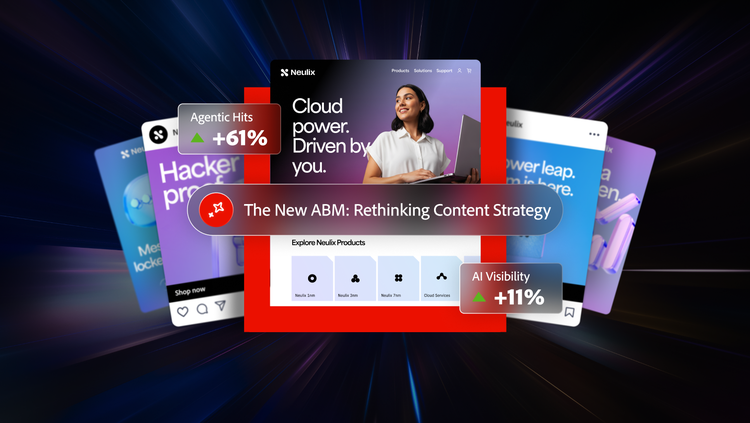
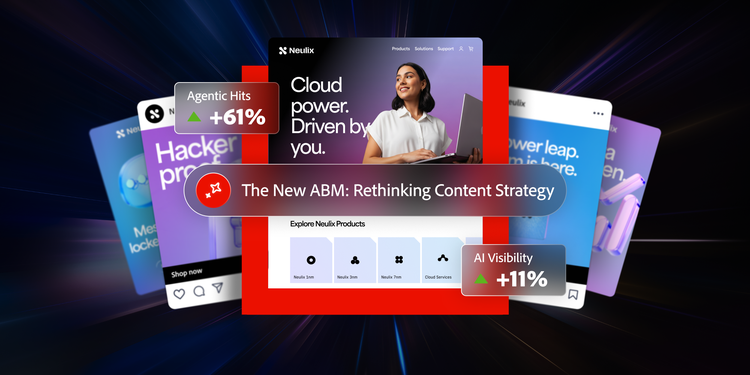
- +61% increase in agentic hits — after rewriting an Acrobat product page using buyer-language prompts instead of product-centric descriptions.
- +57% visibility lift on YouTube — from updating a single video description with prompt-aligned language, earning a new Google AI Mode citation.
- 63 content assets in 14 days — produced by a dedicated GEO content pod, averaging 20 assets per week, with SLAs measured in days, not weeks.
- +11% overall AI visibility increase — with prompt-aligned content structured around buyer questions consistently outperforming content structured around product features.
Ashley Penn, Sr. Director of Global Enterprise Digital COE at Adobe, has been treating business.adobe.com and our enterprise categories as the proving ground for everything we ship in this space. She quotes, "What surprised us most wasn't how much our LLM visibility improved when we got the structure right. It was how much of our visibility was being decided in places that weren't our website at all — community threads, third-party reviews, expert commentary, and social posts. We had to stop thinking of Adobe.com as the destination and start thinking of it as one node in a much larger content ecosystem we needed to influence."
That insight is exactly why I was so glad to see Semrush join Adobe last month. Andrew Warden, who has been leading marketing at Semrush, summed up the combination in a way that stuck with me:
"Traditional and AI search are inextricably linked. In order to be discovered in LLMs and AI Search, you need to send strong technical SEO signals to LLMs and traditional search engines. The brands that will win in agentic search are those who do not see SEO and GEO as two distinct workflows but as a critical, united path to brand visibility." — Andrew Warden, CMO, Semrush
That’s the bet. Brand visibility now has to span SEO, GEO, third-party signal, and structured product data — and it has to do it as one connected practice, because that’s how buyers experience it.
What’s next.
If you do nothing else this month, start with this:
- Audit what LLMs are saying about your brand right now. Most B2B leaders haven’t looked at it. Start there.
- Map your category’s third-party surfaces. Reddit threads, G2, YouTube, podcasts, peer communities. Where do citations come from? Who’s shaping the answer about your space?
- Treat your content team as a content ecosystem team. Different surfaces. Different authors. Different forms of influence. The content calendar is not enough.
Content strategy is the first thing agent-based marketing breaks — and the first thing it rewrites. Next, is the signal we are seeing from our audiences (both humans and agents) and how this turns the customer journey on its head. If your content has two audiences, your data has two definitions. That’s where I’m going next — prompts, not clicks, and what happens to signal, intent, and the customer journey when the most influential moments are happening in conversations you can’t see.
In Part 3 of this new ABM blog series, I’ll go deeper into the new concept of the journey stages and how some of the most important signals (agent conversations, prompts, etc.) live on surfaces we can’t see.
This is Part 2 of a 5-part series on agent-based marketing:
Part 1 — The new ABM: Why the most important acronym in B2B marketing just got rewritten.
Part 2 — The new ABM: Why content strategy needs a ground-up rethink, not an SEO upgrade. (you are here)
Part 3 — Prompts, not clicks: Rethinking signal, intent, and the customer journey.
Part 4 — The great equalizer? Why brand matters more in an agentic world.
Part 5 — Building the agentic marketing org: Operating model, mindset, and the work ahead.
Marissa Dacay is Global Vice President of Enterprise Marketing at Adobe, a leader who turns big ambition into measurable impact.
Marissa leads global enterprise field marketing and campaign execution with a distinctive blend of creative instinct, data-driven discipline, and fearless innovation. She's relentlessly focused on what works – and why. Her approach fuses data intelligence with bold storytelling, driving enterprise marketing strategies that consistently outperform. She leads with both edge and empathy, challenging her teams to think bigger, execute smarter, and raise the bar every time. Marissa isn't just driving results; she's cultivating the next generation of bold marketing leaders along the way.