Product owner
Oversees day-to-day operations, helping you take full advantage of all the features.



Whether you’re in a B2B or B2C space, a CDP helps you build, activate, and maintain unified customer and account profiles — and getting implementation right is crucial.
Learn how to choose the right CDP implementation partner, define a phased plan, align internal and external teams, set the right goals and KPIs, and build a center of excellence to speed time to value with Adobe Real-Time CDP.
Whether your business operates in a B2B or B2C market, a customer data platform (CDP) is a powerful tool for building, activating, and maintaining customer and account profiles. Investing in a CDP can drive long-term success by providing multiple ways to manage your customer data.
But getting implementation right is the first step. A successful CDP implementation:
This implementation guide provides an overview of how to accomplish these three goals with your Adobe Real-Time Customer Data Platform implementation. It covers what implementation looks like, who is involved, and the major phases. You’ll discover how you can shorten time to value (TTV) and help ensure the long-term success of your CDP investment.
Some CDP vendors claim to offer plug-and-play products but implementing an enterprise CDP isn’t an overnight process. It takes careful planning and a well-thought-out, phased implementation roadmap. But you don’t have to do it yourself. Adobe Real-Time CDP implementation starts with selecting an experienced partner to guide you through the process.
Adobe Professional Services is your end-to-end partner — from consultation to implementation and deployment. With thousands of successful implementations done across Adobe solutions and all industries, Adobe Professional Services has the expertise to guide you through your complete Adobe Real-Time CDP implementation process.
Adobe also offers a robust network of specialized partners who have earned a stamp of approval for proven technical expertise, implementation proficiency, and customer success. Choose from more than 150 certified partners globally that provide services and offerings across various fields, experiences, and locations.









With partner support in place, the next step is assembling the right team within your organization. The internal and external teams that deploy Adobe Real-Time CDP must have a deep understanding of the customer data you want to capture in a unified customer profile, where and how that data is stored, and the privacy rules and regulations that apply to it.
Here’s a look at some of the most important roles and responsibilities:
Product owner
Oversees day-to-day operations, helping you take full advantage of all the features.

Project manager
Manages large-scale implementation work for Adobe solutions — like documenting technical and business requirements and driving initiatives.

Data steward
Makes sure all activities comply with company and industry privacy regulations for personally identifiable information (PII).

IT and data engineering leaders
Apply Adobe’s standard data model to all data sources and build custom integrations between applications as needed.

Marketers
Handle data-sharing agreements with partners and manage channels where your customers interact.

Business representatives relevant to CDP
Identify data from call centers, customer relationship management platforms, and other systems to include in customer profiles.

Legal and privacy experts
Advise on how you may and may not use customer data in various contexts and geographies.
Identifying what you want to accomplish from the beginning of the implementation is essential to building your initial value requirements and assessing your ultimate success. Establishing goals and measuring success continually occur throughout each phase of the implementation process.
Here are some sample objectives, goals, and KPIs to jump start your conversations:
Sample objectives

Sample KPIs driven by Adobe Real-Time CDP
Sample marketing KPIs mapped to Adobe Real-Time CDP KPIs
A phased implementation takes place in stages defined by milestones over time. Approaches may differ across business lines and audiences (B2B or B2C), but the implementation follows a clear sequence of events.
The initial implementation phase lays the groundwork, emphasizing planning for both technical and business workstreams — while establishing short-term and long-term use cases for Adobe Real-Time CDP. Project kickoffs give your team the flexibility to define program goals and KPIs to guide the implementation. This phase can be used as a discovery period, allowing the team to manage the required resources and steps necessary for the program’s success.
The second phase involves two parallel workstreams that can be deployed simultaneously. The implementation workstream — centered on technology — focuses on mapping data, creating audiences, and testing performance. The readiness workstream — centered on the business — drives adoption and helps ensure long-term value.
Here’s a closer look at how these phases build on each other:
1. Kickoff
2. Define objectives
Phase 2
Workstreams take place simultaneously
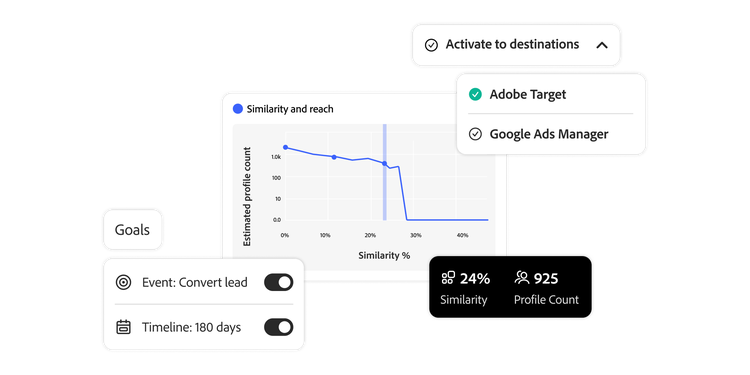
What CoEs do
At the highest level, an audience CoE for data management enables organizations to fully take advantage of their data platform investment. The audience CoE governs platform usage, develops an organizational roadmap, tracks progress, measures results, and communicates effectively throughout the organization.
To get the most out of your Adobe Real-Time CDP implementation, remember these three takeaways:
Contact Adobe Professional Services to get more information on partnering with us for a smooth Adobe Real-Time CDP implementation.
Learn more about how Adobe Real-Time CDP can help you build, maintain, and activate real-time profiles for customers and accounts — with built-in privacy.
Adobe Real-Time CDP collects, normalizes, and unifies known and unknown individual and company data into robust customer and account profiles that automatically update in real time. Marketers use these profiles to deliver timely, relevant, and personalized experiences to any channel at scale. And with best-in-class usage governance, brands can use data more responsibly and transparently — so consumers have greater control over their information.