
#FAFAFA

Guide

Best practices to engage and convert customers.

Discover how Adobe executes experience-led strategies to turn prospects into loyal customers — along with actionable insights to optimize growth.

Check out this comprehensive guide and explore how Adobe utilizes its own tools and proven methods to build seamless, effective customer acquisition campaigns. Equip your team with strategies to:

Marketo Configurator Friday, April 25, 2025 at 15:21
Title
Description
Please share your contact information to download the guide.
Success Type
section
Success Section
form success
Success Content
Thank you. Your guide is ready below.

How Adobe built an experience-led customer acquisition model.

#F8F8F8

Creating exceptional experiences to acquire customers more effectively.

At Adobe, we pivoted our focus toward enablement, ease, and experience. Scaled marketing efforts, centralized data frameworks, and improved AI integrations across touchpoints. These were the pillars of our new vision. Explore our journey of building a customer-first acquisition strategy.

Foreword

Acquiring customers and building long-lasting relationships depends on your ability to deliver immediate, personalized experiences. That’s becoming more challenging as customers interact with brands in-person and online, across a growing number of channels and devices. Wherever and whenever customers show up, marketers and creative teams must be prepared to create unique moments and deliver specialized content that turn curious prospects into lifelong customers. In this guide you’ll read about:

  • The challenges marketers face while driving growth.
  • How Adobe uses its own applications to power an experience-led customer acquisition strategy.
  • Best practices for adopting the technology and strategies needed to increase customer acquisition in your own company.

The customer acquisition solutions from Adobe are powerful, AI-driven applications that can help marketers plan, reach, measure, and optimize campaigns for every customer no matter where they are now or where they go next.

The modern marketer’s role in customer acquisition.

Marketers are the stewards of customer acquisition — they nurture leads, create journeys, and measure engagement, investment, and performance. They must be ready to meet each customer at every touchpoint with content that speaks to who they are and what they need, to steer the journey toward the desired outcomes — conversion and loyalty.
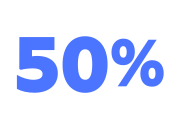
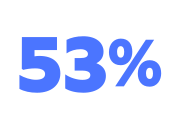
https://main--da-bacom--adobecom.aem.page/assets/icons/resources/guides/how-adobe-built-an-experience-led-customer-acquisition-model/53-number.svg | 53%
of travel and hospitality companies valued at $1B+ say restructuring customer acquisition strategies is critical to driving growth.
Source: Publicis
With the proliferation of channels and devices, the media environment is changing dramatically. Companies need to deliver personalized experiences at scale — a difficult task to execute with traditional marketing tools and unstable budgets, which have dropped from 9.3% of a company’s revenue to 7.9% in just the past year.
Source: Gartner
Marketers look to increase customer lifetime value (CLV) — a metric that represents the success of acquisition strategies by determining how long each customer stays loyal to their brand. But customer behavior is complex and ever evolving. Social channels that dominated the advertising space are making room for the rise of digital and streaming media, like connected television (CTV). According to the Adobe 2025 AI and Digital Trends report, 78% of customers expect seamless interactions at every digital and physical interaction, but only 45% of brands meet this demand. Marketers need to shift gears to an experience-led acquisition strategy, which can more than double their CLV.

The challenges modern marketers face with customer acquisition.

In addition to the complexity of customer behaviors, here are some other obstacles marketers face when building their customer base:

https://main--da-bacom--adobecom.aem.page/assets/icons/resources/guides/how-adobe-built-an-experience-led-customer-acquisition-model/3-1.svg | 3:1

The minimum optimal ratio of customer lifetime value (CLV) to customer acquisition costs (CAC) is 3:1 — the value a customer delivers over time is at least three times the cost to acquire them.

https://main--da-bacom--adobecom.aem.page/assets/icons/resources/guides/how-adobe-built-an-experience-led-customer-acquisition-model/inability-to-correlate-marketing-strategy-with-business-growth.svg

Inability to correlate marketing strategy with business growth.

With a growing number of channels, which are often managed independently, companies typically find it challenging to demonstrate the holistic value and impact that marketing has on driving customer acquisition and increasing business revenue.

https://main--da-bacom--adobecom.aem.page/assets/icons/resources/guides/how-adobe-built-an-experience-led-customer-acquisition-model/low-visibility-of-content-impact-and-performance.svg

Low visibility of content impact and performance.

Across the board, marketers face difficulty while testing their content to understand what element or attribute is performing well and what needs to be adjusted to drive conversion.

https://main--da-bacom--adobecom.aem.page/assets/icons/resources/guides/how-adobe-built-an-experience-led-customer-acquisition-model/disconnected-tools-and-technology.svg

Disconnected tools and technology.

Marketers piece multiple applications together to build a customer acquisition solution. Data and assets are stored across disparate systems, making it difficult to adapt experiences and keep pace with customers’ movements. Without a central ad server, companies lack the ability to evaluate media opportunities relative to one another in order to place ads on the best channels.

https://main--da-bacom--adobecom.aem.page/assets/icons/resources/guides/how-adobe-built-an-experience-led-customer-acquisition-model/anonymous-data.svg

Anonymous data.

Most of the data collected from marketers’ websites and apps remains anonymous. This limits their ability to create cohesive, personalized journeys that guide customers down the funnel across the media mix.

https://main--da-bacom--adobecom.aem.page/assets/icons/resources/guides/how-adobe-built-an-experience-led-customer-acquisition-model/third-party-cookie-loss.svg

Third-party cookie loss.

As data privacy regulations and standards continue to evolve, third-party cookies are a less reliable source of leads. This clouds a marketer’s vision to know where they’ll get the most value for their spend.

Adobe begins a journey to experience-led customer acquisition.

Adobe has built a solid foundation of customers — both B2C and B2B — many of whom have been with us since we first started. But acquiring customers today is not as straightforward as it once was. We’ve grown our business and increased our product lines as customer journeys have expanded to new channels and devices. To reimagine our customer acquisition strategy, we first had to understand where we were falling short.
Source: McKinsey

About Adobeʼs internal marketing organization.

The internal marketing organization at Adobe is made up of multiple teams, such as our global marketing organization, growth marketing and insights, and digital media marketing. These world-class teams are made up of marketers, analysts, data scientists, and other experts who collectively work to drive growth for all Adobe applications, platforms, and cloud solutions — Adobe Document Cloud, Adobe Creative Cloud, and Adobe Experience Cloud — across industries. They have a shared mission of creating business impact with powerful campaigns that build our brand loyalty. Many of these teams, along with external agency partners, have been a part of driving this new customer acquisition model for Adobe.

The customer acquisition challenges Adobe faced.

Our primary hurdle was that we were operating with a cost-focused customer acquisition model — more concentrated on the price tag of creating experiences rather than the needs of the people we were creating them for. Across our enterprise, there were inconsistencies in our approach to how and where we invested our marketing budgets and executed our campaigns. Other specific challenges we faced included:

  • Isolated teams. Our display, paid search and social, and email marketing teams operated as independent entities, with different execution strategies and cost-reporting processes. This fragmented approach made it difficult to get a big-picture view of our marketing efforts, demonstrate our contribution to the business, and identify opportunities for scalable growth.
  • Siloed media agency strategy. Our global media agency partners help plan, execute, and measure our ad strategies. Different Adobe teams contracted with numerous agencies without a cohesive standard operating procedure for vendor management.
  • Proliferation of channels. The evolving media environment increased pressure on our marketing teams to plan, reach, measure, and optimize campaigns across a greater number of destinations. The restrictive nature of our multi-touch attribution impacted our ability to diversify our media mix.
  • Data collection and measurement obstacles. We had difficulty capturing, integrating, and measuring data that could deliver the actionable insights needed to improve our customer acquisition methods. This was often a result of our siloed approach to channel management, media execution, and efficiency initiatives like SEO optimization.
    • Our team had a hard time unifying measurements across fragmented media, making it difficult to adapt to trends, competitor activities, and other changing conditions.
    • With disconnected insights and different analysis tactics between teams, customer journeys were not measured consistently. Even in well-established channels like display ads, the team struggled to monitor and improve campaign performance.
    • Without the right tools to gather real-time, granular insights across channels, the team had to focus on more traditional channels that were easier to measure, thereby limiting our ability to connect with newer, high-potential platforms where we could acquire customers.
  • Poor visibility of marketing ROI. With marketing channels each having their own strategies and independent financial reporting methods, it was difficult to tie each marketing channel to overall revenue and growth.
  • Increasing privacy regulations. Marketing teams rely on data to build strong customer relationships. But increasing and evolving global privacy legislations have made legacy targeting and measurement strategies more challenging. Signal loss and the deprecation and fluctuation of third-party cookies made it even harder to gather accurate data. These factors impacted our ability to garner a sophisticated understanding of the limited channels we had in the market.
  • Rising costs. Digital advertising rates, measured in cost per mille (CPM), were rising. Simultaneously, conversion and click-through rates were falling.
Source: McKinsey
Adobe is built on innovation, regularly putting products out in the world that disrupt the status quo and enhance efficiency for people and businesses. But we needed to apply this innovative mindset to our customer acquisition efforts, shifting our focus from cost to creating exceptional experiences, and to do that consistently across the organization.

Establishing goals to guide our way to an experience-led model.

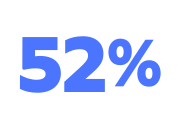
https://main--da-bacom--adobecom.aem.page/assets/icons/resources/guides/how-adobe-built-an-experience-led-customer-acquisition-model/52.svg | 52%
Just 52% of marketing executives can prove marketing’s value and its impact on business outcomes to their organizations.
Source: Gartner

Marketing's mission is to generate revenue by attracting new prospects and strengthening loyalty with current customers. But 47% of chief marketing officers view marketing as a cost center rather than a profit generator.

In the face of these challenges, the internal marketing organization felt called to action — to drive growth through an effective cycle of planning, activation, measurement, and optimization. They wanted to:

  • Create greater marketing process alignment across the global organization.
  • Plan advertising and marketing campaigns effectively across channels using data-driven budget and audience strategies.
  • Expand reach and discover relevant audiences to target and convert the right prospects with impactful customer experiences.
  • Access holistic measurements across our full marketing wallet in a single system.
  • Make real-time, in-flight improvements across all channels and tactics to achieve every conversion goal.
  • Speed up the time from insight to action, maximizing ROI and revenue impact throughout campaign life cycles.

To reach these goals, we needed to create stronger alignment through a new operating model and make data the north star of our customer acquisition strategy.

Realigning our organization with a new operating model.

Adobe has experienced steady growth over the years, and the pandemic accelerated sales of technology solutions and services that supported dispersed workforces, like our cloud-based platforms. In Q2 of 2020, sales were up 14% from Q2 of 2019. Our teams quickly mobilized to meet the surge in demand and invested more in our marketing efforts in a short period of time. This rapid increase in our global campaigns illuminated the weaknesses of our fragmented operation.

Having 22 separate media-buying teams with their own strategies and different agency partnerships led to a lack of global coordination. This approach reduced our leverage of total media spend by spreading our budget across different teams and agency partners.

Our goal was to streamline investments and maximize our global marketing spend to acquire customers in a more efficient and cost-effective way. This new operating model had three critical components:

https://main--da-bacom--adobecom.aem.page/assets/icons/resources/guides/how-adobe-built-an-experience-led-customer-acquisition-model/regionally-focused-teams.svg

Regionally focused teams.

Instead of our US team driving campaigns for other parts of the world, we created regional media teams — AMER, EMEA, and JAPAC. These teams were empowered with the autonomy to create and manage full-funnel media strategies (across discovery, acquisition, engagement, and retention) for our products, in order to drive business growth. They worked on shared data and applications, as well as a centralized framework to keep them all aligned to Adobe media messaging.

https://main--da-bacom--adobecom.aem.page/assets/icons/resources/guides/how-adobe-built-an-experience-led-customer-acquisition-model/global-media-center-of-excellence.svg

Global media center of excellence (COE).

We organized a team of internal stakeholders to ensure consistency across the global organization. The COE aligned regional teams on approaches and dashboards for campaign performance measurement. It also had a dedicated team in each region to oversee global governance with consistent documentation, playbooks, and training for onboarding agency partners.

https://main--da-bacom--adobecom.aem.page/assets/icons/resources/guides/how-adobe-built-an-experience-led-customer-acquisition-model/interagency-team.svg

Interagency team (IAT).

We created the IAT to be an intermediary between the COE and internal engineering and ad-tech groups to support our regional teams with their operational needs.

In addition to building a new operating model, our CEO called for a centralized, data-driven view of the business. The Adobe marketing operations and engineering team drove this initiative by organizing our scattered data infrastructure into a data-driven operating model (DDOM). The connected data across Adobe Experience Platform applications gave us a holistic view of our customer acquisition efforts and we gained a deeper understanding of how to support a global customer acquisition strategy.

Throughout the process, executive leaders championed this transformation to the rest of the organization. We took an iterative approach, aligning our technology to this new model and centralizing all data in Experience Platform to cohesively interpret our performance and realize our business KPIs. With a new model and data foundation in place, we were ready to build a world-class customer acquisition engine.

A diagram showing how all customer transactions and interactions on online applications flow through Adobe Experience Platform.

Developing a world-class customer experience strategy with data.

The DDOM organically placed the customer at the center of the strategy and set the stage for our transformation from a cost-based acquisition model to a customer experience optimization model.

We focused on the core areas that would support this more productive acquisition strategy — planning, reach, measurement, and optimization.

Planning the pillars of the DDOM:

  • A single source of truth for metrics across Adobe.
  • KPIs that are aligned with each stage of the customer journey.
  • An executive leadership team that takes ownership of change and drives the action.

Planning

While strategic planning involves the development of marketing tactics that align with enterprise vision and goals, there are planning motions that are more specific in their scope. For example, we have a planning motion that informs the investment level needed to reach our quarterly targets, and another that optimizes quarterly flighting and tactics within specific channels. Overall, we needed to be more forward-thinking in our approach toward customer acquisition in the planning phase. This meant efficiently and strategically planning channel spend and audience segments for campaign launches. We took steps to:

  • Plan our budget using marginal return on next dollar spend (mROI) and cost per acquisition (CPA) data to maximize return savings.
  • Set up strategic audience activation, identify lapsed or dormant users, and use lookalike audiences and partner data to target high-value prospects.
  • Inform strategy with audience insights like interests, demographics, and purchase behavior, from owned data as well as trusted partners such as other brands and publishers.

Reach

We needed to strengthen the discovery and conversion of prospects, improve engagement at the top of the funnel, and maximize our media strategy. We also looked to:

  • Safely leverage, manage, and activate second- and third-party datasets for prospecting.
  • Enrich first-party data with more attributes for better targeting.
  • Enable privacy-centric data collaboration with trusted partners.
  • Personalize experiences for first-time website visitors by verifying their identities and creating individual profiles.

Measurement

Disconnected metrics prevented us from understanding the interplay between customer experiences — especially how offline and digital interactions influenced one another. We wanted to access granular measurements and insights across our full share of marketing spend. Our goals were to:

  • Allow a two-way flow of data to continually engage customers.
  • Explore channel data incrementally with breakdowns by campaign, creative, and cohort.
  • Measure cross-channel impact of marketing and advertising on audiences across both online and offline touchpoints.
  • Measure growth across channels using an attribution model to see how paid media campaigns impact engagement, retention, and loyalty.

Optimization

We needed the ability to improve our campaigns as they actively engaged customers across channels. This required us to:

  • Review real customer journeys and understand which elements of our campaign had the most impact on conversion.
  • Make adjustments tied to incremental revenue across channels to increase the bottom line.
  • Move more easily from insight to action, to create customized and optimal experiences for customers.

Our approach to building a world-class customer acquisition engine.

Across our enterprise, different marketing teams identified specific customer acquisition areas they were looking to improve. With a new, unified operating model, a lineup of natively integrated products within Experience Platform, and the DDOM creating a solid data foundation — each team could target their own pain points and strengthen their planning, reach, measurement, and optimization strategies.
A diagram showcasing the applications and technology Adobe Experience Platform uses to plan, reach more customers, measure results, and optimize its customer acquisition strategy.

Planning — using mix modeling across paid, earned, and owned channels.

The diversification of marketing channels allowed us to meet our customers in more places with targeted ads, creating more opportunities to forge relationships and drive growth. But knowing exactly where to go had been one of our top challenges. Without real-time, granular data, we couldn’t properly plan our strategy and invest in the places that would deliver the best returns.

The marketing planning and analytics team signaled where we should invest across paid, earned, and owned channels. But our finance team needed deeper, data-backed insights to follow these recommendations. To provide this, marketing planning and analytics built an application to unify measurements across a fragmented media landscape while also demonstrating marketingʼs direct contribution to the business. This was the how Adobe Mix Modeler came to life.

By creating an AI custom model and defining conversion goals, the team provided granular insights into the optimal media mix to better plan our strategy. It also helped teams to:

  • Analyze past actions to arrive at accurate predictions about behavior.
  • Estimate the total expected opportunities, closings, and subscriptions.
  • Include external variables, such as economic or industry-related factors.
  • Incorporate data from media, events, PR, and pricing actions.
  • Combine multi-touch attribution with marketing mix modeling to understand both summary-level data and touchpoint insights.
The finance team can then use all this data to project a variety of scenarios to manage investments across a growing number of channels, guiding us to the best place to invest our advertising dollars and the level of investment needed to reach revenue targets. With AI behind this planning, the proliferation of channels transforms from being a challenge to becoming an opportunity.

How we increased planning accuracy with mix modeling.

We knew our mix modeling application needed both a planning and measurement component to generate accurate predictions. By using an advanced econometric model to identify trends and patterns in data, we can analyze the relationship between multiple variables. This allows for informed decision-making on the best course of action and spending.

The importance of experimentation in customer acquisition modeling.

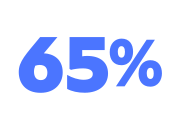
https://main--da-bacom--adobecom.aem.page/assets/icons/resources/guides/how-adobe-built-an-experience-led-customer-acquisition-model/65.svg | 65%
of marketing and tech executives plan to invest in AI and predictive analytics to drive growth.
Source: Adobe
With AI and machine learning, we could rapidly iterate, experiment, and evaluate combinations of creative elements, audiences, and linked and owned experiences. The resulting model helped us determine the best strategy and spend to reach customer acquisition goals. If the team could create multiple models and discover differences between them, they could experiment by running tests to help validate the results and see the gaps. Two of the most effective tests are matched market tests, which show how various parts of our media mix perform in specific geographic areas, and A/B tests, which identify the iteration that resonates the most.

Reach — finding and converting prospects.

With more channels, the restriction and loss of third-party cookies on many platforms, and heavier privacy regulations, our traditional engagement methods didn’t have the same reach they once did. With a new approach and connected data, we ensured continued reach to the right audiences and grew our customer base. We were able to:

  • Build partnerships and overlap data with trusted data partners, publishers, and brands using data clean rooms to find and activate audiences while still adhering to privacy regulations. These partnerships opened new channels — such as CTV, commerce media, new social and short form video, and digital audio — so we could reach known and pseudonymous audiences across new channels. We knew who to reach, where to reach them, and how to deliver meaningful content that provides the information they need to make a purchase decision.
  • Create lookalike audiences to find high-value audiences through prospecting campaigns.
  • Use our own real-time customer data to execute personalized, owned media campaigns to strengthen loyalty with our customers.

Teams across Adobe could expand their reach despite evolving customer behaviors and channel diversification. Here are some examples:

  • The digital media performance marketing team advertises across channels and platforms to drive subscriptions to either a Creative Cloud or Document Cloud application. Working with models created by marketers, they could make more precise investment decisions between channels and partners, and leverage Adobe solutions to expand their reach and inform strategy.
  • They could support investments in display ads and enhance growth in CTV — a valuable destination with rapidly expanding opportunity for customer acquisition — with Adobe Advertising.
  • The native integration between Adobe Analytics and Adobe Advertising helped marketers see both click-through and view-through rates for a deeper understanding of site engagement. They were able to use these insights to deliver performance-based outcomes, like triggering subscription events.
  • Adobe Journey Optimizer let teams build segments and coordinate campaigns across channels, ensuring they reached their desired audience. And with Experience Platform and Adobe Experience Manager Connectors, the right content was seamlessly delivered to the right segment.
  • The Document Cloud team used Adobe Advertising Demand-Side Platform (DSP) to reach new audiences across devices without risking performance. By leveraging AI, they minimized media waste and used view-through reporting for CTV.

Measurement and optimization — making decisions informed by data.

At the heart of our customer acquisition strategy was data — ingesting, unifying, and activating it, and turning it into actionable insights. With DDOM, the entire cycle sat on the same data layer, so each stage seamlessly moved to the next for a connected customer acquisition strategy. We could extract insights from this data to help marketers build deeper experiences at every touchpoint and inform the next cycle of planning.

Analyze audience reach and conversion performance.

With data streaming into Experience Platform from multiple applications, we used Customer Journey Analytics and Adobe Analytics to better understand those insights in real time, such as the most impactful channels, creatives, and messages for each customer segment. Then, we created personalized experiences for each prospect and customer and drove conversions by responding to journey signals.

Using Mix Modeler, the growth marketing and insights team, which is responsible for driving global customer acquisition and creating business impact through insights and analytics, could track incremental impact across channels. With frequent data-driven insights, they were able to refine marketing spend and channel mix faster and with more confidence. This agility enabled them to maximize ROI across campaigns and establish a foundation primed for scalable success.

“Mix Modeler allows us to optimize with precision at both in-quarter and quarterly intervals. By continuously assessing performance data, we can quickly reallocate budgets and fine-tune our strategy as business needs shift, making marketing a consistent, growth-driving force for Adobe.”

Matt Scharf

VP, Growth Marketing Performance, Adobe

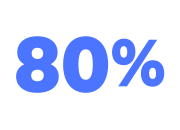
https://main--da-bacom--adobecom.aem.page/assets/icons/resources/guides/how-adobe-built-an-experience-led-customer-acquisition-model/80.svg | 80%
Adobe has seen an 80% increase in return on media spend and marketing investments over the past five years.
Source: Adobe
During this process, we future-proofed our long-term measurement strategy by becoming an early adopter of cookie-less innovations, ensuring we stay ahead of industry changes and maintain data integrity. We can now create and execute a plan, measure its performance, and identify new opportunities to increase contribution and growth.

Best practices for a new acquisition model that delivers a higher ROI.

When we strive to solve a problem at Adobe, we must realign our people, processes, and technology to our brand evolution and edit our playbook accordingly.

As an organization that has gone through several operational shifts, we’ve established the agility, risk appetite, and growth mindset needed to accelerate transformation and navigate meaningful change across these key areas:

https://main--da-bacom--adobecom.aem.page/assets/icons/resources/guides/how-adobe-built-an-experience-led-customer-acquisition-model/peopletag.svg

People — the roles involved in operational realignment or technology implementation.

With every change, we asked ourselves what its impact is on the roles and responsibilities of our teams. We determined whether we needed to create new roles or change responsibilities within roles to fulfill needed skill sets. In this scenario, we transferred certain roles, hired new employees to support growth, and created a COE to help align internal teams to our central mission.

https://main--da-bacom--adobecom.aem.page/assets/icons/resources/guides/how-adobe-built-an-experience-led-customer-acquisition-model/processes.svg

Processes — the organizational behaviors and new ways of working.

Processes often need to be recalibrated to reflect internal and external changes. For example, modern marketers at Adobe facilitate weekly interlock meetings with business partners to review and interpret performance, assess growth opportunities, and determine action plans. This process must evolve frequently through experimentation, especially when talking to customers.

https://main--da-bacom--adobecom.aem.page/assets/icons/resources/guides/how-adobe-built-an-experience-led-customer-acquisition-model/technology-tool.svg

Technology — the tools and applications we use to operate.

We used Experience Cloud applications and their connected data foundation for personalization, workflows, content supply chains, measurement, and more. These applications became the fuel for our redesigned customer acquisition strategy. We implemented new tools and technology through pilot teams and run tests before rolling them out to use cases across the wider organization. This helped us identify internal champions and develop a tried-and-true strategy to ensure success.

Guided by a new global operating model, we centralized functions like sourcing, finance, and program management, and consolidated our agency usage. Then we started to look at the results after a year, and the value realization was remarkable. An aligned customer acquisition strategy across the enterprise gave us a clearer view of our spend and returns. We shifted investments, boosted performance, and improved outcomes while reducing excess spending and waste.

In addition to the financial results, we became a more responsive organization and brought our time to execution down from days and weeks to just hours. Our regional teams flourished, able to drive growth through localized campaigns that aligned to the overall brand instead of funneling them through a central, bottlenecked system.

Our global redesign, along with a data-centered view of our strategy, helped increase our customer acquisition goals, and delivered greater returns on investment.

#F8F8F8

Two examples of success from our new plan-reach-measure-optimize operating model.

#F8F8F8

Igniting growth and building confidence with Mix Modeler:

  • Fostered trust between Adobe marketing and finance teams, enabling data-driven budget decisions.
  • Increased return on marketing investment (ROMI).
  • Unified Adobe’s measurement and planning approach, delivering accurate and consistent insights across the organization.
  • Allowed Adobe to accelerate time-to-insight with its AI-as-a-Service framework, delivering faster, actionable measurement insights.
  • Contributed to a 75% increase in media’s share of subscription growth for Adobe’s digital media products globally.
  • Delivered an 80% higher return on media spend in the past five years with insights for enhancing channel performance.

Expanding our reach with CTV through Real-Time CDP and Real-Time CDP Collaboration:

  • Built confidence in our marketing investments, allowing us to innovate and support new areas of growth for customer acquisition.
  • Expanded investment and testing in CTV for performance marketing using the Adobe Advertising application.
  • Automated performance optimization to meet goals, resulting in a 36% quarter-over-quarter revenue increase and higher return on ad spend (ROAS).
  • Helped make CTV a powerful touchpoint for the entire customer purchase journey, delivering a 200% increase in ROAS after one quarter of testing.

Looking ahead.

At Adobe, weʼre committed to continuous improvement — we apply our innovative applications and talented teams to elevate our capabilities, refine our operations, and improve customer experiences. The areas we’re focused on include:

  • Unifying customer acquisition measurement and optimization within Customer Journey Analytics. This will offer full campaign and creative measurements, including incremental attribution, intelligent conversion uploads using calculated metrics, and advanced investment planning.
  • Establishing Real-Time CDP Collaboration as a foundational application for customer acquisition by powering next-scale audience targeting and measurement. This will allow our teams to enrich, build, and target Real-Time CDP and publisher audiences for direct campaigns, experimentation, and insights.
  • Using intelligent conversion signals to drive scale in performance CTV with Advertising Cloud. This will enable us to work with traditional broadcast partners to close the technology gap of digital walled gardens, with the goal of achieving the performance levels of top CTV players.

A modern customer acquisition solution for experience-led growth.

Customer acquisition is more than selling something to someone — its about building relationships through impactful experiences. With a shift from a cost-focused acquisition model to an experience-led strategy, and data-connected, AI-powered applications across Adobe Experience Platform, you can build your loyal customer base like we did at Adobe. You can plan cost-effective advertising and marketing campaigns that deliver higher returns. You can target and convert high-value audiences across a growing list of channels. You’ll have holistic, real-time insights all in one place, so you can turn an underperforming campaign into a successful one. And one by one, you can convert more customers by turning data into experiences.
Discover how to build an experience-led acquisition strategy to drive growth in your organization.

Sources

  1. 2024 Digital Trends,” Adobe, 2024.
  2. 2025 AI and Digital Trends,” Adobe, 2025.
  3. Adobeʼs fiscal Q2 revenue jumps 14% as product demand rises amid COVID-19,” S&P Global, June 11, 2020.
  4. AI-powered marketing measurement and planning,” Adobe, 2024.
  5. Customer Acquisition and Retention in an Imperfect World,” Adobe x Publicis Sapient, 2025.
  6. Gartner Survey Finds Only 52% of Senior Marketing Leaders Can Prove Marketing’s Value and Receive Credit for Its Contribution to Business Outcomes,” Gartner, September 18, 2024.
  7. Introduction to customer acquisition strategy,” Adobe, September 9, 2024.
  8. Introduction to Data-Driven Operating Model,” Adobe, 2024.
  9. Joe Stanhope with Emily Collins, Bruna Venicio, Christine Turley, “Enterprise Marketers Focus on Personalization and Managing the Customer Lifecycle,” Forrester, March 29, 2023.
  10. Modernizing marketing insights,” Adobe, 2024.
  11. Overview of Analytics for Advertising,” Adobe, November 26, 2024.
  12. What is personalization?” McKinsey & Company, May 2023.

Adobe, the Adobe logo, Adobe Advertising, Adobe Advertising Demand-Side Platform, Adobe Analytics, Adobe Creative Cloud, Adobe Customer Journey Analytics, Adobe Document Cloud, Adobe Experience Cloud, Adobe Experience Manager, Adobe Experience Platform, Adobe Journey Optimizer, Adobe Mix Modeler, Adobe Real-Time Customer Data Platform, and Adobe Real-Time Customer Data Platform  Collaboration, are either registered trademarks or trademarks of Adobe in the United States and/or  other countries. © 2025 Adobe. All rights reserved.

https://main--da-bacom--adobecom.aem.live/fragments/resources/cards/thank-you-collections/generic-dx