New research: Securing shopper loyalty in a landscape of automated commerce.
11-18-2026

Key findings summary.
Consumers are willing to spend more on brands that remember them and they increasingly expect AI-powered experiences to be both convenient and transparent. This combination creates a significant opportunity for marketers: The brands that can connect customer data, execute seamless campaign orchestration across channels and leverage first-party data to deliver personalised content at scale can earn greater loyalty and wallet share.
- Three in ten consumers would spend US$100 or more extra annually with a brand that remembers them — rising to US$500+ for over one in 10 (11%).
- The primary reason AI personalisation builds loyalty isn't emotional — it's functional. Friction removal tops the list (37%), followed by decision fatigue reduction (33%) and automatic savings (32%).
- Consumers are 64% more likely to prefer AI over human interactions for product discovery and this jumps to 74% for Gen Z.
- Two in three consumers say they'd stay loyal to a brand that proactively discloses when they're interacting with AI — even if a competitor offers a lower price.
- When AI offers an unprompted discount based on loyalty history, 71% of consumers find it appealing and 63% find it trustworthy.
- By 2027, consumers will expect AI to be the standard: 54% expect personalised product recommendations, 54% expect a built-in AI chat assistant and 51% expect proactive deal alerts as standard features from major retail brands.
How does real-time personalisation convert passive interest into brand loyalty?
Today, shoppers move constantly between web, mobile and email and their patience for a brand that treats each channel like a stranger is wearing thin. When a brand doesn't recognise a returning customer across those touchpoints, it creates friction that adds up over time and puts loyalty at risk. To understand how much this kind of memory matters, Adobe for Business surveyed more than 1,000 US consumers about their spending habits, trust boundaries and expectations across the modern retail journey.
Operationalising this requires cross-channel identity resolution and advanced audience profiling to ensure returning shoppers receive consistent experiences. Built on Adobe CX Enterprise, Adobe Customer Journey Analytics leverages cross-channel data in the customer engagement domain to provide a single, person-centric view for analysing complete customer journeys. Insights from these analyses, when fed into Adobe Journey Optimizer, enable event-triggered communications at scale, turning memory into long-term loyalty.
How does brand memory affect customer spending across industries?
We start by looking at the direct financial relationship between brand memory and consumer wallet share: How spending limits shift across industries and generations when brands get personalisation right. The data shows the real dollar value of a unified, cross-channel memory and how much predictive experiences influence retention.
How does AI search change customer behaviour?
Conversational search is changing how people shop, shifting them from passive catalogue scrolling toward more direct, intent-driven product discovery. Loyalty is increasingly tied to how well a brand anticipates what's next: More than two in five consumers (44%) agree that an experience that accurately predicts their next action strengthens their loyalty to a brand.
That predictive layer is already making an impression. 25% of consumers say AI-assisted personalisation is an impressive innovation; 7% call it indispensable and actively seek it out and 48% say it's useful, but not essential. Men are 28% more likely than women to say a brand experience that predicts their next action improves their loyalty and younger generations feel it most. Here’s a generation-specific breakdown of personalisation-driven loyalty inclinations:
- Gen Z: 53%
- Millennials: 47%
- Gen X: 43%
- Baby boomers: 33%
How can businesses use AI to improve marketing?
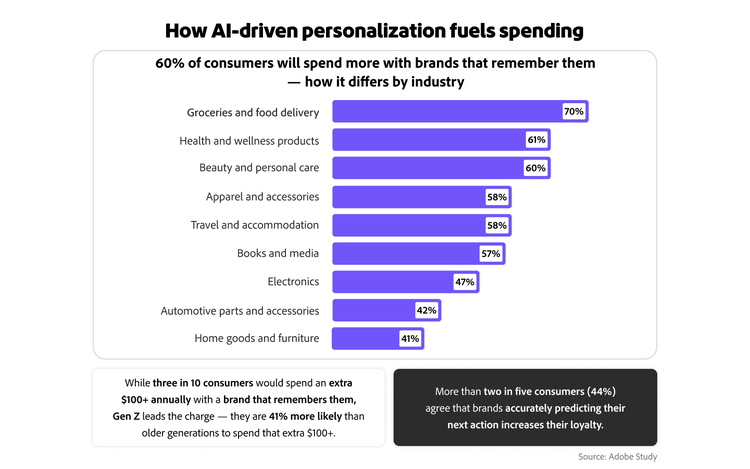
Businesses can meaningfully improve marketing performance by closing what we call the stranger tax: 60% of consumers agree they're willing to spend more with a brand that remembers their past activity and purchases than one that treats them like a stranger and that willingness varies widely by category:
- Groceries and food delivery: 70%
- Health and wellness: 61%
- Beauty and personal care: 60%
- Apparel and accessories: 58%
- Travel and accommodation: 58%
- Books and media: 57%
- Electronics: 47%
- Automotive parts and accessories: 42%
- Home goods and furniture: 41%
On average, consumers say they'd spend US$87 more annually on a brand whose app or website remembers their profile, preferences and past purchases. Looking at the distribution, three in ten are willing to spend over US$100 more and 11% would spend US$500 or more. Gen Z is willing to spend the most: 38% would pay US$100 or more, a rate 41% higher than older generations.
The willingness of Gen Z and other high-value shoppers to spend more highlights the importance of maintaining a unified view of every customer across digital and physical touchpoints. Adobe Customer Journey Analytics allows brands to uncover the specific friction points and behaviour patterns that drive long-term retention, turning omnichannel customer histories into insights that teams can act on.
How can brands balance customer trust and AI automation?
Next, we look at the balance between human-led touchpoints and automated interactions across the purchase journey: Where shoppers welcome AI, where they still want a person and what it takes to earn trust for AI-driven pricing and personalisation.
Brands can balance customer trust and AI automation by treating trust as something AI earns through relevance. Shoppers are increasingly comfortable letting AI guide their purchases when it draws on what a brand already knows about them to save time and surface better options. That growing comfort gives brands a strong foundation for scaling automation across the shopping journey.
How can brands use AI agents to improve their marketing results?
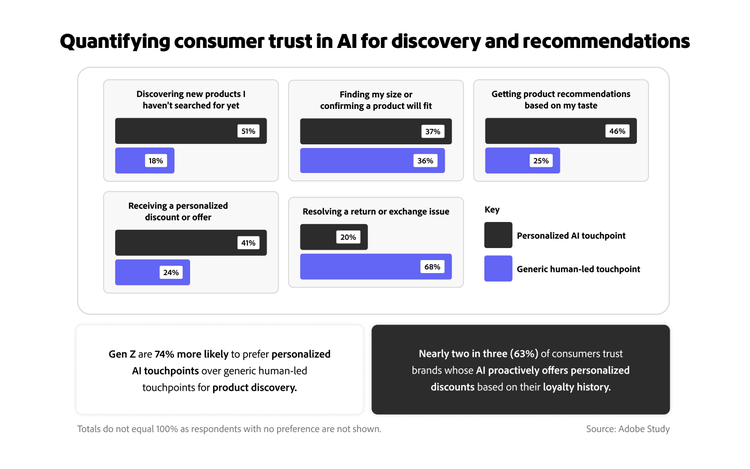
To get the most from AI agents, brands need to focus them on the moments where consumers already prefer automated help over a human and step back where they don't. Consumers strongly prefer AI for discovering new products they haven't searched for (51% versus 18% for a human), getting recommendations based on their taste (46% versus 25%) and receiving a personalised discount or offer (41% versus 24%). Preference is split evenly on finding the right size or fit (37% AI versus 36% human), but the pattern flips hard when something goes wrong: 68% of consumers prefer a human to resolve a return or exchange, compared with just 20% who'd rather use AI.
Trust also depends on how AI delivers personalised offers. Consumers respond very differently depending on the context:
-
63% trust AI that proactively offers a personalised discount based on their loyalty history.
- Gen Z is 18% less likely than older generations to trust this.
-
50% trust AI that offers a discount only after a shopper says the price is too high.
-
44% trust AI that proactively offers a discount as a shopper is about to abandon their basket.
- Gen Z is 31% less likely than older generations to trust this scenario.
When ranking what matters most for long-term loyalty, shoppers put price first, followed by AI transparency, accuracy of recommendations and a seamless experience across channels. However, priorities shift when direct trade-offs are on the table. We asked shoppers if responsible AI practices would keep them loyal even if a competitor offered lower prices. These specific responsible AI practices proved strong enough to win consumers’ loyalty over less expensive competitors:
- Proactive disclosure when you are interacting with an AI agent vs. a human: 66%
- Public-facing policy on ethical AI usage: 59%
- Explicit transparency in how your shopping data is used to train AI: 57%
- Clear labelling of AI-generated images or text descriptions: 55%
- Grounding AI answers in verified brand data rather than general web data: 47%
This deep demand for transparency signals that consumers will embrace automated pricing, but only if experiences are built on ethical, verified brand data. Marketers must abandon intrusive, low-trust behaviours and establish predictive, context-aware engagement surfaces that respect data privacy. By deploying the experimentation capabilities in Adobe Journey Optimizer, brands can run experimental marketing across email, push, SMS, in-app and web experiences using AI-powered analysis to understand why certain treatments win and to scale what works across campaigns and journeys.
Learn more about Adobe Journey Optimizer by watching the overview video.
How does eliminating shopping friction drive long-term retail loyalty?
Finally, we look at the specific moments where friction removal matters most to shoppers and the AI features they expect to become standard by 2027.
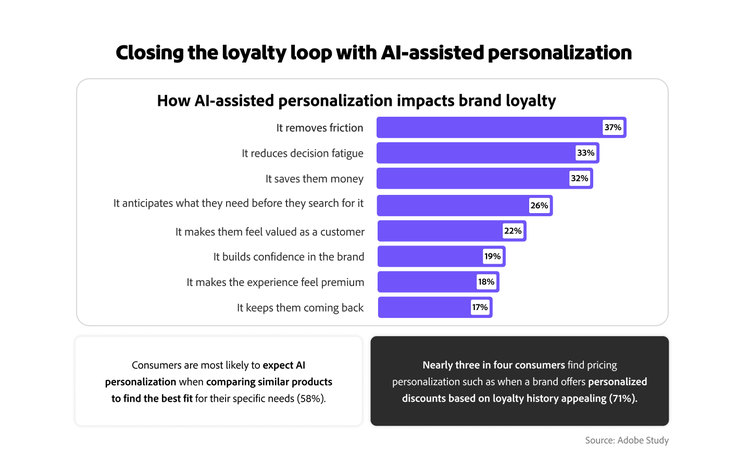
Eliminating shopping friction drives long-term retail loyalty because convenience is what shoppers value most from AI-assisted personalisation. Removing friction (37%), reducing decision fatigue (33%) and saving money (32%) are the top reasons personalisation keeps them loyal and a quarter (26%) value AI that anticipates what they need before they search for it. These practical benefits rank well ahead of emotional ones like feeling valued. Every step AI simplifies gives a brand another chance to earn that loyalty.
How do companies manage content creation at scale?
Shoppers expect AI-driven personalisation at a wide range of touchpoints. Meeting this expectation requires a high volume of content. Among shoppers, 58% want a personalised experience when comparing similar products, 38% want it when searching a new category without a brand in mind, 35% want it when looking for accessories or complementary items, 34% want it during a technical issue or delivering delay and 33% want it when they have items left in an abandoned basket. Smaller but still meaningful percentages of shoppers want it for ‘how-to’ content on a product they own (28%), for milestone moments like a birthday or anniversary (25%) and for location-based offers when they're near a shop (18%).
Delivering personalisation across so many moments requires a steady flow of relevant creative assets. Every audience segment, offer, channel and lifecycle stage can demand its own content variation, making manual production difficult to sustain. Brands need a content supply chain that can generate, adapt and govern creative assets without sacrificing quality or brand consistency.
Managing content at that scale isn't realistic with manual production alone. It takes an enterprise content marketing tool that can resize assets, adjust copy and generate relevant content blocks quickly enough to keep pace with real-time personalisation. Adobe GenStudio for Performance Marketing — a performance marketing software built around AI for content creation — enables marketing teams to leverage generative AI safely to create, manage and optimise campaign content variations. Automating the production of on-brand assets for paid media, display ads and email accelerates the creative supply chain.
What benefits does content management software provide?
Content management and brand compliance software give teams a central, secure hub to keep every asset on-brand while still moving fast on pricing and offers that convert. Consumers find AI-driven pricing scenarios appealing at similar rates to how trustworthy they find them: 71% find an unprompted, loyalty-based discount appealing, 62% find a discount offered after they push back on price appealing and 57% find a proactive, basket-abandonment discount appealing.
Content supply chain solutions make it possible to keep every localised asset, personalisation variant and pricing layout preapproved, version-controlled and brand-compliant before it goes live in any market.
How can businesses use AI agents to improve efficiency?
Handing operational tasks to automated workflows lets brands run thousands of personalised customer journeys with minimal manual effort, freeing up teams to focus on strategy instead of execution. Looking ahead to 2027, shoppers expect several AI-powered capabilities to become standard across major retail brands:
- Personalised product recommendations: 54%
- A built-in AI chat assistant: 54%
- Proactive deal alerts: 51%
- AI-generated product summaries: 49%
- Visual search: 46%
- Automated returns and exchanges: 45%
- Real-time personalised pricing: 45%
- Virtual try-on: 42%
Older generations lean toward chat assistants (55% of baby boomers and 57% of Gen X), while younger generations lean toward personalised recommendations (53% of millennials and 58% of Gen Z).
What will drive customer retention in the next era of commerce?
As consumers grow more comfortable with AI in their everyday shopping, from product discovery to proactive pricing, they're also raising their expectations for what a brand experience should feel like: efficient, personalised and honest about when AI is involved. The brands that win long-term loyalty will be the ones that treat retention, trust and transparency as one connected discipline, not three separate initiatives.
By leveraging Adobe CX Enterprise — Adobe’s unified customer experience platform that brings together brand visibility, customer engagement and content supply chain solutions on a common AI-powered foundation — brands can create proactive, transparent and tailored journeys that seamlessly integrate AI into the shopping experience.
Methodology
This article is informed by proprietary research conducted by Adobe. The study surveyed 1,001 consumers across the United States, providing a 95% confidence level with a ±3% margin of error. Respondents were asked about their direct experiences, expectations, trust metrics and brand loyalties regarding AI-driven personalisation across the digital and physical commerce landscape. As with all self-reported data, results may reflect personal perceptions and experiences rather than actual behaviours.
Frequently asked questions about AI campaign orchestration.
How can businesses use AI to improve marketing?
How does AI search change customer behaviour?
How do companies manage content creation at scale?
How can brands use AI agents to improve their marketing results?
How can businesses use AI agents to improve efficiency?
What benefits does content management software provide?
Recommended for you