We’re at the beginning of a profound shift in how businesses connect with their customers. Artificial intelligence is no longer just a tool. It’s rapidly becoming a primary conduit between brands and consumers, and increasingly, the mediator of discovery, evaluation, and purchase.
As AI agents and conversational interfaces reshape how decisions are made, the customer journey is being fundamentally altered. Traditional marketing levers, like search and paid media, are being redefined in real time as customer journeys become zero-click, and discovery happens via AI-generated responses. For enterprise businesses, this introduces a strategic challenge — the loss of direct access to customers.
At the same time, the mechanisms driving growth are changing, and for enterprise leaders, this moment is urgent. The question is no longer whether to adopt AI, but how to operationalize it to drive growth, maintain trust, and deliver differentiated experiences at scale.
But Adobe sees a clear opportunity — one that harnesses agentic AI to take brands beyond marketing into a more comprehensive and powerful model: personalized customer experience orchestration (CXO). That’s why today we’re introducing a new category-defining offering: Adobe CX Enterprise — an agentic system that is flexible enough to let organizations codify their own business processes and is completely extensible so brands can quickly move from channel-centric marketing to full-lifecycle orchestration.
The next frontier: Orchestrating experiences for AI and humans.
For the past decade, enterprises have optimized for a digital-first world built around human-led journeys. That’s no longer sufficient. AI is becoming the front door to the customer relationship. Customers are increasingly discovering, evaluating, and engaging with brands through AI interfaces, rather than traditional channels.
But this shift isn’t just changing where customers engage — it’s reshaping how demand is created, captured, and converted. And it introduces a new set of must-haves:
- Experiences designed for both humans and AI agents.
- Experiences that are conversational, dynamic, and context-aware.
- Enterprise systems evolved to be agent-aware and AI-native.
At the same time this shift is happening, enterprises are facing a different kind of pressure — an explosion in the demand for content and experiences — without a corresponding increase in team resources. Teams are being asked to do exponentially more, across more channels and segments, with greater precision and speed. While AI is dramatically reducing the time and cost required to generate experiences, it’s also raising expectations for relevance, consistency, and brand integrity.
That’s why orchestration — not just automation — is now the critical capability.
Why customer experience orchestration is the answer.
Despite rapid advances in AI, most organizations remain stuck between AI experimentation and realized efficiencies in production. Part of the challenge is the pace at which AI is advancing and an increasingly fragmented AI landscape. Enterprises are navigating an explosion of platforms, AI models, agents, and point solutions — often without a clear way to unify them into a cohesive system.
Leaders are grappling with real concerns around agentic AI implementation, such as:
- Scaling AI-driven workflows without compromising brand trust.
- Unifying fragmented data, content, and customer journeys.
- Moving from isolated use cases to enterprise-wide impact.
At the same time, trust, governance, and accountability have become board-level priorities. Organizations must ensure that AI-driven experiences are transparent, brand-safe, and aligned with evolving regulatory expectations. Meanwhile, the core business imperative hasn’t changed: attract, engage, convert, and retain customers. What has changed is complexity and opportunity.
CXO requires the ability to bring together data, content, customer journeys, and AI decisioning in a unified manner so enterprises can:
- Anticipate customer intent.
- Deliver personalized experiences in real time.
- Continuously learn and optimize across every touchpoint.
In the era of AI, customer experience orchestration is the system of intelligence that powers growth.
Adobe CX Enterprise is the CXO solution for the AI era.
Adobe CX Enterprise is our response to this new reality. It’s a purpose-built, agentic system for customer experience orchestration, designed to let enterprises deliver experiences personalized to customers and optimized for AI agents — at a global scale — all with trust at the core. At its foundation, Adobe CX Enterprise unifies three critical domains:
Content supply chain. Enterprises must create, manage, and activate exponentially more content — faster and more efficiently than ever before.
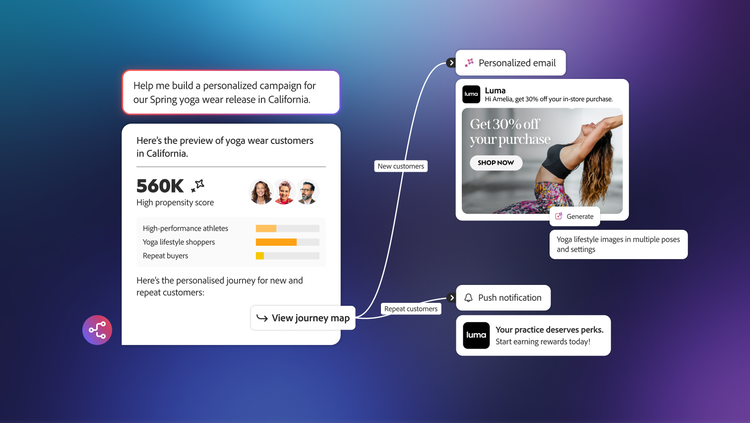
Customer engagement. Every interaction must be personalized, contextual, and orchestrated across channels in real time.
Brand visibility. As discovery shifts from search engine optimization to generative AI environments, brands must ensure they are visible and relevant in AI-driven experiences.
What makes Adobe CX Enterprise different isn’t just its breadth — it’s the deep integration of AI across these domains, powered by a unified orchestration layer.
Built for the agentic AI era.
Adobe CX Enterprise is architected for a world of AI agents and multi-agent systems.
Key capabilities include:
- Enables agentic workflows across the entire customer lifecycle.
- Orchestrates experiences across applications, teams, and agents.
- Optimizes decisions continuously to business goals such as revenue and customer lifetime value.
- Delivers hybrid experiences that combine conversational and traditional interfaces.
- Allows flexibility to use Adobe and third-party agents and generative AI models.
- Provides a foundation of enterprise trust, security, and governance.
Together, these capabilities enable a shift from fragmented systems and manual processes to continuous, AI-driven orchestration.
From fragmentation to unified growth.
Historically, customer experience has been constrained by silos across teams, tools, and data. Adobe CX Enterprise changes that.
By unifying content, data, and customer journeys — and infusing them with AI — enterprises can now:
- Accelerate growth through goal-based optimization.
- Increase efficiency through end-to-end automation.
- Deliver consistent, on-brand experiences across every interaction.
- Scale personalization without scaling complexity.
This is not an incremental improvement. It’s a fundamental shift in how customer experience is designed and delivered.
A platform for the future of enterprise AI.
The rise of platforms like ChatGPT Enterprise, Microsoft Copilot, Google Gemini, and others is reshaping how work gets done. Adobe CX Enterprise is designed to integrate into this evolving ecosystem, bringing customer experience intelligence into the tools where decisions are made.
With support for agent interoperability, open protocols, and an extensible ecosystem of skills and tools, Adobe enables enterprises to operationalize customer experience orchestration across their entire technology landscape.
The path forward.
Customer experience is no longer a function. It’s a competitive advantage. In the era of agentic AI, the organizations that lead will be those that can orchestrate experiences intelligently, at scale, and with trust.
With Adobe CX Enterprise, we’re defining this next chapter — bringing together creativity, marketing, and AI to power the future of customer experience.
Learn more about Adobe CX Enterprise and how it powers AI-driven customer experience orchestration.
Amit Ahuja is the Senior Vice President of Customer Experience Orchestration Platform and Products at Adobe. Prior to this role, Amit was responsible for Business Development and building Adobe’s ecosystem. Amit has held several other roles within Adobe, including the Head of Emerging Businesses, General Manager of Adobe’s DMP business, and several positions in Corporate Development. Amit joined Adobe via the acquisition of Macromedia, where he was in the Corporate Development Group, focusing on mobile and video. Amit began his career at Hambrecht & Quist as a technology investment banker and also spent several years at a technology start-up. Amit is a B.S. from the University of California, Berkeley, and an MBA from UCLA’s Anderson School of Management.