The benefits of creative operations.
Regardless of the challenges your creative team is currently facing, the right creative framework can help your company realise the operational benefits. From increased efficiency and effective cross-department collaboration to consistent resourcing and project management, creative ops can be beneficial to marketing teams of any size. Here are eight specific benefits:
1. Operational efficiency.
Process inefficiencies are, unfortunately, a large issue in the creative world. Creative ops can help teams move faster by optimising each person and process, as well as closing technology gaps.
2. Collaboration across the team.
Great work can often be sacrificed due to disparate platforms. By centralising where you work, you can get everyone on the same page no matter where or when they’re working.
3. Customisation.
A seamless operation shouldn’t come at the expense of the creative process. The best part of building a creative ops framework is that every team’s work style can be considered. Creative ops help build dashboards customised to each team member’s preferences within an overarching workflow that solidifies standardisation.
4. Accountability.
No more last-minute requests or half-baked intake forms. With a centralised intake process and standardised form, creative teams have all the relevant information needed to kick off a project and hit realistic deadlines.
5. Security.
Compliance is everything, especially in heavily legislated industries like finance and healthcare. Creative operations can provide additional oversight to creative work, ensuring compliance is met if an audit ever comes up. They can also provide structure for following brand standards — so creative teams can focus on producing work that’s high-quality and compliant every time.
6. Data-driven decisions.
Creative ops should enhance, not stifle, the creative process. Luckily, reporting functionality and operational data can help your team move from a reactionary stance to an ahead-of-the-curve approach. Data will help you to see areas to improve prioritisation, quantify resourcing needs and communicate your team’s value to leadership.
7. Project consistency.
Inconsistencies in workflows can lead to administrative burnout. By leveraging a single creative work platform, you can streamline your intake and assignment process to create consistency and improve speed to market.
8. Forecasting.
A lack of clarity about the future can be detrimental to resource planning. With creative operations, you can access the data needed to accurately forecast how much money, time and resources will be needed to complete a project. Aligning projects to statements of work has never been easier.
Use cases.
Improve customer experience.
Due to increased media spending and content needs, global insurance company Liberty Mutual’s in-house agency, Copper Giants, received a major uptick in creative development requests. Describing its intake process as a “deli counter” and its collaborative efforts as a “mosh pit,” the agency knew an infrastructure upgrade was non-negotiable to keep up with production demands. Copper Giants developed a creative operations framework to drive its teams toward organisational excellence.
The team members began by outlining three functional requirements: project workflow, prioritisation and operational reporting. Then, they searched for and found an end-to-end platform to help them to manage it all.
With the tech and infrastructure upgrade, Copper Giants:
- Brought teams together in one centralised platform
- Served up a customised experience for each team member and partner
- Created transparency and alignment with stakeholders
- Communicated their team’s value across Liberty Mutual
“Operational data has helped us to grow as a team in more ways than one over the years. It helped us to quantify resourcing needs when requests were on the rise. It prepared us for the ebbs and flows of work throughout the year, particularly when we had more seasonal work. It highlighted an opportunity area to shift resources when we were allocating our time to less important priorities. But most importantly, it has continuously helped us to communicate our value to leadership and showcase our accomplishments to our stakeholders.”
— Michael LaBerge, director of strategic operations, Copper Giant
The creative process optimisation ensured that Copper Giant had everything needed to produce effective content at scale. Today, the in-house agency supports personalised products and 80% of Liberty Mutual’s active creative in the market.
Empower remote teams.
Telecommunications giant CenturyLink’s globally based creative team is a prime example of creative work being able to flourish any time, anywhere. By integrating a system of record for work with its team operations, CenturyLink creatives could create, deliver and measure their work in one place.
“We found that small projects often require as much time as large projects, so, as part of our creative operations, we aim to combine multiple small projects to create a larger deliverable.”
— Shane LaBounty, former marketing operations leader of brand, creative and digital, CenturyLink/Lumen Technologies
After months of focusing on planning and standardising creative work processes, effectively collaborating across the world became even more effective. With creative operations, the CenturyLink creative team was transformed from a request-led, reactive operation to a powerful, planning-led digital force.
Faster results.
Each month, the New Jersey Lottery introduces new games that require an in-store point-of-sale and promotional materials, advertising support, web and social pages, retailer newsletters and more. Deadlines for completing and delivering the items are tight.
A few years ago, the Northstar New Jersey Lottery Group was tapped to handle the lottery’s sales and marketing. However, the team struggled with tracking projects without a centralised system.
“It was difficult and time-consuming to track everything that went back and forth via email. Requests or comments would occasionally be lost or misfiled and we would also catch errors too late, which required reprinting. Reprints added time and cost to the job. I realised very quickly that managing projects this way wouldn’t scale.”
— Laura Antos, senior manager of 360 marketing operations, Northstar New Jersey Lottery Group
To improve project communication and management, Northstar deployed end-to-end creative operation tools. Once the tools were adopted widely, the effects were swift and impressive across departments — 360-degree visibility, project turnaround time improved by at least 24 hours and reporting became 90% faster and more accurate. Today, Northstar teams spend their time coming up with the next big lottery marketing idea instead of searching servers and email folders for files.
Creative request management processes can improve project efficiency.
Use creative briefs to improve project execution.
How many times have you seen it happen? A designer submits a first draught to an internal client after hours of hard work and the client returns the draught with so many changes that it hardly resembles the project you were asked to deliver? Frustrated creatives, unsatisfied clients and a lot of rework are all results of poor visibility between client and creative.
Creative briefs are the remedy. Sit down with internal clients before diving into a project and determine each other’s expectations for the work. Make sure you understand the who, what, why, when and where of the project, then write it down in a creative brief where you, the client and anyone that ends up working on it can refer to the details of the request. Or make the process even easier with your work management solution by using customisable creative briefs that are built in to the request process that help you to gather all the information you need from the start.
This simple best practice kills chaos by offering visibility into the specs of a project right from the beginning. It ensures that creative teams and clients stay on the same page throughout the project, which in turn means less rework, happy creatives and satisfied clients.
Centralise request management.
When requests come in myriad ways, like personal emails, Google Chat or sticky notes, you can count on the entire project being one big ambiguous, chaotic mess. The only way to reduce this chaos is to standardise and centralise your intake process.
Designate one way to receive requests, whether with an online form, an email alias or a work management solution. Then, communicate that method to your team and clients. Both internal clients and the creative team must buy into this method for it to work, which will require some enforcement; if requests continue to come in the hallway or with sticky notes on the desk, kindly but firmly remind clients to submit them through your established process.
When all requests are received, assigned and tracked from one location, it’s easy to have visibility into what the work is, who is doing it and when it’s due, bringing clarity to a chaos-prone process.
Hire or designate a traffic or project manager.
Having all requests channeled to one place is a first step to controlling chaos in request management, but then those requests need to be organised and distributed to the team.
Place one person in charge of request “triage.” This team member should be the gatekeeper and should have complete visibility into every request that comes to the team. Then, they can manage priorities and projects with a clear view of all the requests made of the team. If your team lacks the bandwidth to appoint or hire a dedicated traffic manager, the creative director or a senior graphic designer could assume this role as an additional responsibility.
The traffic or project manager in charge of request management can gain visibility into all incoming and outgoing work. That visibility enables the project manager to keep track of workloads, appropriately assign tasks and ensure that projects are completed according to client expectations.
The roles within a creative operations team.
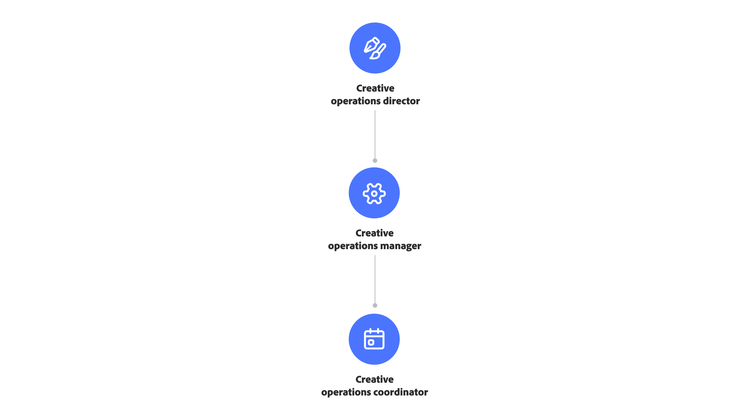
Creative directors, copywriters, designers, photographers, videographers and producers are all common creative roles — and all are considered part of creative operations. But there are a few roles specifically focused on creative ops as a unit that ensure process and organisation are an integral part of the creative process. Let’s walk through what those roles entail.
Creative operations director.
Individuals in this role typically possess 10 or more years of operational experience in a creative setting. As natural planners, they not only know what makes great creative, but they also serve as the business and operating mind for the creative department. These operational spearheads develop systems and improve processes in partnership with inputs from account leads, finance teams and other stakeholders. Creative op directors lead the charge for establishing creative efficiencies, strategic planning, project management and, most importantly, creating an environment for creatives to thrive and grow.
Creative operations manager.
Creative operations managers thrive on efficiency and help the operations director drive effective change across creative departments. With typically 5 or more years of experience on their resume, managers in creative operations must be incredibly collaborative and have a deep understanding of brand, marketing and product design lifecycles. This deep knowledge is leveraged to address common roadblocks, maintain clear cross-department alignment and keep projects running smoothly. They partner with creative leadership to advance team initiatives and support decision-making for the best possible creative setting.
Creative operations coordinator.
At the coordinator level, people are typically newer to the creative operations unit, but they bring an eagerness for new challenges and a fresh perspective to the organisation. Under the direction of the manager and director, the coordinator evaluates and tests current creative processes. Coordinators typically oversee timekeeping for staff and freelancers to ensure accurate reporting. They also help co-ordinate reporting of daily operations, prepare materials for operations meetings and maintain the organisation of projects, records and resources. With so much work in data, coordinators must have strong analytical and debugging skills and be able to effectively communicate numbers and ideas with multiple departments.
Getting started with creative operations.
Overhaulling your creative workflows and processes can feel overwhelming for companies of any size. But the benefits are worth it. By integrating a system of record with your team operations, creatives can create, deliver and measure their work in one place. Stakeholders get their requests completed sooner, customers connect on a more personal level with your brand’s work and your company saves time, money and resources.
With a work management platform like Adobe Workfront, you can gain visibility into and manage complex workflows and measure everything in your creative operations.
- Deliver content faster. Workfront connects seamlessly with solutions like Adobe Creative Cloud so creatives can spend more time creating and less time navigating platforms.
- Communicate team value. Collect operational metrics to extract insights and communicate your team’s value to the company.
- Reduce project failure. Gain real-time insights into project progress and resource utilisation.
See how Workfront and Adobe power creative operations.