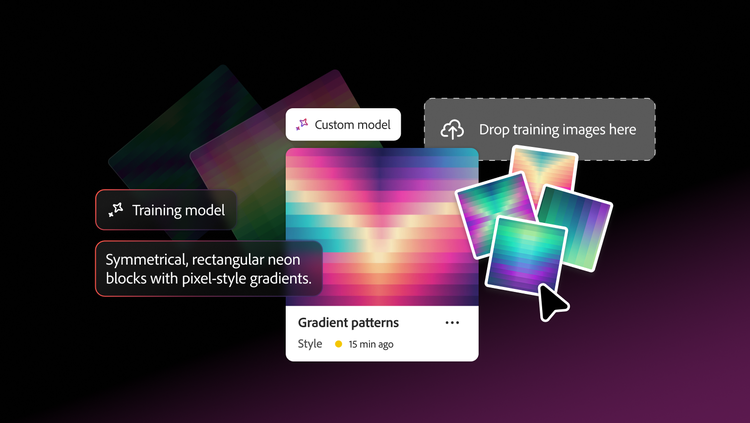
Custom model training doesn’t start with the model itself.
The organisations extracting the most value from AI aren't necessarily using fundamentally different models. Rather, they’re building stronger systems around those models, including everything from governance and digital asset management to review workflows and performance measurements.
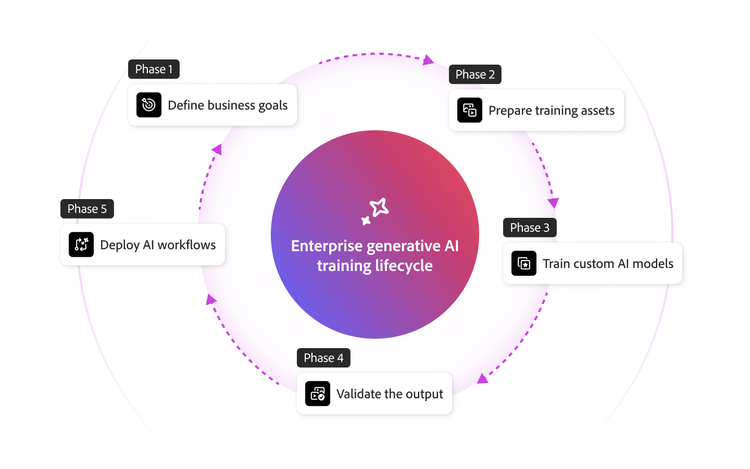
The five phases below provide a practical framework for how enterprises train customised AI models and operationalise them at scale. While implementation may vary across organisations, these phases offer a repeatable process for building AI-powered creative workflows responsibly.
Phase 1: Define business goals and creative use cases.
Before evaluating tools, selecting training assets or redesigning workflows, organisations need to establish what they're trying to achieve and where AI can create the greatest impact.
The most effective use cases often emerge from existing operational challenges. A global marketing team may need to localise campaigns across dozens of markets without extending production timelines. A retailer might require thousands of product image variations to support seasonal promotions. Another organisation may be looking for a faster way to create personalised content across multiple audience segments.
In each case, the objective is to remove a bottleneck that prevents teams from reaching their full potential. This phase also provides an opportunity to evaluate how content moves through the organisation today. Where do approvals create delays? Which tasks consume the most creative resources? What prevents teams from meeting growing content demands?
Answering these questions early helps ensure AI investments remain tied to measurable business outcomes rather than isolated technology experiments. It also creates clear success criteria for every phase that follows.
Phase 2: Prepare and govern training assets.
Enterprise AI models inherit the strengths and weaknesses of the assets they're trained on. If training assets are inconsistent, outdated, poorly governed or disconnected from current brand standards, the resulting outputs will reflect those shortcomings.
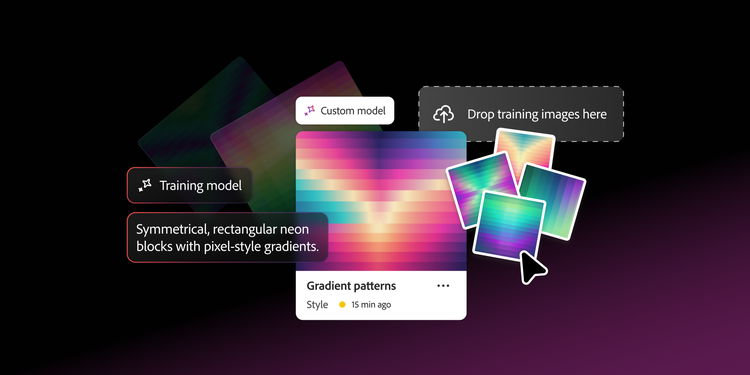
You can train a custom model with as few as 10 style-consistent or subject-consistent images. The asset preparation phase focuses on identifying, organising and validating these images that will shape model behaviour. Depending on the use case, this may include photography libraries, product imagery, design systems, campaign assets, templates and metadata structures.
This phase also establishes the governance foundations that support long-term AI adoption.
Organisations need clear processes for managing asset ownership, usage permissions, rights management, licensing validation, review requirements and brand standards. Without those controls, they are exposed to unnecessary complexity and risk.
This step also presents an opportunity to improve content operations. Preparing training assets often highlights gaps in content governance, creates greater visibility across creative repositories and improves how approved assets are managed across the business.
Phase 3: Train customised AI models.
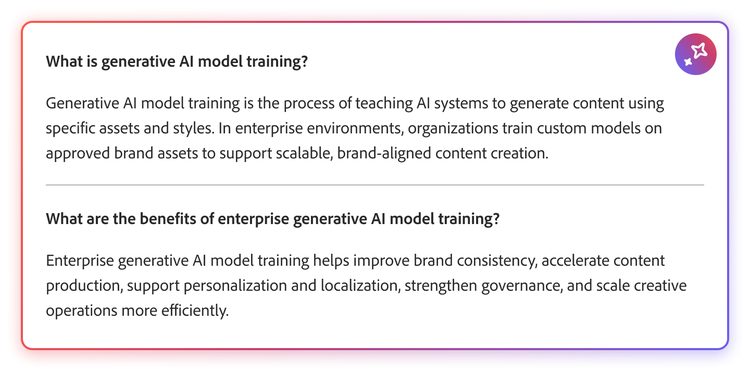
At this stage, organisations can start training custom models to generate outputs that align with specific brand requirements and creative expectations.
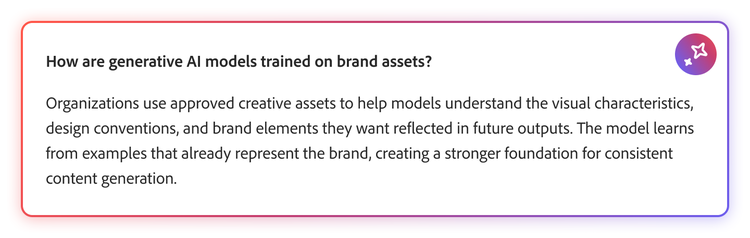
Custom models learn from approved brand assets, visual styles and established creative patterns to generate imagery that reflects the brand.
For example, a retail brand may train a model using approved photography, campaign imagery and design assets, while a global enterprise may use regionally approved creative to support localised content creation. This allows organisations to generate content that feels more consistent, relevant and aligned with their brand.
The objective isn't to replicate existing assets but to extend their use. A well-trained model helps teams create new content that follows established brand principles while giving them the flexibility to scale production more efficiently.
Prompts, model guidance and creative constraints also play an important role in this phase. While prompting is a discipline of its own, these controls help operationalise brand standards and ensure generated outputs remain aligned with business objectives after training is complete.
Phase 4: Validate outputs and maintain governance.
Before organisations deploy AI-generated imagery, they must validate outputs for quality, usability, compliance and brand alignment.
Depending on the organisation, validation may involve creative reviewers, brand teams, legal stakeholders, compliance specialists or other subject matter experts. These human-in-the-loop workflows help identify inaccuracies, inconsistencies or governance concerns before content is published.
Rather than reviewing every output individually, organisations should establish repeatable mechanisms that maintain quality. This often includes defining performance criteria for brand consistency, asset usage compliance and overall output quality.
Organisations that invest in thoughtful review and approval processes early are often better positioned to scale because they can build confidence in both the content and the workflows used to create it.
Phase 5: Deploy, monitor and optimise AI workflows.
Enterprise custom model training doesn't end when a model is trained. Content evolves, campaign priorities shift, brand standards change and customer expectations increase. Therefore, organisations should treat model deployment as the beginning of an ongoing process.
Once AI-powered workflows are operational, teams should continuously evaluate both the quality of outputs and the effectiveness of the processes supporting them. Performance data, human feedback, approval trends and content outcomes can all provide insights into where improvements are needed.
Over time, it’s straightforward to train a model again on updated assets based on learnings, strengthen governance processes, improve model performance and identify new opportunities for automation.
This creates a feedback loop in which every output contributes to future improvements. The model becomes better informed and workflows become more efficient.
As adoption matures, many organisations also begin looking beyond individual models and toward broader workflow orchestration with agentic AI. Agentic AI can support content creation, review, localisation, activation and optimisation across the content supply chain.