How to track brand mentions in AI search.

Adobe for Business Team

06-26-2026

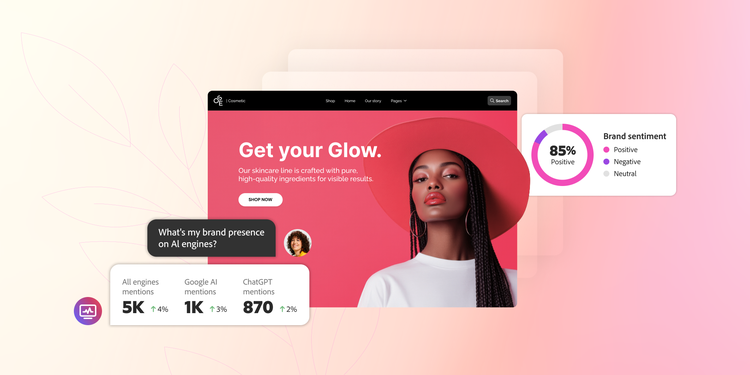
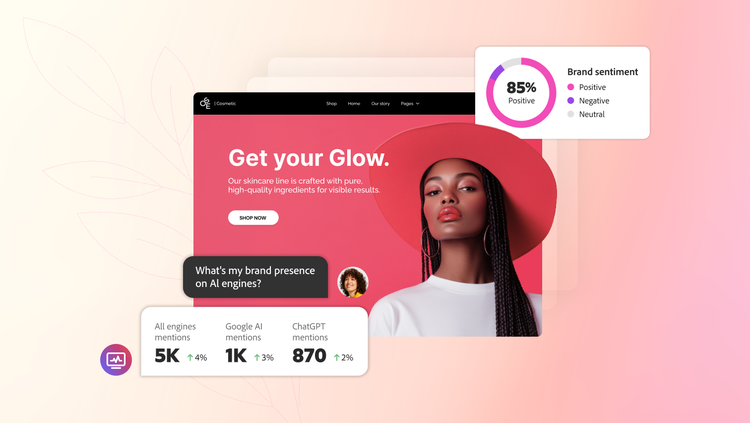
AI dashboard showing brand mentions, sentiment, and visibility metrics across AI search platforms.

Tracking brand mentions in AI search means monitoring whether and how your brand appears in answers generated by ChatGPT, Perplexity, Gemini, Google AI Overviews, and other LLM-powered answer engines. Unlike traditional SEO, visibility is defined by inclusion within generated answers rather than position on a search results page.

As AI-driven search experiences continue to reduce reliance on traditional clicks, brands that are missing, misrepresented, or inconsistently surfaced in AI responses risk losing visibility during high-intent discovery moments. For enterprise SEO and growth teams, that makes structured AI brand monitoring a priority.

In this article, we explore how AI is reshaping SEO fundamentals, how brand monitoring works in today’s world, why traditional measurement models are evolving, and how enterprise teams can establish a defined framework for tracking presence across AI-powered search experiences.

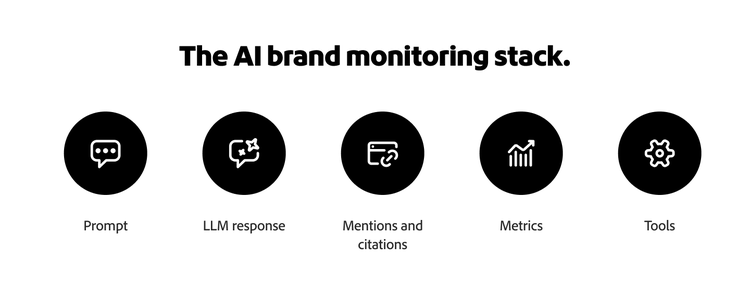
Diagram of an AI brand monitoring stack showing prompt, LLM response, mentions and citations, metrics, and tools.

JUMP TO SECTION

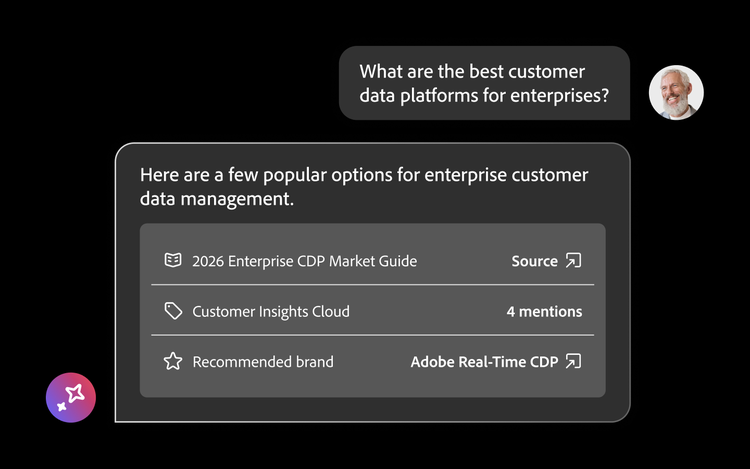
Brand mentions in AI search refer to any instance where an LLM includes your brand, such as your company name, product, or service, within a response to a user prompt. For example, a query about “best customer data platforms for enterprises” may generate a list of recommended vendors rather than requiring users to evaluate a list of search results.

These mentions typically appear in three forms:

AI-generated response showing enterprise CDP recommendations with cited sources, brand mentions, and a recommended solution.

This differentiation is fundamentally different from traditional SEO, built around citation, representation, and recommendation.

How tracking brand mentions in AI search differs from traditional brand monitoring.

As AI reshapes how users discover and interpret information, brand monitoring also needs to evolve. Tracking brand mentions in AI search requires understanding how LLMs generate, prioritize, and present information differently from traditional search engines.

Traditional monitoring focuses on traffic, rankings, backlinks, and mentions across indexed web pages. In contrast, AI search monitoring examines how brands appear within generated responses, where they are positioned, and how they are represented within conversational experiences.

Comparison: Traditional vs AI search-based brand monitoring.
Comparison point
Traditional brand monitoring
Tracking brand mentions in AI search
Visibility signal
Rankings on SERPs
Inclusion within AI-generated responses
User action
Clicks and visits
Answer consumption, with or without clicks
Tracking method
Keyword tracking, backlinks, mentions
Prompt-based testing and response analysis
Experience type
Static and replicable SERPs
Dynamic, variable responses
Measurement focus
Volume and position
Share of voice, sentiment, and positioning

In AI-generated responses, there is no list of blue links or page two. Brands are either present in the answer or not. This alternate search experience requires different metrics to measure brand presence, authority, and performance, rather than position and traffic.

Tracking brand mentions in traditional search engines revolved around widely understood standards. AI search introduces a newer environment where many of those conventions aren’t best practices, creating a different set of operational and measurement challenges.

Several hurdles shape AI brand monitoring today:

These constraints are exactly why structured workflows and dedicated monitoring capabilities are becoming increasingly important for enterprise SEO and growth teams. The challenge is understanding how AI systems interpret, consolidate, and prioritize information at scale.

Learning how to track brand mentions in AI search is not about running a few test queries and noting what appears. Effective monitoring depends on a structured process built around real user prompts and ongoing visibility measurements.

The process involves five connected steps: identifying high-impact prompts, testing across AI platforms, measuring brand inclusion and positioning, monitoring citations and source URLs, and benchmarking visibility over time.

Let’s take a closer look at how to approach each one in practice.

How do you identify high-impact prompts to test?

Identifying the right prompts begins by understanding how people naturally search within AI environments and what they are likely to type, and building a prompt library based on real-world user intent.

Use conversational queries that are typically longer, more contextual, and tied to a specific outcome or recommendation. Include discovery-stage questions, comparison requests, and decision-oriented prompts. For example, “What is the best marketing automation platform for mid-sized businesses?” provides a more realistic visibility signal than a short keyword phrase such as “marketing automation.”

Which AI platforms should you test across?

Brand visibility varies considerably across AI systems, making cross-platform testing important. Each platform draws from different models, sources, and response structures, creating the need for a holistic approach.

Testing should typically include:

These environments will give you a representative view of how your brand surfaces across AI-driven discovery experiences and how visibility, citations, and sentiment vary between platforms.

Because every AI system retrieves and prioritizes information differently, brands that appear consistently across multiple answer engines are more likely to establish sustainable AI search visibility over time.

How do you measure brand inclusion and positioning?

Tracking AI brand visibility goes beyond identifying whether your brand appears across AI search engines. You also need to understand how it appears and how consistently it is positioned across AI-generated answers.

Is your brand mentioned first or listed lower in the response? Is it positioned accurately? Is it framed positively, neutrally, or critically? Is it the primary recommendation or simply buried among competitors?

These nuances influence user perception long before a click or conversion takes place, which is exactly why traditional ranking metrics no longer tell the full story.

This is where emerging AI visibility metrics become increasingly useful:

How do you monitor citations and source URLs?

When AI systems provide citations, the referenced URLs reveal which sources are influencing the generated response. You can monitor these citations manually by testing groups of related prompts or by using dedicated AI brand monitoring software.

Monitoring citations helps answer two important questions. First, whether your owned content is being surfaced. Second, which third-party publications, forums, or expert sources are shaping how your brand is represented.

This creates a direct relationship between content strategy and AI visibility. It also reinforces the importance of publishing authoritative, well-structured content while building credible third-party references across the broader web ecosystem.

How do you benchmark AI brand visibility over time?

One-off checks only provide snapshots. SEO and growth teams should establish a baseline across prompts, platforms, competitors, and visibility metrics from the start, then consistently track how representation evolves over time.

A standardized framework helps teams establish a repeatable measurement cadence. This makes it easier to track how improvements in content quality, topical authority, citation coverage, and brand credibility shape AI inclusion and recommendation rates over time. The goal is not simply to observe visibility but to understand why representation changes across AI systems and how those changes influence discoverability.

Kathie Yang, Senior Product Marketing Manager at Adobe, advises teams to “monitor your brand's AI footprint, take corrective action where representation falls short, and invest in data transparency through dashboards that benchmark performance and spot trends.”

Tools and software for AI brand monitoring.

As AI referral traffic continues to grow across industries, SEO and growth teams need new measures to understand how their brands are being surfaced within AI-generated experiences. As AI brand monitoring matures, several categories of tools have emerged to help organizations track visibility across AI search environments.

These generally include:

For enterprises, brand optimization tools can help connect AI visibility insights with content workflows, customer journey analytics, and performance measurement. Growth teams can gain a broader understanding of how their brands are seen, cited, and represented across AI-driven experiences.

Manual and DIY approaches to tracking brand mentions.

For many small and mid-sized teams, manual testing can be a practical starting point. This usually involves running selected prompts across multiple platforms and documenting the generated responses. The approach works well for initial exploration and small-scale audits but becomes increasingly difficult to scale.

As prompt libraries grow, maintaining consistency, tracking visibility changes, and identifying meaningful trends and growth opportunities becomes difficult to sustain. Over time, manual tracking also introduces a higher risk of fragmented coverage and inconsistent measurement across teams and workflows. Based on your needs, adopting dedicated AI brand monitoring tools is often the more sustainable approach.

How to evaluate AI brand monitoring tools.

The right AI brand monitoring tool depends on how effectively it supports structured visibility and measurement across platforms and prompts. Multiple factors should be taken into account during evaluation.

Capabilities to consider in an AI brand monitoring tool.
Capability
Why it matters
Multi-platform LLM coverage
Ensures visibility across all major AI systems
Visibility scoring
Uses proprietary scoring to measure overall AI presence
Prompt and query tracking
Aligns measurement with real user behavior and inquiries
Citation analysis
Reveals which URLs or domains get cited as sources
Sentiment analysis
Reports how models perceive and describe your brand
Competitive benchmarking
Provides context for performance and share of voice
Trend tracking
Enables ongoing optimization and visibility analysis

Enterprise approach to AI visibility.

At enterprise scale, AI visibility cannot operate independently from the rest of the marketing ecosystem. It must be deeply embedded across workflows and systems, allowing teams to connect AI-driven discovery to customer journey orchestration, search behavior, and content governance.

Adobe brand visibility solutions can monitor brand mentions in AI search engines and help organizations:

Tory Brunker, Senior Director of Web Marketing at Adobe, advises teams to “start with an AI search visibility audit that examines not just owned digital assets, but how the brand is referenced across the web — including third-party citations from expert forums and respected publications.”

Once visibility is measured, the next step is to improve it. That does not demand an entirely new content strategy, but it does require adapting how content is structured and published across AI-driven discovery experiences. Content that answers questions directly, demonstrates expertise, and follows a logical structure is easier for AI systems to interpret and reuse within generated responses.

Topical depth, authority, and third-party credibility also play a critical role. AI systems rely heavily on contextual relationships, authoritative references, recurring entity associations, and consistent brand signals when shaping recommendations and generating answers.

At a high level, improving visibility in AI search boils down to making your brand easier to understand, trust, and surface across conversational experiences. The right solution can empower SEO teams to earn this trust and authority by connecting AI visibility insights to content performance, engagement signals, and broader marketing workflows.

Explore how Adobe can help your enterprise improve brand visibility across AI-powered search experiences.

https://business.adobe.com/fragments/resources/cards/thank-you-collections/generative-ai