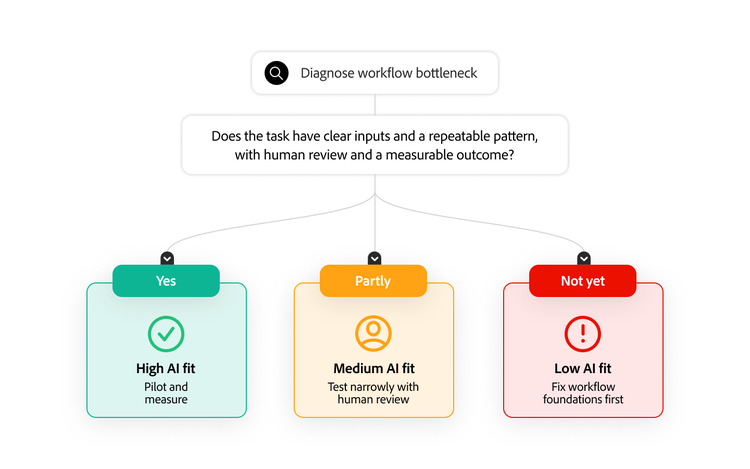
Identifying and removing bottlenecks at scale is complex. Today, only 7% of organisations have embedded AI in their workflows and are delivering measurable impact. This suggests that while teams are experimenting with AI, few have operationalised it across recurring workflow breakpoints.
Workflow bottlenecks can emerge at every stage of the campaign lifecycle, whether through cross-team handoffs, approval delays, limited data availability or fragmented processes. Understanding where these dependencies or blockers occur is key to determining which issues require operational changes.
Let’s explore how bottlenecks appear across different workflow stages, along with the role generative AI can play in helping teams address them.
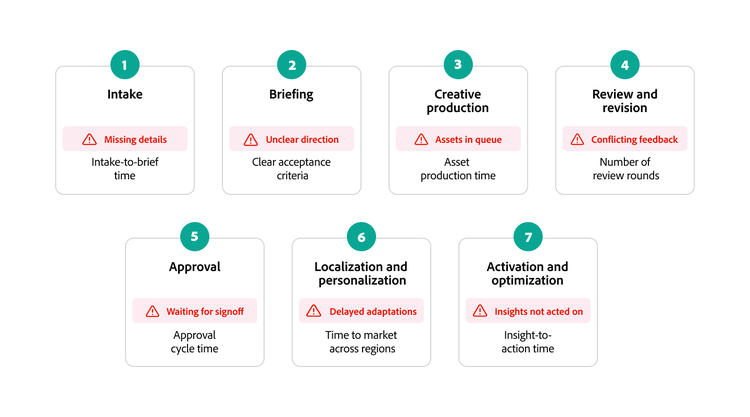
Intake bottlenecks.
Campaign work can stall before it begins when requests arrive with missing information, unclear priorities, unclear processes or scattered context. Track the complete-on-first-submit rate, intake-to-brief time, clarification requests and rerouted submissions.
How generative AI helps:
Standardising required fields and routing gives each request a dependable starting point, after which generative AI can summarise and classify requests, flag missing information and draft an initial workback plan for human review.
Content brief bottlenecks.
A complete request can still create delays when campaign strategy does not translate into clear direction.
How generative AI helps:
When content briefs have an unclear audience, channel, messaging or measurement decisions, teams need to address those gaps first. Once the direction is clear, generative AI can help to structure a brief draft and check it against required inputs. Human teams should always validate any AI-generated outputs and provide feedback to developers who trained the AI model.
Creative production bottlenecks.
Production slows when teams cannot create enough assets, formats or variations to meet campaign demand. Measure production queue time, asset production time, output volume, asset reuse and brand-related rework.
How generative AI helps:
With generative AI, teams can deliver more campaign content without proportionally increasing production effort. Performance marketing agency KINESSO faced similar production pressure while helping Amazon Fresh extend its Christmas campaign. Using Adobe Firefly Custom Models trained on approved brand imagery, the team produced 262 unique images with a 93% faster turnaround than previous production processes, while designers retained creative control and the brand’s visual identity.
Review and revision bottlenecks.
Assets remain in review when feedback is late, vague, scattered or contradictory. Track review rounds, comments per asset, conflicting comments, time in review and rework hours.
Frequent conflict often signals unclear criteria or the absence of a single feedback owner.
How generative AI helps:
Clear review criteria and a simple process create a more controlled process. Within that structure, generative AI can organise comments and surface recurring themes, while humans retain control of creative judgement.
Approval bottlenecks.
Approval covers final signoff on governance, compliance or risk. Track approval cycle time, missed service-level agreements, queue time by approver group and reapproval after minor edits.
Persistent delays often indicate unclear decision-making authority or a complicated process that could be simplified.
How generative AI helps:
Clear decision rights and risk-based approval paths become more important when scaling marketing campaigns. Workflow automation can handle routing and reminders, while generative AI can summarise changes or flag material for specialist review, keeping final approval with a human.
Localisation and personalisation bottlenecks.
Adaptation slows when regional work starts late. Additionally, localisation stalls if teams cannot access approved assets, audience data or market guidance. Measure adaptation cycle time, time to local launch and number of regional review rounds.
Localisation involves much more than translation, so regional experts still need to validate cultural relevance, accuracy, brand consistency and compliance.
How generative AI helps:
Generative AI can support first-pass localised or personalised versions within specified guardrails. The impact becomes clearer in real-world applications. Adobe marketers in Latin America faced a similar challenge when adapting content into Spanish and Portuguese. Using Adobe GenStudio for Performance Marketing, the teams customised core assets for regional audiences within established brand guardrails. As a result, asset localisation time fell by 75%, helping email campaigns launch weeks faster.
Activation and optimisation bottlenecks.
Approved assets can stall before launch when channel handoffs are incomplete, while performance data may arrive too late to guide the next creative decision. Track approval-to-launch time, activation failures, creative refresh frequency and insight-to-action time.
These delays often reflect manual handoffs, disconnected performance data or unclear ownership of the feedback loop.
How generative AI helps:
Once teams address those issues, generative AI can adapt approved assets for channels, summarise performance and recommend the next variation for human review. A recent Adobe use case shows how this can work in practice. After a five-touch Adobe Creative Cloud onboarding email journey underperformed, the lifecycle marketing team revised its messaging strategy and developed more precise audience profiles. The team used Adobe GenStudio for Performance Marketing with approved images and brand guidelines to develop new variations, reducing content creation time by 96%, from 27 days to one day. The full campaign launched in six days and click-through rates rose by 84% quarter over quarter.
Each stage of the bottleneck, from intake and briefing to localisation and optimisation, depends on clear handoffs from its previous stage to keep the campaign work moving. Mapping these connections can help teams understand where bottlenecks appear, find their underlying cause and choose the right operational fix to improve the campaign workflow.