Data is the fuel brands use to power engaging customer experiences. But the data itself isnt’ enough — it must be refined, understood and managed to deliver real value. Successfully harnessing customer data and preparing it for intelligent activation is critical as we enter the agentic era.
Agentic AI is transforming how customers engage with brands, creating new opportunities for interaction and discovery. However, it won’t magically fix organisational data issues. Instead, it exposes them.
Organisations require a solid foundation to make data useful, actionable and valuable. To succeed, they must work across multiple data types and structures, use varied modalities and expand from first-party data assets into trusted second- and third-party sources. This data must be visible, governed and supported by agentic capabilities to create audiences and profiles that engage customers across the entire journey while respecting individual preferences.
Adobe Real-Time CDP is introducing critical new capabilities designed to help customers strengthen and scale their data foundation — so they can take full advantage of AI-driven opportunities.
Expanding the Real-Time Customer Profile: Bringing more context to customer engagement in the agentic era.
Agentic AI fundamentally changes how customers engage with brands. It also broadens the scope and impact of interactions, introducing new opportunities. Customers now ask specific, intentional questions in natural language as they interact, shop, engage and consume. This creates opportunities for brands to personalise experiences in an increasingly AI-driven world.
With AI-focused channels becoming a prominent interface, brands can expand their understanding of customers by using unstructured data such as chat logs, audio files from call centre engagements and video — alongside structured data such as CRM or channel analytics. This integrated approach creates a comprehensive view of the customer, enabling more effective engagement.
To help brands power experiences and support this shift, Adobe is expanding Real-Time Customer Profile. Customers can now use unstructured datasets like conversational intent, audio, video, images and documents, with traditional structured data like CRM and owned channel engagement.
This unified profile harmonises data assets — stitching attributes with rich fragments and signals — to provide a multi-faceted view of the customer. It enables brands to deliver context-rich, real-time experiences at scale and make every interaction meaningful.
With expanded semantic understanding of profiles, brands can make more informed decisions and personalise interactions based not only on behavioural attributes and business rules, but also on emotion and intent. This expanded profile supports teams across the enterprise — including marketing, sales, service and agents — interacting across the customer journey.
Adobe is helping brands connect what was once disconnected by tying customer motivation to action through a more complete and context-rich view. While this expanded profile capability is being introduced first for Adobe Brand Concierge customers, it will soon be available for owned channels, paid media, AI-powered channels, brand assistants and conversational experiences.
Re-envisioning audience creation and management with agentic capabilities.
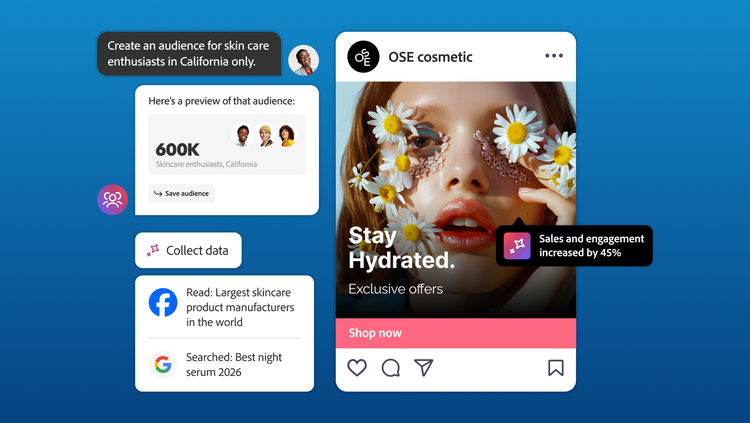
Adobe is making audience management in Real-Time CDP simpler, faster and more intelligent by embedding agentic capabilities directly into existing marketing workflows. With enhancements to Audience Agent — powered by Adobe Experience Platform Agent Orchestrator — and continued evolution of Audience Builder, marketers can manage audiences more efficiently while automating repetitive manual tasks.
Audience Agent can proactively alert teams when audience sizes change, explain why changes happened and help clean up downstream operations like unmapping audiences from destinations when they’re no longer needed. These capabilities reduce time spent on troubleshooting and maintaining audiences, allowing marketers to focus on strategy and activation instead of operational overhead.
Real-Time CDP is also making audience creation more intuitive within Audience Builder. Agent-powered field discovery helps marketers find the right attributes and events faster using natural language, while recommended fields surface commonly used data.
Marketers can create new audiences from existing ones, reuse saved definitions and scale creation without starting from scratch each time. Audience Agent will soon support audience optimisation by helping marketers build machine learning models aligned to specific campaign objectives, such as identifying profiles most likely to buy or convert.
Together, these innovations reflect Adobe’s continued investment in ‘audiences’ — an essential component of the customer experience process that helps organisations fully craft their data assets using structured and unstructured data, as well as first-, second- and third-party sources, to drive personalisation across channels. These advancements reduce complexity, guide marketers through their workflows and make audience creation and management more intelligent, streamlined and outcome-driven driven.
Advancing innovations in Real-Time CDP Collaboration.
First-party data alone is not enough to move from interest to engagement. Strong customer relationships depend on deep knowledge, context and respect. That’s why Adobe continues to enhance Real-Time CDP Collaboration.
This purpose-built data collaboration application — embedded directly within Real-Time CDP or available as a stand-alone offering — helps organisations discover, reach and measure high-value audiences. It connects customers to an ecosystem that safely expands their first-party data footprint.
New offerings are advancing the data collaboration category and expanding support for personas and use cases. A new agency-focused offering helps customers connect owned media with paid advertising for fully integrated and measurable engagement.
Real-Time CDP Collaboration, along with Adobe GenStudio for Performance Marketing, will soon support retail and commerce media networks and publishers with audience planning, onsite and offsite activation, creative generation and measurement through a self-serve portal. Real-Time CDP Collaboration Starter is now available, enabling organisations to invite, invest in, and collaborate with any brand, publisher, agent or data partner without licensing requirements for the invited party. This removes any barrier to scaling collaboration.
Enriching data and growing data assets are key in the agentic era. Real-Time CDP Collaboration helps businesses safely utilise new data assets to deepen their understanding of customer context.
Delivering personalisation at scale during peak business moments.
For large enterprises, personalisation happens continuously across multiple channels and touchpoints. But peak periods — like a large sporting event, an annual sale or a tentpole conference — become critical. These require trust and confidence that personalisation can be delivered consistently and at scale under high volumes of data and experiences.
Real-Time CDP provides enhanced visibility into utilisation and allows customers to scale critical capabilities, like streaming and edge segmentation, that make real-time personalisation work.
New dashboards help teams prepare for high-impact moments and ensure performance at scale. With the right tools in place, brands can confidently deliver impactful, high-volume, high-stakes experiences with built-in observability and control — now and in the future — as volumes surge and channel surfaces increase.
Building on the flexible approach to data composability.
Real-Time CDP offers a flexible approach to data composability to help customers orchestrate consistent and impactful experiences. With Adobe Experience Platform Federated Audience Composition, customers can enrich and activate audiences directly from their warehouse partners using zero-copy methodology with traditional data ingestion.
Adobe is expanding bi-directional, zero-copy data sharing with additional enterprise warehouse partners to support Snowflake, Google BigQuery and other partners.
Beyond these innovations, audience building now includes relational data objects from enterprise systems. These objects could include household relationships, product descriptions and other non-person data to support sophisticated audience creation and more precise targeting across B2B and B2C use cases.
Agentic capabilities are now embedded into existing composable workflows for better speed and efficiency. Customers can use natural language prompts — with human-in-the-loop validation — to set up data connections, perform modelling and support audience creation.
These flexible approaches ensure secure, compliant and efficient methods for audience creation and activation with minimal or zero-copy data movement efforts. In turn, this enables customers to drive a lasting impact by activating and orchestrating customer experiences across channels, using diverse data sources.
Powering the agentic era.
Real-Time CDP, with these new impactful capabilities, is empowering customers to be ready for the agentic era. This requires cultivating context-rich profiles that take semantic meaning into account, enabling visibility and monitoring, supporting flexible data composability, embedding agentic intelligence and facilitating data collaboration across the ecosystem.
Legacy customer data platform approaches — that relied solely on structured first-party data and rigid tools for connectivity and capacity management — are no longer sufficient. Modern customer experience requires refining massive experience data into actionable intelligence with context and control.
Customers can now harness and activate data in innovative ways — ensuring meaningful business impact like never before.
Ryan Fleisch serves as head of product marketing for Adobe Real-Time CDP and Audience Manager. His current role coupled with his previous leadership roles in solution consulting have allowed him to understand the technical nuances of marketing and advertising technology as well as the big-picture trends that are transforming the industry at large. Prior to Adobe, Ryan worked at J.Crew and iProspect allowing him to gain a strong understanding of challenges and needs from both a client and agency perspective