As AI takes on a greater role in enterprise operations, organizations must make increasingly consequential decisions about how they develop, deploy, and use the technology. These decisions include establishing appropriate oversight and managing risk.
Establishing an effective approach to AI governance helps enterprises navigate these responsibilities as AI adoption grows. With clear expectations and processes in place, organizations can pursue new AI applications while maintaining the controls needed to support responsible use and long-term business objectives.
This article will cover:
What is AI governance?
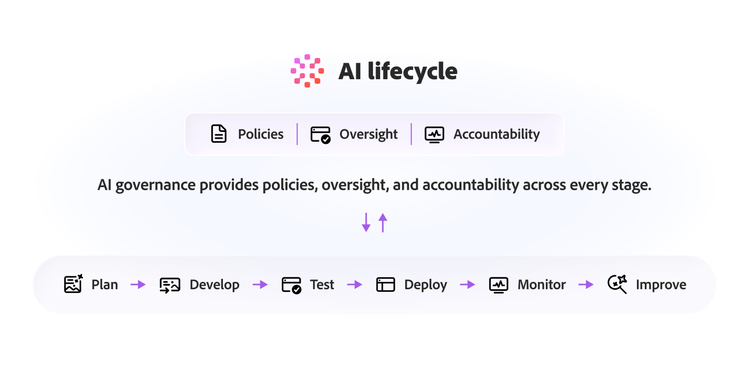
AI governance is the framework of policies, processes, roles, and controls that help organizations develop, deploy, and manage AI responsibly while balancing innovation, risk, transparency, and accountability.
Governance applies across the entire AI lifecycle, from data collection and model development to deployment, monitoring, and continuous improvement. Its scope extends beyond the technology itself to include the people who build and use AI, the data that powers it, and the processes organizations establish to evaluate its performance and oversee its use.
As AI adoption expands across business functions, organizations face growing challenges in maintaining consistent oversight. Different teams may adopt their own tools, establish separate practices, or operate without clearly defined governance responsibilities. These inconsistencies make it harder to understand how teams use AI across the enterprise and whether appropriate safeguards are in place. According to IBM’s 2026 Tech Leader Study, 77% of organizations surveyed report that AI adoption is already outpacing their governance capabilities.
Effective governance helps organizations manage these risks while creating a more reliable foundation for AI adoption. Clear policies and defined responsibilities give teams greater confidence in how they can use AI, while established controls help organizations maintain accountability as initiatives scale. These benefits may also extend to business performance. In PwC’s 2025 Responsible AI survey: From policy to practice, nearly 60% of surveyed executives reported that responsible AI improves ROI and efficiency, while 55% said it improves customer experience and innovation.
Governance for generative AI.
Generative AI introduces governance considerations related to the content it produces and how that content is used. Organizations need processes to evaluate the accuracy and reliability of generated outputs, protect sensitive information, and address potential intellectual property concerns. Transparency is also important, particularly when AI-generated content is used in customer-facing communications or influences business decisions.
Governance policies should establish appropriate usage guidelines and define when human review or approval is required. These requirements may vary depending on the application and its potential impact. For example, marketing teams may need to verify that generated content aligns with approved brand standards, while other business functions may prioritize the protection of confidential information.
Governance for agentic AI.
AI agents can access systems, perform tasks, and take actions on a user's behalf. Governance is needed to establish clear permissions and boundaries for what agents can access, what tasks they can perform, and what actions they can take.
These boundaries often depend on the impact of the task and the risk it carries. Enterprises should clearly define where agents can act independently and where human review or approval is needed.
Visibility becomes critical as agents perform more tasks. Teams need to track agent actions, monitor outcomes, and establish controls for intervention when needed. This makes it easier to identify issues, understand decision paths, and maintain accountability over time.
Components of an AI governance framework.
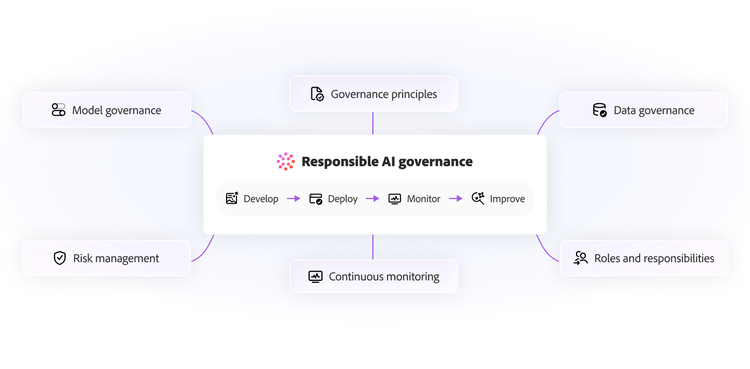
The structure of an AI governance framework depends on an organization's industry, risk tolerance, and level of AI adoption. A financial services company, for example, may require stricter controls than a retailer. Despite these differences, most enterprise frameworks share several foundational components that establish consistent oversight throughout the AI lifecycle.
Governance principles.
Governance principles establish the expectations that guide how an organization develops and uses AI. These principles provide a common foundation for decision-making and help teams evaluate whether their AI practices align with organizational values and responsibilities.
Core AI governance principles include:
- Transparency: Document how AI systems are developed, configured, trained, deployed, and used to support explainability, traceability, and auditing. Additionally, transparency around system limitations, intention, and restricted usage is important.
- Accountability: Assign clear ownership for AI systems, governance decisions, approvals, and even escalations.
- Fairness: Evaluate data and outputs for unintended bias. Monitor AI systems for unequal or harmful outcomes.
- Privacy and security: Protect sensitive data, control access, and secure AI systems throughout their lifecycle.
- Human oversight: Maintain appropriate human review and accountability for AI decisions and outputs. Effective oversight requires reviewers with the expertise, context, time, and authority to intervene or reject outcomes. For high-volume systems, risk-based escalation keeps reviews manageable, while logging and monitoring support auditability and continuous improvement.
Governance policies.
Governance policies translate organizational principles into specific requirements for AI development and use. They establish rules for handling data, adopting third-party tools, and determining which applications require additional oversight or restrictions.
These policies should also define how teams demonstrate compliance with established requirements. Clear policies help apply governance expectations consistently across departments while accounting for differences in risk.
Roles and responsibilities.
Effective AI governance requires clear ownership across the organization. The teams and individuals responsible for overseeing AI may vary depending on an enterprise's structure, industry, and regulatory requirements. Regardless of how responsibilities are distributed, organizations need to establish who has the authority to approve AI applications, assess potential risks, and address governance concerns.
Defining these responsibilities helps prevent gaps in oversight and supports consistent and accountable governance decisions throughout the AI lifecycle.
Data governance.
The quality and reliability of AI systems depend heavily on the data they use. Incomplete, outdated, or biased information can undermine model performance and contribute to inaccurate or harmful outputs.
Data governance establishes standards for how information is collected, maintained, accessed, and used in AI applications. Organizations need visibility into data sources and lineage, along with controls that protect sensitive information and maintain data quality. These practices can help AI systems operate with reliable information and support efforts to meet organizational and regulatory requirements.
Model governance.
AI models require oversight throughout their lifecycle, from initial development and testing to deployment, updates, and eventual retirement. Without clear processes, it is difficult to understand how a model was built, whether it meets performance expectations, or when it should be replaced. In addition to model governance, governance of the broader agentic ecosystem and infrastructure (including the harness and hooks, and increasingly complex agent workflows) should be considered. Enterprises should incorporate model governance standards for documentation, testing, validation, version control, and approval workflows. It should track performance standards and limitations. These practices support consistent oversight of both internally developed AI models and third-party AI systems.
Risk management.
Risk management helps organizations evaluate the potential consequences of AI use and determine the appropriate level of oversight for different applications. The process involves assessing the likelihood and impact of potential issues, including inaccurate outputs, biased decisions, security vulnerabilities, and regulatory concerns.
Not every AI application requires the same level of oversight. With a proper governance system in place, teams can assess the impact a potential risk has and take action.
Continuous monitoring.
AI governance requires ongoing evaluation as systems, data, and business requirements evolve. Models that initially meet performance expectations may become less reliable over time, making regular testing and monitoring essential for identifying emerging issues.
Organizations should monitor model performance, review outputs, and conduct periodic audits to identify potential problems. Monitoring should also extend to the governance framework itself. As AI capabilities and regulatory requirements change, teams need to evaluate whether existing policies, controls, and oversight processes remain effective. Findings from these reviews can inform improvements for both AI systems and the governance practices that support them.
How to implement AI governance.
Implementing AI governance requires organizations to translate governance principles into practical processes that guide how AI must be developed, deployed, and used. The approach should reflect existing business priorities and the organization's risk tolerance. The following five steps outline the foundational activities involved in establishing and maintaining an enterprise AI governance framework:
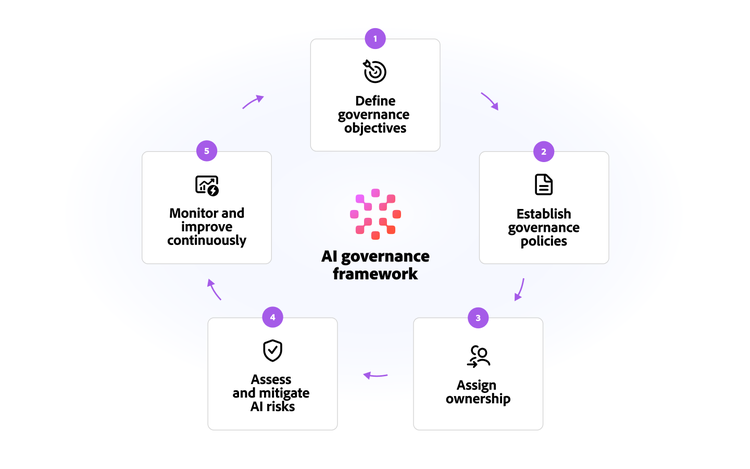
Step 1. Define governance objectives.
Begin by identifying what the organization needs from its AI governance framework. Objectives should reflect broader business priorities and account for the risks associated with current and planned AI applications. Defining these goals early helps organizations determine where oversight is most critical and provides a foundation for developing governance policies and evaluating their effectiveness.
Step 2. Establish governance policies.
Create governance standards that determine how AI systems are developed, deployed, monitored, and used. Cover areas such as data handling, documentation, human oversight, regulatory compliance, third-party AI tools, and restricted use cases. Document these requirements and communicate them across teams. Once defined, policies need to be communicated across business units and incorporated into existing operational processes.
Step 3. Assign ownership.
Determine which teams or individuals will be responsible for approving AI applications, assessing risks, and overseeing compliance with governance policies. Responsibilities should align with the organization's existing structure while accounting for the expertise required to evaluate different AI use cases. Some enterprises may establish dedicated governance committees or review boards, while others distribute oversight across existing functions. Documenting decision-making authority and escalation procedures helps ensure governance responsibilities remain clear as AI adoption expands.
Step 4. Assess and mitigate AI risks.
Evaluate AI systems for potential bias, privacy concerns, security vulnerabilities, inaccurate outputs, and intellectual property issues. Assess regulatory obligations, operational disruptions, and reputational impact. For high-risk use cases and regulated industries, consider red teaming, where independent experts or knowledgeable employees proactively test systems to uncover risks and vulnerabilities. Review risks before deployment and implement controls to mitigate identified risks as models, data sources, and requirements change.
Step 5. Monitor and improve continuously.
Establish ongoing monitoring processes to evaluate AI performance and identify emerging governance concerns after deployment. Regular reviews can reveal changes in model behavior, gaps in compliance, or controls that are no longer effective. Organizations should use these findings to refine governance practices and address issues before they affect broader operations. Periodic reassessment also helps ensure the framework remains aligned with evolving business needs and regulatory requirements.
AI governance, risk management, compliance, security, and responsible AI.
AI governance is closely connected to AI risk management, compliance, security, and responsible AI. Each serves a distinct purpose in how organizations develop and use AI, with governance providing the overarching framework for establishing accountability and coordinating oversight. Understanding these distinctions helps clarify how each discipline works together to support responsible AI adoption:
Get started with AI governance.
Effective AI governance provides the structure organizations need to manage AI responsibly as its capabilities and applications evolve. Establishing clear expectations for AI use, defining accountability, and maintaining ongoing oversight can help enterprises scale adoption while managing emerging risks.
For marketing and creative teams, these governance considerations also extend to how AI-generated content represents the brand. As content production expands, organizations need ways to maintain consistency with established brand standards across teams and workflows. Adobe Brand Intelligence supports this effort by centralizing brand knowledge and helping teams check AI-generated content against uploaded brand guidelines. It supports brand governance and doesn’t replace an organization’s broader AI governance, legal, or compliance processes.
Disclaimer: This article is for general informational purposes and isn’t legal advice. Requirements vary by industry and jurisdiction, so consult your legal and compliance teams.
Recommended for you
https://business.adobe.com/fragments/resources/cards/thank-you-collections/brand-intelligence