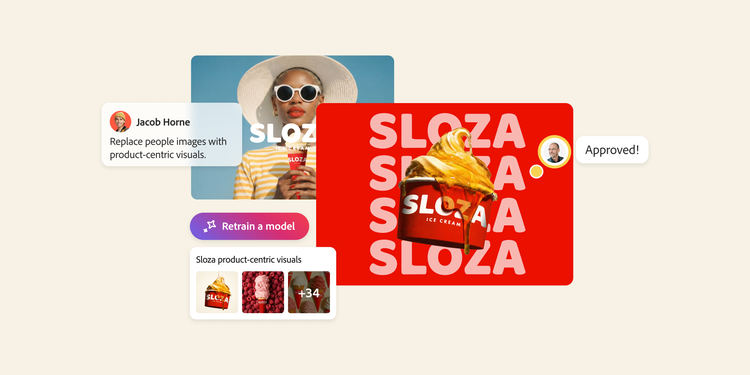
AI models are actively changing how enterprises approach creative production. Imagine this increasingly common scenario: AI/ML researchers and software engineers trained a custom AI model on their brand's visual assets to generate content more efficiently. The early results were impressive. Content moved through production faster, creative teams spent less time recreating visual iterations, and outputs consistently reflected the brand. Six months later, however, the visual outputs felt outdated and inconsistent. They no longer matched the tone or creative direction that teams expected.
The brand kept evolving with new campaigns, an updated visual identity, and a shift in messaging, while the model continued to generate content based on what it learned the day training ended. Enterprises face this challenge as they scale creative production with AI. Models trained on brand assets do not produce relevant content on their own. Over time, they may not reflect evolving brand standards, business priorities, or campaign shifts.
According to Adobe's 2026 AI and Digital Trends Report, 76% of 3,000 surveyed executives and practitioners in CX roles report either strong or moderate improvements in the volume and speed of content production with generative AI. As enterprises continue investing in custom AI models to scale creative production, it’s just as important to maintain model quality after configuration and deployment. Retraining AI models is important for teams to maintain content quality, consistency, and brand alignment in AI-generated outputs.
The article will cover:
What is model drift in generative AI models?
Organizations often focus on training, configuring, and deploying AI models and assume their performance will improve over time. In practice, AI adoption follows a curve. The model does not change after deployment, but brands do.
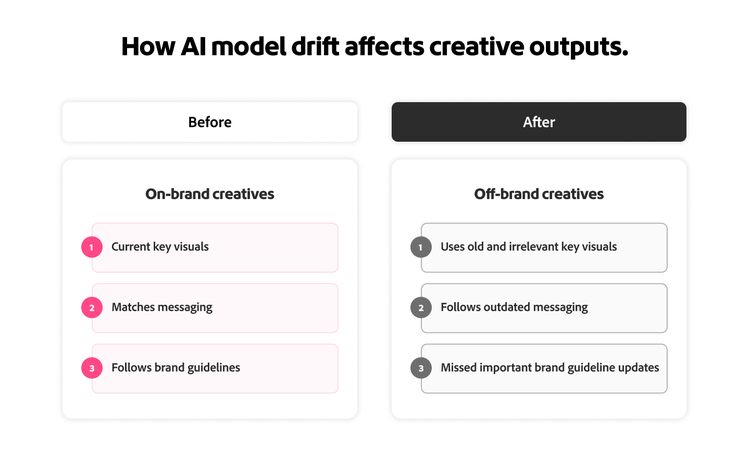
Model drift happens when a generative AI model continues to generate content based on past training while the brand evolves. The model does not automatically adapt to new brand guidelines, visual trends, creative strategies, or business priorities. Over time, its outputs become less aligned with the brand.
For example, a retail brand trains a model using assets from a holiday campaign. A year later, the brand may shift to a more minimalist aesthetic with different styling, color choices, and visual priorities. If the model is not updated, it will generate content that reflects warm, bright colors, visuals, and seasonal cues related to the earlier campaign rather than the brand's current direction.
As a result, the model’s output may reflect outdated positioning, messaging, or design choices. As audience expectations, market conditions, and brand priorities shift, the model's definition of on-brand content can become less relevant.
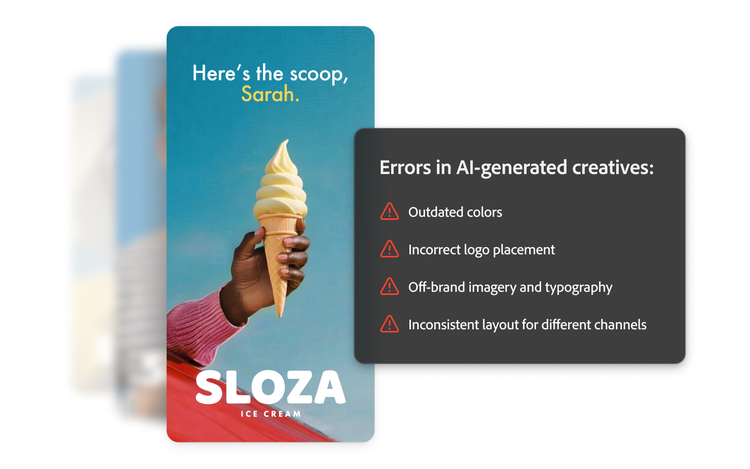
For creative teams, drift rarely appears as a sudden failure. Instead, it happens when small inconsistencies build over time. For instance, a creative strategy team updates visual guidelines such as logo placement, color palette, and visual themes. Team members may add nuances to the guidelines, but they didn’t provide them as feedback to developers so that they could update the AI model. As a result, the gap between what the brand wants and what the AI produces grows. The model may continue to generate imagery with outdated color palettes, photography styles, logo placement, or messaging frameworks that no longer match current brand standards. The outputs may still look professional, but they are no longer on-brand.
Signs of model drift.
Model drift usually shows up as recurring issues across reviews, approvals, and production cycles.
Here are some common signs:
- Assets no longer match the brand's visual identity. The model generates images and animated creatives with outdated color palettes, styling conventions, or overall visual direction.
- Outputs feel generic. Content looks polished and technically correct, but it lacks the visual cues that make the brand recognizable and distinct. It feels generic rather than on-brand.
- Review teams reject more assets. Creative directors and brand managers increasingly find that outputs do not align with current campaign goals or brand guidelines.
- Teams spend more time on manual corrections. Designers often need to retouch images, adjust layouts, replace visual elements, or refine brand details before assets are ready for use.
This means that outputs are "close enough, but not quite right." Assets consistently miss subtle creative cues and require revision before they meet brand standards.
Unlike analytical AI systems, creative AI drift is harder to detect because the signs are more qualitative than quantitative. These signs can’t be measured with performance metrics and require a human to identify them. Regular creative reviews and proactive monitoring can help detect inconsistencies before they reach the customer through marketing campaigns.
How to monitor AI models for drift.
Enterprises scaling content across regions, channels, and audiences produce multiple creative assets with AI models each month. To keep those assets aligned with current brand standards, teams need a clear process for monitoring quality over time.
In practice, creative and marketing teams should regularly review AI-generated imagery against the brand's current visual identity, voice, and creative direction. By identifying quality issues early, enterprises can align outputs with current brand standards and create a strong content supply chain.
A comprehensive monitoring framework includes:
- Conduct regular creative reviews. Audit AI-generated assets against current campaigns, visual guidelines, and brand priorities. A visual asset can follow every documented brand rule and still miss the mark. Quarterly reviews help teams identify patterns that may not be visible in individual assets.
- Track workflow signals. Monitor rejection rates from creative directors and brand reviewers. Measure how often designers need to retouch assets or make manual adjustments before approval. More review time can signal a growing gap between the model and the brand's current creative direction.
- Maintain a benchmark library. Create a reference set of approved outputs when the model is first deployed. Teams can compare new outputs against this baseline to evaluate changes in quality, consistency, and brand alignment over time.
- Establish feedback loops. Keep track of all the instances when creative directors, brand managers, and distributed marketing teams flag recurring quality concerns, approval issues, and signs of drift. This feedback helps teams determine when a model requires updates or retraining. Identifying the instances in which AI models are helpful to creative teams and when they pose challenges is important.
- Document reviews and model updates. Maintain records of model performance, review decisions, feedback, and retraining activities. This creates an auditable history that supports broader AI governance.
Of 1,600 marketers surveyed, 71% expect content demand to increase fivefold by 2027. As brands scale production to meet this demand, they also need to stay in touch with creative standards. Effective model monitoring helps organizations balance both objectives by retraining models before quality begins to decline.
When to retrain AI models.
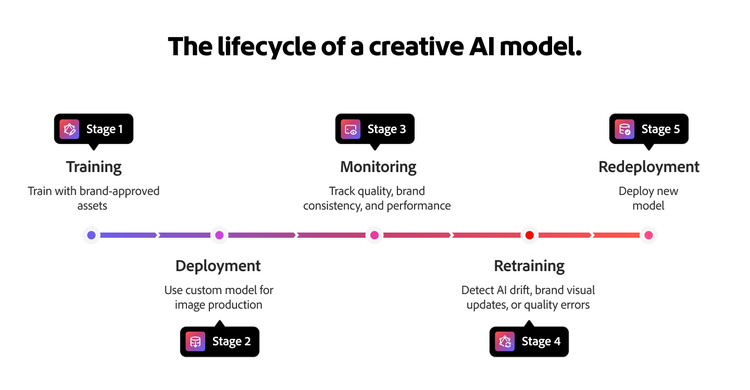
Retraining is not a one-time fix. It is an ongoing process that helps AI models uphold brand standards. Teams need clear signals to determine when a model no longer reflects the brand's identity and needs an update.
Common retraining triggers include:
- Scheduled retraining: Update the model at planned intervals, such as before major campaigns, seasonal launches, or brand refreshes. For example, an enterprise should retrain its model with the latest campaign assets and creative guidelines ahead of the holiday marketing season.
- Threshold-based retraining: Retrain the model when output quality starts to decline. An increase in rejected assets, frequent manual edits, or repeated reviewer feedback is a clear indicator that the AI model doesn’t meet brand expectations.
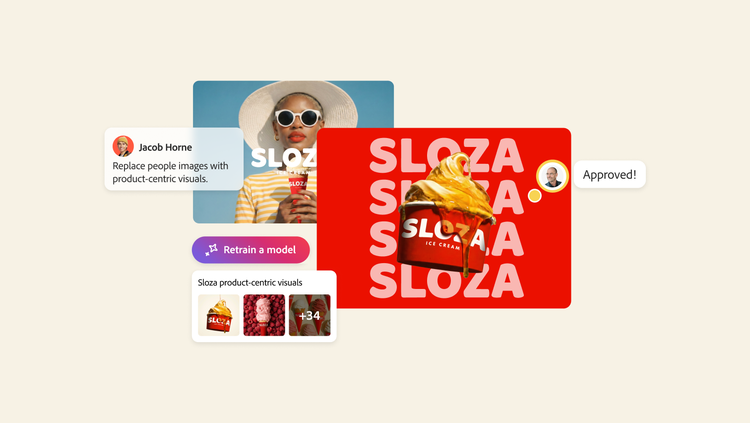
- Event-based retraining: Retrain the model when the organization introduces a new visual identity, brand positioning, product portfolio, or creative strategy. For example, a company moving from product-centric marketing to lifestyle storytelling should update the model with new images and creative references.
No single retraining schedule works for every enterprise. The right approach depends on how frequently campaigns, creative standards, and business priorities change. By combining scheduled reviews with performance-based triggers, marketing teams can inform developers when to retrain the models.
When to retire an AI model instead of retraining.
In some cases, retraining is not the best option. Organizations should retire an AI model when its training data no longer reflects the brand or when it can no longer meet quality, governance, or compliance standards. For example, if a brand undergoes a major repositioning or adopts new content-creation requirements that the existing model cannot support, it may be more efficient to deploy a new model rather than continue retraining an outdated one.
For organizations that use custom AI models, knowing when to retrain and when to retire a model helps maintain brand consistency while scaling AI-driven content creation.
How to retrain AI models.
Retraining does not mean rebuilding the model from scratch. In many cases, it is closer to how creative teams refresh brand guidelines or update content libraries over time.
Development teams can retrain a custom AI model with newer brand assets, approved campaign materials, and updated creative references. This helps generate outputs that better reflect the brand's current visual direction, messaging, and aesthetic choices. The goal is to help the AI model learn what "on brand” looks like today.
To improve AI-generated outputs, follow this three-step approach:
- Train with current, high-quality assets. Use approved campaign materials, design systems, and creative assets that reflect the brand's latest visual identity.
- Validate outputs against established benchmarks. Compare new outputs with performance and quality standards defined during deployment and ongoing monitoring.
- Review outputs against active campaigns. Check whether generated assets align with the creative standards currently in the market before rolling them out at scale.
This allows the AI model to understand what has changed and adapt accordingly. Teams should also document when and why a model was retrained, along with the data and brand assets used. This helps create a record of model updates. This record supports governance and makes it easier to investigate issues if outputs change over time.
Continue creating on-brand content with model retraining.
AI model drift is a natural part of using AI to develop creative assets over time. Teams that incorporate monitoring and retraining into their creative operations can keep AI-generated creative assets aligned with changing brand standards and business priorities. As organizations increase content velocity and reduce reliance on manual production work, creative judgment remains essential for evaluating what feels on-brand and what does not. These decisions continue to play an important role in responsible AI.
Enterprise AI continues to evolve, and model quality needs to evolve with it. Adobe Firefly Custom Models allows teams to train, refine, preview, and retrain models using their own branded assets. Treating retraining as an ongoing practice helps scale content production without sacrificing brand quality and keeps content aligned with changing creative directions. Request a demo to see how Firefly Custom Models can help you create on-brand content at scale.
Disclaimer: Features vary across model providers. Be sure to check what is available to you.
Recommended for you
https://business.adobe.com/fragments/resources/cards/thank-you-collections/firefly