An AI model registry provides the foundation for governance. More importantly, it helps organizations translate policies into day-to-day operational practices.
Three capabilities are particularly important in this process — version control, access management, and audit trails. Together, they help organizations maintain visibility and accountability as AI adoption scales.
Version control
AI models are not static. They evolve as organizations update training data, refine performance, adopt new policies, or adapt to changing brand standards.
Consider a company that refreshes its visual identity, updates its color palette, and re-trains a custom model using updated brand assets. Without clear version control, teams may continue using retired and replaced models, leading to inconsistent outputs across teams, campaigns, and regions.
An AI model registry addresses this by tracking every model version with a unique identifier, change history, and rollback capability. Teams can see when a model was updated, what changed, and which version is approved for production.
This record becomes particularly valuable during reviews and audits. If an asset generated months earlier is questioned, organizations can attribute it to the exact model version that created it.
Teams that lack this clarity risk producing content with one version while attempting to audit another.
Access management
Not everyone in an organization may need the same level of control over enterprise AI models.
Access management enables teams to define who can view, train, configure, modify, deploy, or decommission models based on their roles and responsibilities. Clear permission structures ensure that model changes occur through established processes rather than ad hoc decisions that may create compliance risks.
Custom generative AI models make the need for controlled access particularly apparent. If unauthorized users modify the model, they may unintentionally affect visual style, output quality, or brand consistency. What begins as a small adjustment can quickly influence content produced across the organization.
Strong access controls can also reduce the risk of shadow AI initiatives, unauthorized deployments, and policy violations without creating bottlenecks.
Well-governed access management can give teams fast, self-service access to approved models while maintaining appropriate oversight. More importantly, it establishes accountability for the systems influencing enterprise content, experiences, and decision-making.
AI audit trail
Effective governance depends on more than tracking changes. Organizations also need to understand how and why those changes occurred.
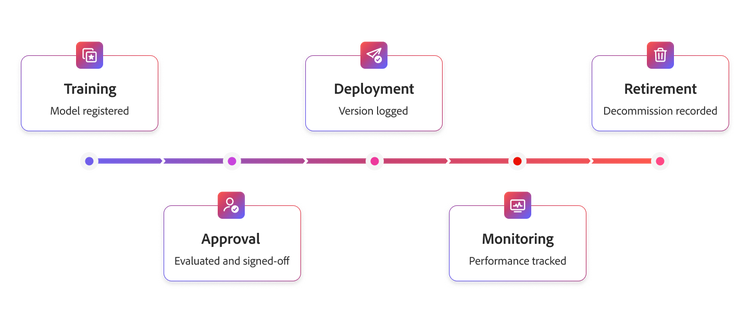
An AI audit trail records activity throughout a model's lifecycle, including who trained and configured a model, who approved it, when it was deployed, and which version was used to generate a specific output.
The resulting record follows a model throughout its lifecycle — from development to production use.
For organizations using AI-generated content, this level of traceability is important. Internal stakeholders, external partners, and regulators expect transparency into how content was created and which systems influenced it, and an audit trail provides that evidence. This concept closely aligns with content credentials, which attach metadata to digital assets and provide additional context about how they were produced.
An audit trail allows teams to govern AI models proactively. Instead of scrambling to reconstruct decisions after an audit request or governance review, organizations have a continuous record of model activity readily available.
Without a registry, piecing together that history across creative, marketing, and IT systems is a challenge.