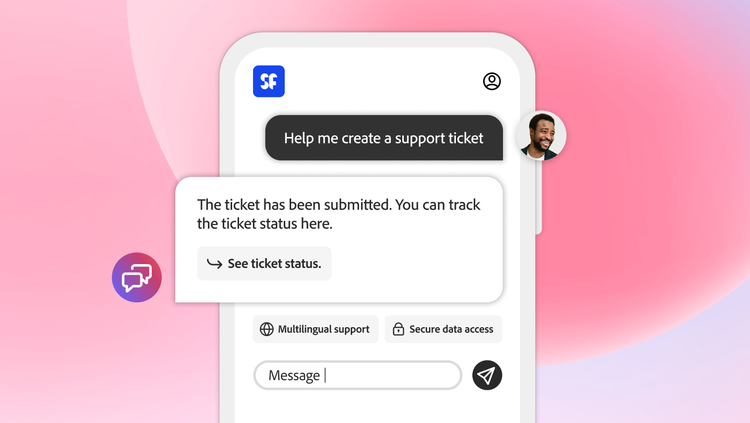
Agentic AI-powered self-service can reduce customer support load.

Enterprise leaders face a persistent challenge: scaling customer support quality while managing costs and agent burnout. Agentic Artificial Intelligence (AI) can provide automated self-service solutions that empower both customers and support teams.

As customer expectations rise and support volumes grow, traditional approaches struggle to keep pace. AI in customer service has changed how enterprises deliver high-quality customer support. Self-service AI agents can enable customers to resolve issues independently while freeing customer support representatives to focus on high-value interactions with customers. The result is a customer support system that scales efficiently without sacrificing the service quality your customers need.

Jump to section:

How can agentic AI transform customer service?

AI in customer service has developed beyond scripted chatbots. Today, agentic AI can reason, plan, and execute multi-step tasks autonomously. AI Agents can understand intent, maintain context across multi-step interactions, and improve over time through governed fine-tuning, analytics, and feedback.

For leaders evaluating customer support technology, the distinction between these systems is fundamental to understanding their impact on customer experience:

Type

How it Works

Capabilities / Limitations

Traditional Chatbots
Recognize keywords and deliver pre-written responses from a fixed script.
Best for simple FAQs; fails or loops when the request is unique.
Basic Automation
Follows a linear decision tree to route users or provide status updates.
Transfers customers to a human agent as soon as a request deviates from the path.
Agentic AI
Interprets user intent, accesses multiple data sources, and orchestrates complex workflows.
Can troubleshoot, diagnose, and resolve issues that previously required human expertise.

The impact on global operations.

This shift from routing to resolving can make customer service interactions more effective at scale. Agentic AI needs to be configured to support dozens of languages fluently. With the right language support, governance, and knowledge sources, enterprises can expand global service coverage. This can help a customer who reaches out in French, Japanese, or English to receive valuable assistance.

Analyzing patterns and root causes.

The value extends beyond individual conversations. AI-powered conversational systems can surface recurring intents, sentiment patterns, and issue clusters, helping teams optimize self-service experiences and prioritize fixes. This allows an enterprise to identify patterns before they become a widespread issue, turning support into a source of proactive business intelligence.

Measuring success and efficiency.

To ensure the technology is genuinely improving the experience rather than just hiding the volume, leading enterprises track specific indicators of health:

  • Containment and satisfaction: Monitoring the percentage of issues resolved entirely by AI alongside customer satisfaction scores.
  • Operational health: Tracking cost-per-contact and first-contact resolution to measure efficiency.
  • Agent empowerment: Measuring agent satisfaction and the average handle time for escalated cases. A key question to ask is: when AI handles the routine stuff, are the remaining complex cases easier for human staff to manage?

These metrics can help enterprises validate if their AI in customer service strategy is delivering added revenue and customer satisfaction.

What are the key benefits of AI-powered self-service?

AI-powered customer self-service delivers measurable improvements in operational efficiency, customer experience, and human agent workload, creating a virtuous cycle that compounds value over time.

Automate routine tasks and provide 24/7 availability.

The most immediate benefit of a conversational self-service system is automating high-volume, repetitive inquiries. Password resets, order status checks, account balance inquiries, and subscription management represent significant portions of support volume across industries. An AI ticketing system can handle these requests instantly, regardless of time zone or staffing levels.

Research from McKinsey indicates that AI-powered automation can handle up to 70% of customer interactions without human involvement, dramatically reducing queue times and operational costs. This around-the-clock availability can limit customer frustration when they need help outside business hours or during peak periods.

Enhance self-service and empower customers.

Self-service AI agents go far beyond static knowledge bases. Intelligent systems guide customers through interactive diagnostics, asking clarifying questions, and adapting recommendations based on responses. AI-supported personalization means that each customer can receive guidance tailored to their specific situation, product configuration, and history.

This approach transforms self-service from a cost-reduction tactic into a genuine customer experience improvement. Many customers prefer resolving issues independently when given effective tools, and they value the speed and convenience of not waiting for a human agent to be available. Guided self-service can resolve issues faster than traditional customer service channels.

Gartner predicts that by 2029, agentic AI will resolve 80% of common customer service issues without human intervention. Enterprises that invest now in building robust self-service capabilities position themselves to capture this efficiency.

Reduce operational costs and improve efficiency.

The business case for AI-powered enterprise support extends beyond simple cost-per-contact calculations. Automation does reduce the volume of interactions requiring human customer support agents. However, the strategic value lies in how enterprises redeploy newly available resources.

IBM found that organizations operating or optimizing AI in their customer service functions reported a 17% increase in customer satisfaction. This dual benefit reflects the reality that faster resolution and 24/7 availability directly enhance customer experience. Additionally, efficiency gains compound over time as AI systems learn from each interaction.

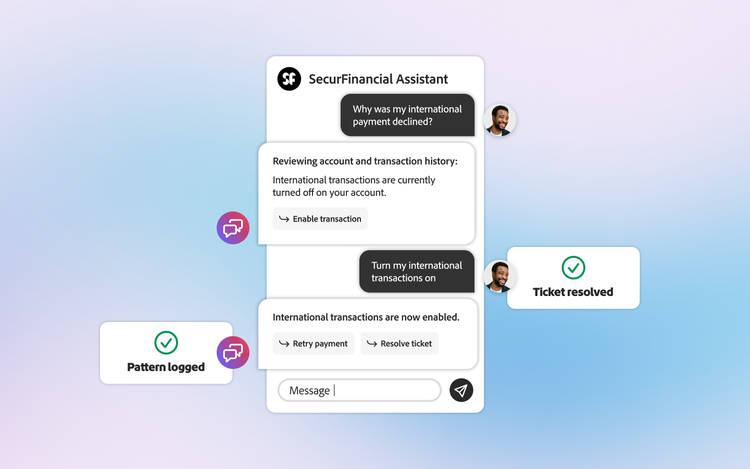
Visual of an AI support assistant enabling an international payment, logging the issue, and resolving the ticket.

Introducing Adobe Brand Concierge.

Adobe Brand Concierge is an AI-powered conversational experience designed for product discovery, evaluation, and engagement across brand-owned digital properties. It helps brands guide consumers and business buyers through complex journeys, moving from exploration to confident decisions through natural, brand-guided conversations.

Rather than relying on static pages or traditional search, Brand Concierge turns discovery into a conversational experience. It interprets customer intent in real time and responds with relevant, personalized guidance grounded in brand-approved content and first-party data. Each interaction can adapt to where the customer is in their journey, whether they are seeking inspiration, comparing options, or ready to take action.

Learn how Brand Concierge supports product discovery, decision support, and self-service knowledge experiences through the examples below.

Interactive guidance and diagnostics in natural language.

Brand Concierge engages customers through natural, brand-guided conversations rather than predefined or scripted exchanges. When a visitor describes a need or challenge, Brand Concierge interprets intent, asks relevant follow-up questions, and guides them through next steps using brand-approved content and domain knowledge.

These AI-powered conversations create an experience that feels closer to engaging with a knowledgeable advisor than relying on scripted chatbots or static support content. Brand Concierge understands context from previous messages, retains relevant details, and adapts responses based on what has already occurred in the conversation. Customers receive guidance tailored to their situation, whether they are comparing products, planning an experience, or resolving a known issue.

Seamless handoff to sales and support teams.

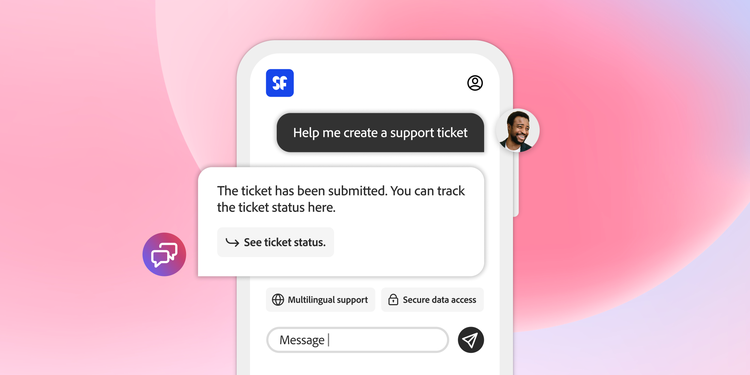
Brand Concierge captures the full conversational context when a human team is required. This includes the original questions, expressed preferences, content shared, and steps already taken, and then routes the customer to the appropriate team. Depending on the use case, this can include booking a meeting with a B2B sales representative, routing to a live B2B support agent, and triggering a follow-up journey or task in connected systems.

This context-rich handoff ensures human teams start with a complete understanding rather than asking customers to repeat information. Teams can focus immediately on resolution or recommendation, while organizations benefit from reduced handle times and more consistent, connected experiences.
The human-AI partnership in B2B and B2C customer support.

Successful enterprises that implement Brand Concierge recognize its role in extending and supporting high-performing human teams. Brand Concierge handles high‑volume and routine interactions, while human customer support teams focus on situations that require empathy, creativity, and nuanced judgment.

This approach allows B2B and B2C customer support teams to operate as strategic problem solvers. Instead of spending time on repetitive requests such as password resets or order status checks, human teams engage with customers who have more complex needs or require deeper guidance.

Human involvement remains essential in situations involving emotional customers, novel scenarios, or decisions with significant business impact. Brand Concierge is designed to recognize these moments and escalate appropriately, ensuring customers are connected with human support when it matters most.

When Brand Concierge and human customer support teams work together effectively, organizations can reduce support team burnout while improving overall service quality. Support teams build skills in oversight, complex problem resolution, and customer relationship management, enabling enterprises to deliver more consistent, high‑quality customer service experiences.

See how Brand Concierge can transform product discovery and engagement today.

Let’s talk about what Adobe can do for your business.

Get started