AI search insights: Why 59% of shoppers abandon brands for AI recommendations.
10-05-2026
Fifty-nine percent of consumers will abandon a preferred brand for an unfamiliar competitor the moment an AI tool recommends it instead. That single statistic captures the risk now facing every brand competing in conversational search: the assistant sitting between a shopper and a purchase decision can make or break a brand relationship in one exchange.
To understand exactly how this shift is playing out, Adobe for Business surveyed 1,011 U.S. consumers who use large language models, including ChatGPT, Claude, Gemini, and Perplexity, to research, compare, and choose what they buy. The findings below map how trust, discovery, and loyalty are being rebuilt around AI recommendations. To help enterprises navigate this shift, Adobe for Business examines what these changes mean for any brand aiming to maintain large language model (LLM) visibility in this new search-everywhere landscape.
Key findings summary.
- 59% of consumers will abandon their preferred brand for an unfamiliar competitor if AI recommends it.
- 83% of consumers stick with a brand they first discovered through AI, making it a long-term catalyst for brand switching.
- 61% stay with the AI-recommended brand for better value, and 60% stay for superior quality.
- 35% of consumers see incorrect AI-produced data as a shared ecosystem mistake, but when blaming a single party, 38% point to AI platforms versus 13% who blame the brand.
- 59% of consumers lose trust in a brand if AI displays incorrect information about it.
- 36% of consumers trust traditional search and AI search equally, while 27% already trust AI search summaries more than traditional search.
- 47% of website click-throughs from AI are triggered by side-by-side brand evaluations, while key feature summaries drive 42%.
- 95% of consumers use AI to research purchases under $500, making AI visibility essential for capturing high-intent commerce.
These findings show that AI is opening a new door for brands to connect with shoppers exactly when they're ready to buy. Instead of competing for the top link on a results page, marketers now have the chance to introduce their brands through helpful recommendations that consumers already trust and return to. Keeping product information accurate and easy to find is what turns a routine comparison into a lasting customer relationship.
Why are consumers bypassing traditional search for AI recommendations?
Discovery has become a distributed decision system: shoppers now trust an AI assistant to do the heavy lifting, such as analyzing features, running side-by-side comparisons, and delivering a direct recommendation, rather than digging through pages of search results themselves. That shift is replacing the old link-hunting routine as the default way people find what to buy.
For today's marketer and search optimizer, that shift means moving past classic page rankings and toward content built for how language models retrieve information. Getting this right positions a brand to capture the new non-funnel shopper during what we call a zero-click journey.
Zero-click journeys are shifts in user behavior where a customer’s search intent or discovery process is fully resolved inside an interface — like an AI-powered answer engine, a conversational chatbot, or a feature-rich search results page — without the user ever clicking through to an external brand website.
What is AI search optimization?
AI search optimization, also referred to as AI search engine optimization, or LLM visibility, is the practice of structuring enterprise content and product data so it can be parsed, indexed, and surfaced by language models, not just traditional search algorithms. When done well, it gives brands reliable visibility inside conversational, always-changing search environments.
Why does AI search matter for brands?
Visibility inside conversational interfaces increasingly decides whether a brand gets discovered at all, since more consumers are skipping standard search results in favor of a direct recommendation. Brands that don't structure their data for this shift risk quietly disappearing from a shopper's journey — never ranked, never rejected, simply never mentioned.
How does AI search change customer behavior?
AI recommendations are rewriting how brands win and keep customers: 62% of consumers say they've bought from a brand they wouldn't otherwise have considered, based strictly on an AI recommendation. Brand loyalty has long been viewed as one of a company's strongest competitive advantages, but AI is beginning to reshape that dynamic, influencing which brands consumers discover first and which ones they continue buying from. Rather than reinforcing existing preferences, conversational AI is expanding consumers' consideration sets by creating new opportunities for challenger brands while increasing the risk of customer loss for established players.
The willingness to switch brands isn't confined to one or two industries, either: 59% would try an unfamiliar competitor over their preferred brand if AI recommended it, rising to 64% among Gen Z. Consumers reported they would consider AI-recommended alternatives across almost every major retail category:
- Automotive parts and accessories: 69%
- Beauty and personal care: 69%
- Groceries and food delivery: 69%
- Health and wellness products: 68%
- Apparel and accessories: 67%
- Books and media: 65%
- Home goods and furniture: 64%
- Electronics: 63%
- Travel and accommodation: 60%
Rather than disrupting isolated markets, AI recommendations are influencing purchase decisions across the consumer economy.
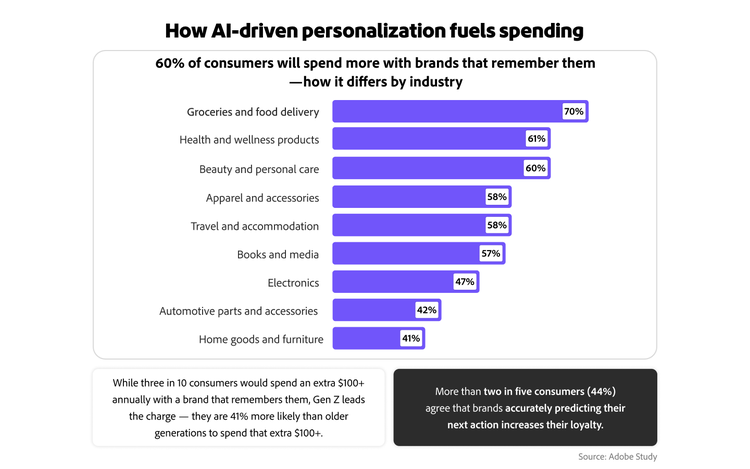
83% of consumers continue purchasing from brands they first discovered through AI recommendations, showing that conversational search can create lasting customer relationships in addition to one-off purchases. Repeat business is ultimately earned delivering on customer expectations. Better value for money (61%) and better product quality (60%) are the biggest reasons consumers stay loyal after an AI-driven discovery, well ahead of factors such as discounts, customer service, or rewards programs.
What keeps consumers coming back also varies by audience. Men are 24% more likely than women to remain loyal because of lower prices, while women are 73% more likely to stay with brands that better align with their personal preferences. Gen Z and Baby Boomers are most likely to return because of product quality (63% and 58%, respectively), while Millennials and Gen X place greater emphasis on value for money (59% and 58%, respectively). AI may earn brands a place in the consideration set, but long-term loyalty still depends on delivering the quality and value customers expect.
How can brands improve visibility in AI search?
If AI recommendations increasingly determine which brands consumers consider, then being absent from those recommendations can be just as significant as appearing in them. While many shoppers will continue searching for a preferred brand, our research suggests they're also willing to explore alternatives or change how they search when AI doesn't return the result they expect.
When consumers can't find their preferred brand in AI recommendations, they typically respond by:
- Searching for their preferred brand manually: 49%
- Searching for alternatives outside the AI tool: 37%
- Researching why their preferred brand wasn't recommended: 36%
- Rephrasing their query to the AI tool: 34%
- Asking friends or family for recommendations: 22%
- Choosing one of the AI-recommended brands: 21%
- Delaying their purchase decision: 18%
- Browsing social media for recommendations: 17%
On average, consumers need 2.15 attempts before AI surfaces their preferred brand. Gen Z is also 53% more likely than older generations to turn to social media when their preferred brand is missing, highlighting how quickly younger consumers move between discovery channels when AI doesn't provide the answer they're looking for.
The takeaway: LLM visibility is a data problem, not a ranking one. Being left out of an AI recommendation can cost as much as being buried in the results page. Brands earn a place in AI answers when their public data is accurate, structured, and consistent everywhere a language model can read it.
27% of consumers already trust AI search summaries more than traditional search.
Securing visibility in AI search is only half the challenge. Brands also need to earn and maintain consumer trust as shoppers increasingly rely on AI-generated recommendations alongside traditional search. Rather than replacing search engines entirely, AI is becoming another trusted source of product discovery, meaning brands must deliver accurate, consistent information wherever consumers choose to research.
How does AI search differ from traditional search?
Traditional search engines rank webpages based on signals like keywords, backlinks, and authority, leaving users to evaluate multiple sources themselves. AI search takes a different approach by synthesizing information into a single response, comparing products, summarizing key features, and recommending options based on user intent rather than simply returning a list of links.
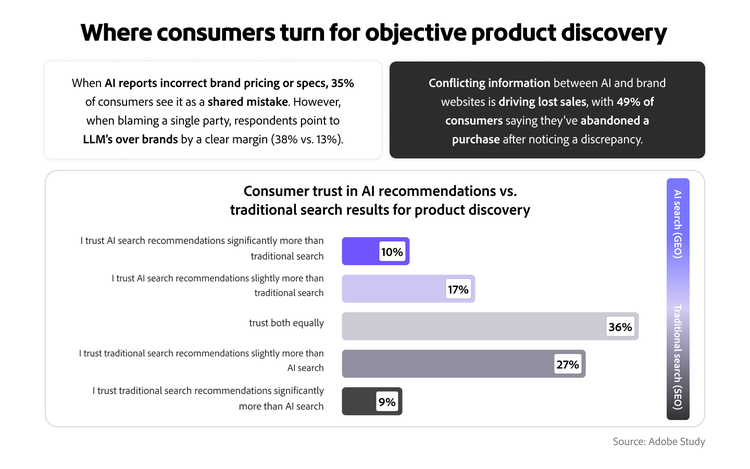
Consumers are already placing significant trust in those recommendations. Our research found that:
- 36% trust AI search and traditional search equally.
- 27% trust AI-generated search summaries more than traditional search.
- Within that group, 10% trust AI recommendations significantly more than traditional search.
That growing confidence doesn't mean consumers accept AI responses without question, however. 64% say they verify AI-generated information against a brand's website at least most of the time, including 30% who always check. Gen Z is slightly less likely to verify information, with 61% checking always or most of the time, suggesting younger consumers may become increasingly comfortable relying on AI as these tools mature.
How does AI search affect marketing?
59% of consumers say they lose trust in a brand when AI displays incorrect information about it, even if the brand wasn't responsible for generating the response.
When AI presents incorrect pricing or product specifications, consumers don't always blame brands directly. Instead:
- 35% see it as a shared responsibility across the AI ecosystem.
- 38% place the blame on the AI platform itself.
- Just 13% blame the brand directly.
Gen Z is 22% more likely than older generations to blame the AI platform, highlighting a generational shift in how responsibility is assigned when recommendations go wrong.
Even so, brands still bear the commercial consequences. Whether inaccurate information originates with the AI model or outdated public-facing content, consumers are likely to associate those inconsistencies with an unreliable buying experience.
What are AI search marketing tactics?
That trust gap has a direct cost: 49% of consumers say they've abandoned a purchase after noticing a discrepancy between what an AI tool told them and what they found on a brand's website. When pricing, specifications, or product details don't align, uncertainty can quickly outweigh purchase intent.
For any modern search engine optimization (SEO) practitioner, closing that gap comes down to three structural practices that treat public-facing data as infrastructure rather than a one-time project:
- Keep your data identical everywhere: Keeping pricing, specifications, and product descriptions identical across every public-facing channel, so no two sources give an AI model conflicting information to reconcile.
- Structure your data with schema: Using structured data and schema markup so language models can parse product details accurately rather than inferring them from unstructured text.
- Maintain one source of truth: Maintaining up-to-date product documentation and knowledge hubs, and auditing public-facing content on a regular cadence, so AI systems always reference one current source of truth.
As AI becomes a larger part of the purchase journey, brands that invest in accurate, structured, and consistently maintained information will be better positioned to build trust, reduce friction, and convert AI-driven product discovery into confident purchasing decisions.
How can brands convert AI search recommendations into website referral traffic?
One of the biggest misconceptions about AI search is that it eliminates website traffic altogether. While AI often answers questions directly, our research shows consumers still click through to brand websites when they need to verify information, compare products, or continue their purchase journey. The challenge for brands is understanding which types of AI responses are most likely to generate those visits and ensuring the information consumers find matches what the LLM recommended.
What triggers consumer click-throughs from AI recommendations?
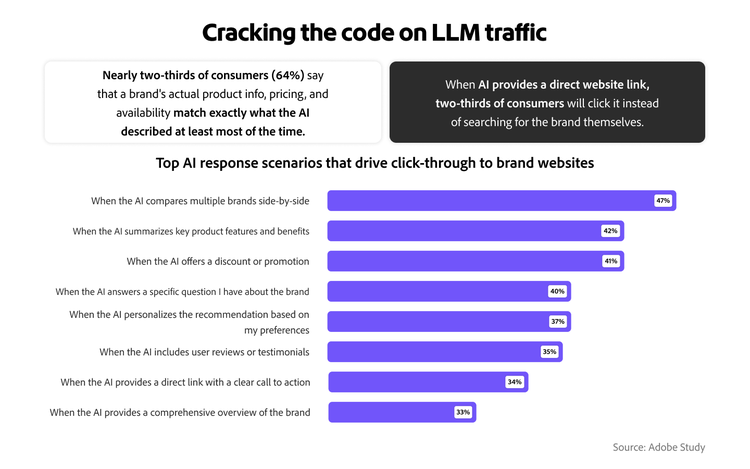
Consumers are most likely to leave an AI conversation when they're ready to evaluate a purchase more closely. When AI provides a direct website link, nearly two-thirds of consumers (64%) say they'll click it rather than search for the brand themselves. Our research also highlights the types of responses that most often encourage referral traffic:
- AI compares multiple brands side by side: 47%
- AI summarizes key product features and benefits: 42%
- AI offers a discount or promotion: 41%
- AI answers a specific question about the brand: 40%
- AI personalizes recommendations based on user preferences: 37%
- AI includes customer reviews or testimonials: 35%
- AI provides a direct link with a clear call to action: 34%
- AI provides a comprehensive overview of the brand: 33%
Consumers are most likely to click when AI helps them evaluate their options rather than simply recommending a single product. That makes consistency especially important: if a customer arrives on a website and finds pricing, product information, or availability that doesn't match what the AI described, confidence can quickly erode. Consumers also report buying a different product or accessory than the one originally recommended by AI an average of twice per month, highlighting how AI often influences broader purchasing journeys rather than a single transaction.
As AI becomes a larger source of referral traffic, brands also need better visibility into how large language models recommend their products and which response types lead consumers to click through. Pairing those insights with an ecommerce analytics platform can help teams understand how AI-driven visitors behave once they reach a website, making it easier to identify where recommendation content aligns with the on-site experience and where inconsistencies may be affecting conversions.
How do purchase price points dictate AI shopping research?
AI has become a routine part of everyday shopping. Only 5% of consumers say they never use AI to research purchases under $500, meaning 95% use it at least occasionally when researching lower- and mid-priced products. For brands, that signals AI-assisted shopping is becoming a standard part of the buying journey.
The pattern changes as purchase values increase. Consumers are still willing to use AI when researching higher-value purchases, but they're more cautious and more likely to combine AI recommendations with additional research. Our survey also highlights several demographic differences:
- Women are less likely than men to always use AI when researching purchases over $500 (19% vs. 25%).
- Gen Z is 61% more likely to never use AI when researching purchases over $500, suggesting greater caution when financial risk is highest.
AI has already become part of mainstream purchase research, particularly for everyday consumer spending. As purchase values increase, however, trust becomes more conditional. Understanding this AI shopping gap across higher-value purchases is essential for safeguarding long-term conversion rates. Brands that provide accurate, detailed, and consistent product information across both AI platforms and their own websites are better positioned to maintain confidence throughout longer, higher-consideration buying journeys.
What will drive customer retention in the next era of commerce?
Securing visibility in AI search has moved quickly from an experimental marketing tactic to a core commercial requirement. The brands winning in this environment treat accurate, well-structured product data as infrastructure, not a one-time project, so that every AI platform describing their products is working from the same accurate source.
Adobe for Business supports that work as the operational response to these data challenges, through a suite of connected AI optimization tools. Semrush-powered Adobe Brand Visibility tracks your competitive share of voice online, flagging missing information gaps across platforms like ChatGPT, Claude, Google Gemini, Microsoft Copilot, and Perplexity. From there, Adobe Real-Time Customer Data Platform can update a customer's profile the moment they click through from an AI recommendation, and Adobe Customer Journey Analytics connects that conversational touchpoint to what happens next.
As shopping continues to move toward this kind of distributed, conversational discovery, the brands that stay visible and accurate will be the ones that keep earning repeat business.
See how Adobe Brand Visibility tracks how AI platforms represent your brand.
Methodology.
This article is informed by proprietary research commissioned by Adobe for Business. The study surveyed 1,011 consumers who have used LLMs to shop across the United States, providing a 95% confidence level with a ±3% margin of error. Respondents were asked about their direct experiences, expectations, trust metrics, and brand switching tendencies when utilizing independent LLMs to research, compare, or discover products. Crucially, this research isolates consumer interactions with public AI assistants (such as ChatGPT, Claude, Gemini, and Perplexity) rather than in-brand features like retailer-specific search bars or customer service chatbots. As with all self-reported data, results reflect personal perceptions and experiences.
Frequently Asked Questions.
How can brands improve visibility in AI search?
What is AI search optimization?
Why does AI search matter for brands?
How does AI search change customer behavior?
How does AI search differ from traditional search?
How does AI search affect marketing?
What are AI search marketing tactics?
Recommended for you
https://business.adobe.com/fragments/resources/cards/thank-you-collections/brand-visibility