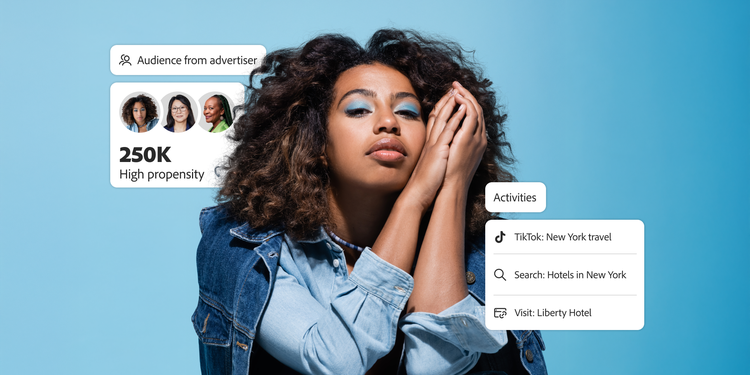
As customers expect seamless, personalized experiences across every touchpoint, many brands are still struggling to connect the dots. Their biggest obstacle? Fragmented data systems that scatter customer insights across platforms, teams, and timelines.
At Adobe we believe the future belongs to brands that treat data not as a byproduct of business, but as a foundational asset to be actioned on. This post unpacks why customer data platforms (CDPs) are essential in today’s real-time economy, and how Adobe Real-Time Customer Data Platform is helping enterprise teams break down silos, build unified profiles, and unlock smarter, faster, more human experiences at scale.
Let’s explore how brands are using connected data to not only meet rising customer expectations — but to rise above them.
What is a customer data platform (CDP)?
A CDP centralizes customer information from multiple sources — online and offline data from data warehouses, and even pseudonymous data where not all details about a specific customer are known yet — into unified and actionable profiles and audiences. Unlike CRMs or traditional databases, CDPs are purpose-built to activate data in real time across marketing and customer experience channels.
Adobe Real-Time CDP enables brands to not only manage customer data but also act on it to power personalized experiences at scale, throughout the funnel, while respecting customer privacy and preferences.
Balancing data fragmentation with higher customer expectations.
As organizations navigate a mixed-cookie world, new privacy regulations, and a proliferation of digital touchpoints, disconnected data systems create significant barriers to growth. According to the Adobe 2025 AI and Digital Trends report, brands cite data fragmentation as one of the top obstacles to delivering relevant, real-time experiences.
A customer data platform helps brands connect siloed data, build trust, and respond to customers’ needs with speed and precision.
Challenge #1: Attract new audiences with unified customer data.
Modern customer journeys span apps, websites, connected television (CTV), and commerce media — but the supporting data often lives in isolated systems. In a mixed-cookie environment, the complexity of managing disparate datasets grows even more challenging. Without a unified view, it’s difficult to engage customers in a consistent and relevant way.
Organizations that use a CDP can overcome this fragmentation by unifying first-, second-, and third-party data. By creating a foundation for deeper insights, smarter audience targeting, and more consistent messaging, brands can more effectively attract and retain customers. Learn how Adobe Real-Time CDP helps brands engage new audiences.
And while 65% of marketers are working to unify their data, many still face significant challenges linking disparate sources. As customer journeys grow more complex across channels and devices, brands that aren’t yet unifying their data risk falling behind on personalization and performance.
Australian broadcaster SBS, for example, achieved a 93% improvement in advertising cost efficiency by using Real-Time CDP to centralize its first-party data — proving the power of an integrated data approach.
Challenge #2: Deliver seamless cross-channel experiences with unified customer profiles.
Disconnected customer data doesn’t just create organizational inefficiencies — it creates disjointed customer experiences. Research shows that 75% of marketers believe fragmented data makes customer engagement more difficult, while 72% say it leads to conflicting messaging. Without a unified profile that ties together online, offline, and pseudonymous data, brands risk missing critical engagement opportunities or delivering conflicting messages across touchpoints.
Using a CDP allows organizations to connect fragmented data sources and build rich, real-time profiles. With a complete understanding of their customers, brands can offer better personalization at every interaction, strengthening loyalty and improving outcomes. Adobe Real-Time CDP offers a better solution for creating unified customer profiles.