It’s an exciting time for marketers learning how to use AI powered tools within their processes. Especially in customer experience (CX) where generative AI is a hot topic. This post gives you a framework for getting started with generative AI for your business and how to get the most out of this emerging CX technology.
The pressure is on for brands to drive scale and efficiency while delivering digital experiences that meet customers’ constantly evolving needs and preferences. Generative AI could potentially lead to substantial changes in the day-to-day activities for your creative and marketing teams, but those changes look promising. An Adobe report on AI and digital trends found that 56% of customers say AI improves their experience with a brand.
With an AI assistant by your side, you can increase your internal agility and efficiency to meet every customer’s individual needs more easily — 76% of organizations reported gains in content volume and production from generative AI experimentation. Generative AI tools are already helping brands craft better ideas, execute campaigns faster, and create more highly personalized experiences — at scale.
Here are five tips to consider for getting started with generative AI to help you achieve standout customer experiences and profitable growth for your business:
- Identify the challenges you want to solve.
- Get your team ready to use AI.
- Outline which processes you need to put in place.
- Assess generative AI tools and pick the right one for your business.
- Measure AI performance before you scale.
Identify the challenges you want to solve.
Since generative AI is so new, there aren’t established best practices for using it in many industries. To find the most relevant application of the technology, you need to look at the challenges you’re already facing in your business.
Are you experiencing backlogs in your creative processes? Could you use additional help with ideation, content creation, or asset editing?
Look for areas of your business where an AI assistant could be helpful to amplify your ideas, kick-start conversations, and clear pathways.
Ask yourself these questions to find opportunities to use generative AI within your business:
- What are your key business objectives? Consider your main goals or KPIs for your business and think of ways that generative AI might help get you reach your goals or improve your KPIs.
- What are your existing pain points? Look at your current processes and workflows to identify any bottlenecks or repetitive tasks that could benefit from automation.
- How are companies in your industry using generative AI? Other businesses in your industry may already be using generative AI to improve their processes, save time, and deliver increased ROI. Your competition may be the best place to look for inspiration on how to use generative AI.
- Which data do you have available? Generative AI models get stronger the more data they have available to work with. Assess your current data availability and see what opportunities it presents to train your AI model.
- Which uses will have the biggest impact or ROI? The best places to start with generative AI are those areas that will deliver the greatest payoff or save the most time.
Once you’ve identified a few promising use cases, start with one focused, measurable pilot rather than scaling everything at once. Choose a narrow workflow—such as drafting social captions or accelerating one stage of asset production—where success can be clearly defined. A pilot like this helps teams validate impact, capture learnings, and build a stronger business case before expanding to additional use cases.
Get your team ready to use AI.
If you’re considering using generative AI for your business, you’ll need to work with everyone on your team. First, you need to convince marketing and technology leadership of the benefits and approve the use of generative AI.
Next, you’ll need to loop in your data analysts or IT team to implement the new tools and analyze whether the results are positively impacting your company’s bottom line. And finally, decide which team members will be using the generative AI tools and how you will get them up to speed.
Getting your workforce ready starts with understanding your team’s readiness. Generative AI delivers the most value when people know how to guide it, review the output, and apply it in the right workflows. If new tools are introduced without training, guidance, and clear guardrails, adoption can become inconsistent and harder to scale.
Before rollout, it helps to understand where your team stands:
- Skills and comfort level. Run a short internal survey or work with team managers to understand who is already experimenting with AI tools, where confidence is high or low, and where the biggest knowledge gaps exist.
- Prompting and AI fluency. Teams often get more value from generative AI when they know how to give clear direction, provide context, and evaluate outputs critically. A short training session or a shared library of prompts and examples for common tasks can make adoption more practical and consistent.
- Champions and support. Identify a few early adopters across teams who can share what’s working, answer questions, and help others build confidence, rather than relying on IT alone.
It’s also important to be transparent about how these tools will be used, what good usage looks like, and where human review still matters. The goal is to help teams feel informed, supported, and empowered — and to combine business context with the right AI capabilities in a way that is both effective and responsible.
Outline which processes you need to put in place.
Generative AI is a new and evolving tool, so you’ll need processes in place to account for the new technology. For example, if you’re using generative AI to create digital ad assets, here are some steps you may want to take before publishing:
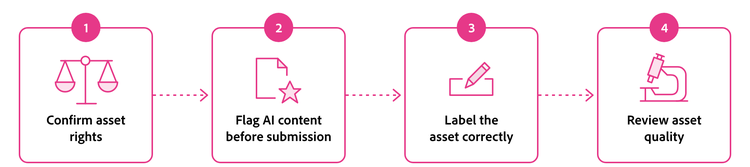
- Ensure you have the appropriate rights to use the assets. Consult your legal team to be sure your assets are aligned with your compliance and regulatory requirements.
- Flag the content as generative AI prior to submission. You should clearly label AI content as such so there is no confusion later about who created the asset.
- Label the asset with the correct asset type, title, and keywords. AI can generate content much faster than traditional methods. Your digital asset management systems will need to keep up so you can find the assets when you need them.
- Review the asset for accuracy and quality. While generative AI can create some amazingly high-quality assets, the results can vary based on the inputs, your guidelines, and the model you’re using. Any AI-generated content should be carefully reviewed before publishing.
Assess generative AI tools and pick the right one for your business.
New generative AI tools seem to launch every day. With so many options, it can be easy to get overwhelmed with choosing the right tool. Consider the following criteria when selecting the right AI tool for your company:
- Performance quality of the model. You should assess your AI tools for accuracy and creativity in the outputs they generate.
- Training and support resources. The best tools will provide training and support resources so your team can get started quickly and troubleshoot any issues that could arise.
- Cost. Understand the different pricing models that AI tools use. There may not just be an initial cost, but also ongoing fees like subscription or maintenance costs.
- Meets enterprise security, privacy, and data standards. Not every generative AI tool will meet your enterprise standards. You’ll need to select a tool that won’t put your business at risk for liability due to data privacy or security issues.
- Built for your brand standards. If the content an AI model creates is inconsistent or doesn’t align with your brand guidelines, it could end up taking more time and resources.
- Scalability. While a generative AI tool may meet your needs right now, consider where your business may be in the future. The best AI tools will be able to grow with you as you scale your business.
IP liability and legal readiness.
Security and privacy standards remain essential, but for many enterprises liability is equally important: if a generative AI output results in an intellectual property claim, who assumes the risk?
Before executing an agreement, organizations should confirm what the vendor’s indemnification covers, which plans and features are eligible, whether beta or pre-release features are excluded, and whether liability caps or other contractual limitations apply. Legal review is most effective when it happens early. A concise brief outlining the tool, the intended use case, and the relevant indemnification and usage terms usually makes that process more efficient.
Approaches to intellectual property risk vary across generative AI vendors. When evaluating platforms, enterprises should consider factors such as training data sources, indemnification terms, exclusions, and contractual limitations rather than assuming all offerings provide the same level of protection. For example, Adobe has stated that the first commercially released Adobe Firefly model was trained on Adobe Stock images, openly licensed content, and public domain content where copyright has expired. Adobe also provides contractual IP indemnification for eligible customers using qualifying Firefly features and outputs, subject to applicable terms, conditions, and exclusions.
Measure AI performance before you scale.
Before expanding beyond an initial pilot, define what success looks like and how it will be measured. Clear success criteria, baseline metrics, and a regular reporting cadence make it easier to assess progress, align stakeholders, and decide whether a use case is ready to scale.
From day one, it helps to track a mix of operational and business outcomes:
- Efficiency metrics: Time saved per asset, campaign, or workflow compared with the previous process
- Output metrics: Volume of content produced, number of variations tested, or turnaround time for requests
- Business metrics: Engagement, conversion, or revenue impact tied to AI-assisted content where the effect can be reasonably isolated
- Adoption metrics: Active usage across teams, frequency of use, and how adoption changes over time
Revisit these metrics on a defined cadence — for example, at 30, 60, and 90 days — and pair them with clear owners and decision thresholds. That creates an ongoing feedback loop to help teams determine whether to expand the use case, refine the workflow, or pause and reassess.
Get started with generative AI.
Generative AI presents many exciting opportunities to streamline your operations, rethink your creative and marketing processes, and improve your customer experiences — all at scale. This is a pivotal point for customer experience professionals who will recall the drastic shift in their careers from pre-generative AI to a post-generative AI world.
Explore how to get started with generative AI.