


Content as a Service v3 - rtcdp - Tuesday, July 15, 2025 at 14:09



JUMP TO SECTION
Harmonize data to compile a complete view of your customers
Audience activation for relevant omnichannel customer experiences
Empower marketers with end-to-end audience management
Shifting from third-party cookies to first-party data
Data governance to protect customers with enterprise-level tools
Choose the right customer data platform for your business.
Master your first-party data strategy with this customer data platform buyer’s guide.
Learn must-have CDP capabilities such as harmonizing data to compile unified profiles, collecting data from first-party sources to enhance customer experience, segmenting and managing audiences, staying compliant with privacy laws, protecting customers with data governance, and more.
Data and personalization are at the center of nearly any customer engagement. You need to track user interactions, compile them into unified profiles and actionable audiences for easy access, and then use that data to drive personalization in future interactions. But to manage that data and activate it on all your digital channels, you need the right platform.
What is a customer data platform (CDP)?
A customer data platform is software that creates persistent, and accurate views of each customer by unifying data from all sources.
In this guide, we’ll examine five essential capabilities to help you choose the right CDP for your organization.
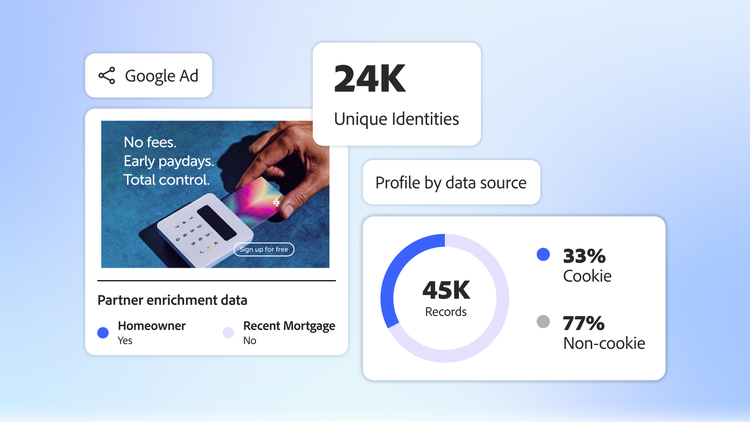
1. Harmonize data to compile a complete view of your customers.
The ways customers interact with your brand are increasing faster than ever. That’s why you need a CDP that can compile critical customer interactions into actionable unified profiles. Powered by an identity graph, a CDP provides your business with a comprehensive view of your customers, no matter where they are engaging with your brand.
Experience Leaders are six times more likely to provide real-time accessibility and availability of omnichannel customer data compared to less mature peers.
Why unified profiles are a must-have.
The amount of data and data sources that enterprise companies deal with can be overwhelming. A CDP should be able to link interactions from many sources, including online and offline engagement and through multiple mechanisms, so you can fully understand your customer.
Customers will interact with your brand in a variety of ways. Whether it’s through social media, email, in-app, on your website, or in person, your business must be equipped to gather key information about customer preferences and make it actionable, ensuring that every subsequent interaction is more meaningful.
Team needs
Key CDP capabilities
A way to identify unknown customers
Customer recognition across known and unknown devices
More organized data management
Standardized ingestion and normalized for all customer experience data
Harmonized data
Automated data ingestion, federation, and compilation to create actionable customer profiles
Real-time data utilization and activation
Instant activation of data for recommendation and personalization algorithms
2. Audience activation for relevant omnichannel customer experiences.
Collecting data is straightforward, but its true value lies in how you activate it to better connect with your audiences. When all your systems, including email marketing, social media, and digital advertising platforms, are connected and utilize audience data, it improves the effectiveness of all your channels. Each new customer engagement can then inform what the best next action should be for them, whether that’s a special offer on your website or a targeted ad on social media.
How audience activation makes all your data more valuable.
Customers may interact with your brand a few times per month or several times throughout the day. You need a CDP that allows you to compile every interaction and instantly use that data to inform customer journeys for cross-channel marketing campaigns, email campaigns, targeted advertising, and other use cases.
Audience activation across channels allows you to offer cohesive and seamless customer journeys regardless of which channel your customer uses to interact with your brand. Without this capability, each channel acts as a silo in which personalization efforts are channel specific and not reflective of the entire customer journey. Combining audience data from all channels helps create more meaningful connections with your customers, which drives engagement, loyalty, and business growth at every step and interaction.
Team needs
Key CDP capabilities
A way to integrate known and unknown data from multiple channels
Pre-built integrations with internal and external third-party platforms for seamless data compilation
One platform for planning complex, cross-channel audience activation
Easy-to-use activation for technical and non-technical users
An alternative to third-party cookies and legacy integrations for event-level data
An open framework to use second-party data for collaboration and durable third-party identities from providers of your choosing, with modernized integrations.
3. Empower marketers with end-to-end audience management.
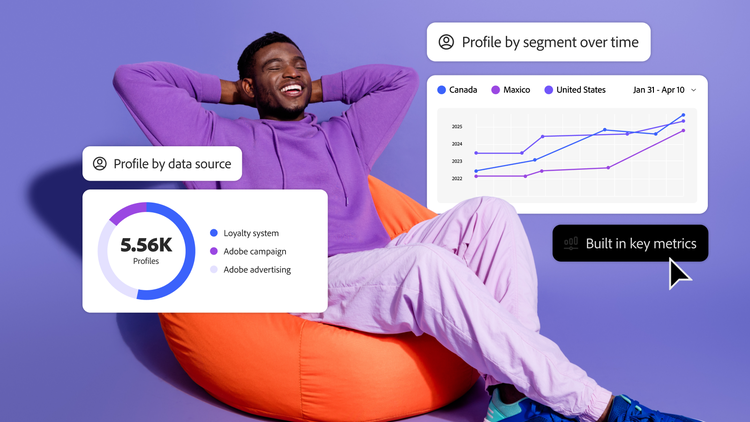
Audiences are constantly evolving as marketers find new ways of segmenting existing customers. Your CDP should allow you to create, enrich, and group your customer and account profiles in real time. You need a platform that enables granular audience segmentation based on basic and advanced logic and with history and preferences built in. The level of segmentation provided is a key driver for personalization at scale for enterprise businesses.
How your CDP can improve your audience management.
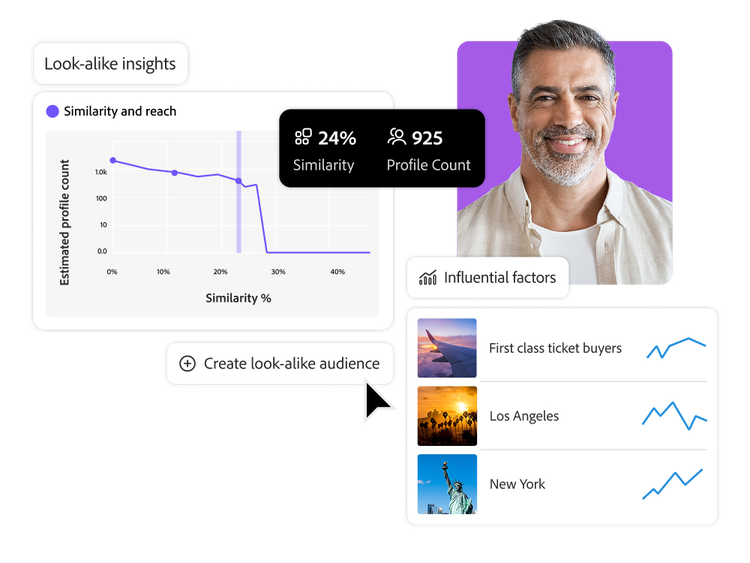
One benefit of using a CDP is that you can manage all your audiences from a single platform. You should look for built-in features like lead propensity scoring, look-alike modeling, AI-powered insights, and easy-to-use dashboards.
When you’re able to manage your audiences more effectively, you’re able to deliver relevant content to show your customers you understand their needs. When you understand who you’re talking to, you can allocate your resources toward the highest value audiences that are most likely to convert.

of customers want consistent brand experiences, and 87% of organizations leveraging AI-driven personalization have already seen boosts in customer engagement.
Team needs
Key CDP capabilities
A better way to manage audiences
Simple user interface to create audiences through segment definitions and other sources directly in the CDP
AI-powered insights available within the CDP
Agents, dashboards, and analytics with insights into audience data
Faster ways to launch new campaigns
Pre-defined workflows for common use cases, including launching a campaign, required data sources, and audiences to match the use case.
Simple ways to build audiences based on similarities
Look-alike audiences powered by machine-learning-based insights to target customers like your high-performing audiences or target customers
Lead scoring to know which leads are most likely to advance through the sales cycle
Predictive lead scoring, powered by AI, determines the customers or accounts most worth investing in
4. Shifting from third-party cookies to first-party data.
To gain a cohesive view of customers, marketers must find new ways to connect relevant touchpoints. With growing privacy concerns, adopting a first-party data approach is essential. Data-driven marketing and ad targeting aren’t going away, so making sure your business is ready to adapt is key.
How your CDP can help you move beyond third-party cookies.
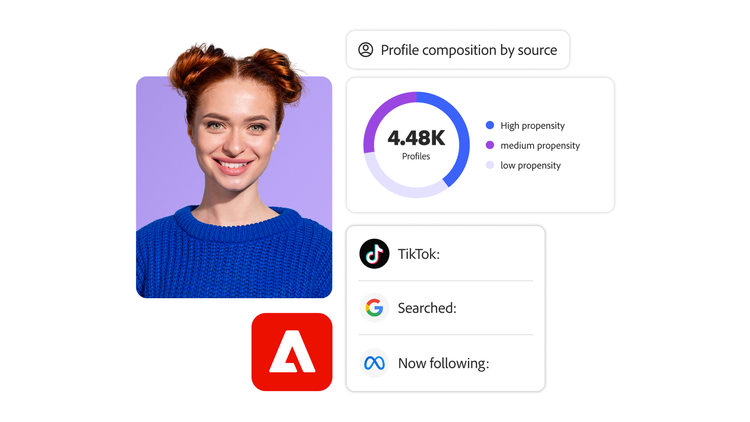
Even though it may be more difficult to track unknown user behavior without third-party cookies, the right CDP can help you make the most out of your data — while complying with data collection and usage regulations. CDPs are useful for collecting data from first-party data sources and then combining that with data from other sources to develop comprehensive user profiles with identity resolution.
You can use second-party data from data collaboration partners, but you need the right platform to seamlessly integrate that data with your own. Look for a CDP with built-in workflows and integrations for data collaboration. This enables you to work securely with key partners, like other brands and publishers, while combining third-party data with your first-party data to uncover richer insights.
Team needs
Key CDP capabilities
A way to share audiences for partner collaboration
Data collaboration applications that allow for two entities to work together, in a secure environment, without sharing any underlying customer data
Full-funnel marketing support without third-party cookies
Support for creating prospect profiles and working with third-party data using durable identifiers
Data-driven ad targeting
Pre-built integrations with ad platforms like Google Ads
5. Data governance to protect customers with enterprise-level tools.
Data privacy can be both a roadblock and an opportunity for businesses trying to build connections with their customers. More privacy means less access to your customers and their data, but it also presents an opportunity to establish your business as a trustworthy, responsible steward of customer information. Some level of transparency helps establish trust with your customers — and the right CDP can assist with that.
How your CDP improves your data security and privacy measures.
Your CDP helps with ingesting consent signals, data labeling, and data usage enforcement — all to keep your operations compliant with industry and regional regulations. Leading CDP solutions can automate data usage enforcement so users can’t activate sensitive data by accident or in non-compliant ways. Your customers want to know which data is collected, where it’s from, and what policies you have in place to protect that information.
Staying compliant with privacy laws like the General Data Protection Regulation (GDPR) or the California Consumer Privacy Act (CCPA) can be difficult, especially if you’re trying to manage data at a granular level for hundreds of thousands of users. An enterprise CDP ensures nothing slips through the cracks.
The right data governance and protection measures help minimize risks such as data breaches, unauthorized access, or data loss. Your CDP should include robust security features, end-to-end encryption, access controls, and regular data audits, to safeguard your business and its customers. If your business operates in multiple countries, you may need to consider a CDP that can support cross-border data transfers.
Business needs
Key data and governance capabilities
Simpler solutions for creating, managing, and enforcing data usage policies
Data usage labels for categorizing datasets and fields according to the governance policies that apply to them
Governance to avoid potential data policy violations
Alerts from the CDP whenever data actions aren’t aligned with policies or regulations
Knowing where data comes from and which policies apply to that data
Data lineage that tracks the origin of data and how it moves through your systems, so proper governance policies can be applied
Clear customer data and privacy preferences
Consent management signals stored within the CDP that track what permissions you've collected from which users.

of potential customers today are beyond reach for companies that rely heavily on third-party cookies.
Adobe Real-Time CDP can meet your needs.
The right CDP for your business will empower your data and marketing teams to seamlessly compile, organize, and activate insights across digital channels. Without one, you risk struggling to connect with customers and deliver the personalized experiences they expect.
Adobe Real-Time Customer Data Platform is a comprehensive solution for B2C and B2B brands — helping customers to realize value and take action on their data across the customer journey, from user acquisition through customer loyalty. Real-Time CDP includes a patented data governance framework to help keep data secure. With third-party data integrations and embedded data collaboration, you can prospect new customers, enrich top-of-funnel experiences, optimize your target audience, and more. Adobe Professional Services offers in-house consulting to help set up and tailor Real-Time CDP, ensuring you get the most value.
Recommended for you
Let’s talk about what Adobe can do for your business.

cardTitle
A buyer’s guide to customer data platforms.
cardDate
2026-02-02
cardImage

CardDescription
Explore five must-have CDP capabilities to strengthen your first-party data strategy and deliver personalized crosschannel engagement.
primaryTag
caas:content-type/guide
Tags
caas:content-type/guide, caas:products/adobe-real-time-cdp

