Increase content velocity




Adobe and IBM team up to help retailers transform their content supply chains with AI.

Learn how Adobe and IBM help retailers use generative AI to accelerate content velocity, bridge the consumer trust gap, and enhance personalized experiences.
Find the newest AI innovations that make it possible to connect your workflows, scale team capacity, and drive impact with unmatched speed, precision, and imagination.
The retail industry has entered an age of unprecedented personalization. Customer experiences that were innovative a few years ago are now commonplace. For example, shoppers wouldn’t think twice if they received an email coupon for a grocery staple they’re almost out of, or if they were greeted with a text message with personalized product recommendations as they entered a store.
Both consumers and retailers agree that hyper-personalization is crucial for success. However, delivering truly memorable experiences is becoming tougher. According to Adobe 2025 AI and Digital Trends Report, 14% of practitioners report being able to deliver exceptional digital customer experiences that surprise and delight. The challenge lies in meeting escalating consumer expectations: 71% of consumers want brands to anticipate their needs with personalized offers or helpful information, but only 34% of brands deliver. What’s even more concerning is the trust gap, as 88% of consumers expect assurance that their personal data is handled responsibly and securely, but only 49% of organizations meet this expectation. Organizations must address these gaps to build the loyalty that fuels growth. “We need to reach customers where they spend their time with communications that reflect their specific style and interests. It’s not just about price. Shoppers need to feel that we’re listening and responding to them. Receiving personalized offers, recommendations, and preferred content makes customers feel valued and encourages repeat visits. Our goal is to make sure our loyal members look to Macy’s first for their shopping needs,” said Bennett Fox-Glassman, senior vice president of customer journey at Macy's.
However, as the demand for more tailored retail experiences grows, so does the demand for content. To reach customers through every digital and physical touchpoint and at every stage of their journey, retailers must create thousands or even millions of content assets and integrate the delivery of this content into digital and physical channels to ensure a seamless experience.
“How much content your supply chain can assemble and how quickly you can build it is now crucial to the success or failure of your retail personalization efforts overall,” said Brett Wachter, EMEA marketing technology consulting leader at IBM.
A new generation of disruptive technologies — including AI and generative AI, which combine humanlike creativity with high-speed cloud computing — promises to help brands speed up and predictably scale content production. C-suite leaders are already set to invest in them. According to IBM Institute for Business Value’s CEO study, 61% of CEOs believe that competitive advantage will depend on who has the most advanced generative AI.
Let’s dive in to see how an Adobe and IBM collaboration is helping retailers build AI-powered content supply chains that connect the people, tools, and workstreams needed to effectively plan, create, manage, deliver, and measure content.
These journeys are less linear, more complex, and involve more touchpoints than ever before. Brands can now reach consumers on more than 300 digital touchpoints, including marketplaces, social media, and influencer-owned channels, which means retailers need content that’s customized for every touchpoint. The more touchpoints, the more content customization is required.
Retailers are increasingly targeting small segments or even individual consumers. This focus on hyper-personalization is now an executive mandate: Nearly two-thirds (65%) of senior executives identified using AI and predictive analytics as primary contributors to growth in 2025. Furthermore, 61% of senior executives agree that boosting customer engagement with personalized experiences will be critical to achieving growth. Personalization is only as good as the underlying data. Retailers can generate massive amounts of data as shoppers interact with content and offers, and AI is the key to managing this data at scale.
Of course, the more you personalize experiences, the more variants of key content you need. Content that must be customized can be wide ranging, including ads, emails, flyers, instructions, offers, product descriptions, signage, search results, and social media posts. Many retailers are optimizing content weekly or daily, which is further increasing the demand for new assets.
Physical stores are becoming more connected to digital channels. Facial recognition and even gait recognition technologies can identify shoppers as they interact with store environments. These shoppers can then receive personalized offers and messages. Data-driven product assortment also means stores are updating their offerings more frequently and refreshing related content.
Increase content velocity

Improve content relevance

Enable real-time content distribution

Manage content production costs
Content production remains a highly fragmented and manual process for many retailers. The content workflow can take months to produce (original 2D content) and requires multiple handoffs and approvals from various teams (campaign strategy, photography, design, copy, merchant approvers, retouching, legal, etc.). This often creates a bottleneck and streamlining the process can free up resources to produce more personalized content. Typical challenges include lack of visibility into project status and delays, inability to find assets stored across multiple repositories, high percentage of content waste, significant time spent on repetitive manual tasks, and siloed teams and technologies.
Retailers can accelerate content velocity by:
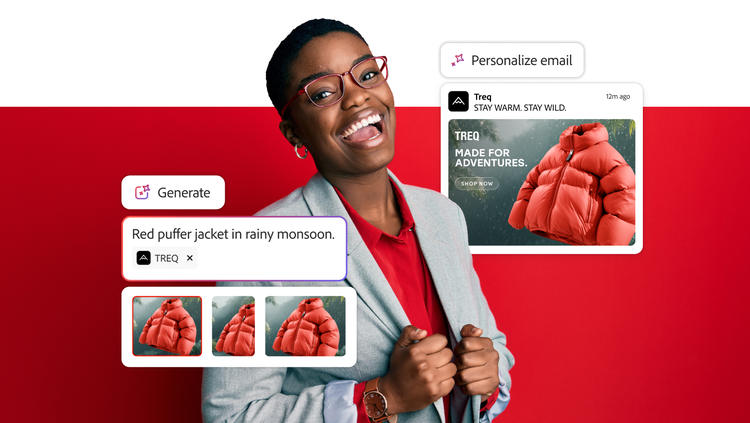
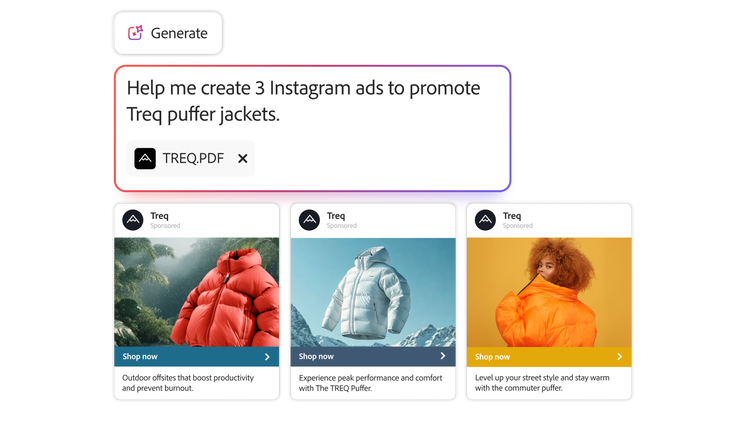
Generative AI, such as Adobe Firefly, can help human creators be more productive by producing photorealistic images and copy blocks in response to simple text prompts and automatically creating thousands of personalized variations of content, like ads and landing pages. Generative AI tools, such as Firefly, may be able to source and assemble content modules on the fly to create unique product pages, social posts, and more. Firefly is the world’s first copilot in creative and design workflows and gives users magical new ways to work.
IBM uses watsonx™, its enterprise platform for data and AI, to help businesses train, tune, and deploy AI by leveraging critical, trusted data wherever it resides. The platform is open for model variety and, in the marketing domain, gives strategists, creators, and digital production and analysis teams a leg up in creating the most relevant and impactful brand content.
Quality content speaks directly to audiences and individuals and inspires them to take action. Irrelevant content, on the other hand, can prompt them to tune out and opt out. Retailers can end up producing suboptimal content if they don’t measure its performance by customer segments and feed it into the content planning process.
Enabling this kind of content measurement requires a few things:
• The content must be tagged with relevant metadata/attributes so you can see how certain attributes drive lift.
• Rich customer data that captures how a shopper interacts with content, and whether that leads to a purchase.
• A way to easily measure how different content performs with specific customer segments.
Enabling this kind of content measurement requires tapping into different systems. These capabilities, often consolidated within a modern customer experience platform, connect data sources such as Adobe Commerce, Adobe Customer Journey Analytics, Adobe Experience Manager, Adobe Target, and POS systems. Retailers should also make content performance reports that attribute engagement and sales to specific content assets available to content planning teams.
Alexis Zamkow, intelligent marketing lead at IBM Consulting, has identified three ways AI can support the development of relevant content. “First, it can rapidly summarize performance data and identify the highest-performing content for different audiences. Next, it can predict which types of content are most likely to be effective for different segments and in different contexts and create customized outputs. Finally, it can improve ecommerce search results, so they are more relevant and actionable,” says Zamkow.
Every retail interaction, whether it happens online or in store, should trigger personalized, content-driven experiences. For example, ordering a flashlight could trigger a coupon for batteries. But this doesn’t happen if the content can’t be instantly connected to shopper behaviors.
Retailers can enable real-time content delivery by ensuring they can collect and streamline customer event data. Highly advanced organizations are designing content modules that can be assembled into experiences in real time. For this to work, teams must develop extensive metadata for content and ensure each new asset is accurately tagged as soon as it enters the DAM.
“AI could make split-second decisions about which content to display and how to assemble content modules based on customer, segment, and content performance data,” said Bruce Richards, retail industry strategy and marketing lead at Adobe. He also noted that eventually AI may be able to predict the next step in a shopper’s journey and assemble relevant content seconds before it’s needed. “Training solutions like watsonx with specific datasets can ensure any content built on the fly taps into both a retailer’s customers’ behavior as well as associated product offerings and services from the brand,” added Wachter.
Reimagining processes and adding automation to increase content velocity usually helps decrease content production costs. To reduce costs further, marketers may want to reconsider their approach to the early stages of creative planning and ideation. The time and labor required to communicate ideas to agencies and bring new campaigns to market are often overlooked sources of content-related costs. Generative AI has many promising applications in this area.
Retailers are using AI capabilities to increase content production. According to the State of Customer Experience in Retail in an AI-Driven World report, 31% of retailers now use generative AI to create branded content, leading to a 49% jump in content production output, which in turn has increased conversions by 8%.
AI can help human creators quickly create photorealistic mockups that can inform creative briefs and jump-start brainstorming sessions, getting projects off to a faster and less costly start. Generative AI can rapidly develop numerous creative concepts based on customer, product, and campaign parameters — but humans should ensure supervision before publishing.
By pairing Adobe’s AI-accelerated content supply chain solution and IBM Consulting’s services, retailers can adopt AI to improve their content supply chains in ways that are effective and responsible. “We believe retailers that are first to add AI to their content supply chains will have a lasting competitive advantage,” said Richards.
As part of this expanded partnership, Adobe’s enterprise customers will have access to IBM Consulting experts, including 21,000 data, AI, and experience consultants, who can help them effectively implement generative AI solutions for their design and creative processes.

Adobe Firefly enterprise AI solutions help businesses meet the increasing demand for content. From accelerating ideation and editing to streamlining bulk production and assembly, Firefly is the leading technology powering creation and production at scale.

Adobe AI for Business makes it possible to connect your workflows, scale team capacity, and drive impact with unmatched speed, precision, and imagination. Built into key creative and marketing tools — all with enterprise-grade trust and control — your teams can use Adobe AI to focus on the moments that matter.

IBM’s watsonx, which helps enterprises train and tune machine learning models on trusted data and content sources, scale experiences, and govern the use of content and assets.
“We’re seeing incredible momentum in AI adoption as more brands turn to generative AI to create seamless and highly personalized customer experiences to drive growth and improve productivity,” said Matt Candy, global managing partner for generative AI at IBM Consulting. “By expanding our strategic partnership with Adobe, we can help marketers more effectively design AI-powered experiences while establishing appropriate guardrails, so the AI is built on trust and transparency principles to promote brand consistency and integrity.”
“Both Adobe and IBM are pioneers in the thoughtful development of AI and its application to a wide range of enterprise business challenges,” said Olivia Kwon Best, general manager for retail and consumer goods at Adobe’s Digital Strategy Group. “This partnership will make it easier for our customers to quickly start using AI to accelerate their content supply chains and spend less time on costly, repetitive work.”

AI is already disrupting how consumers experience shopping and shaping their expectations. Truly individualized, one-to-one experiences, powered by hyper-personalized content, could soon become the new normal. Retailers that embrace the power of AI and generative AI to enhance every stage of their content supply chain, from ideation to creation to real-time delivery, will be well-positioned to succeed in this new world. But the challenge for many would be to get there. If this is something you’re wondering about, Adobe and IBM can help.
“5 mindshifts to supercharge business growth”, IBM, 2025.
“Deliver personalized retail experiences at scale,” Adobe for Business, 2025.
“State of Customer Experience in Retail in an AI-Driven World,” Adobe for Business and Incisiv, 2025.
Vivek Pandya, “Adobe research: 71% of marketers say the demand for content will grow 5X or more between now and 2027”, Adobe for Business, June 2025.