AI model governance: Version control, access management and audit trail.

AI adoption is maturing across organisations and the emerging challenge is governance.

Consider a hypothetical global brand launching a major campaign across three regions. Each regional creative team is using a customised AI model trained on the company's brand assets. On the surface, everything may appear smooth. But behind the scenes, one team is still using an older version of the model, another has retrained it for localisation without approval and a third cannot verify which model generated a campaign asset that is now under review.

This leads to inconsistent creative output, unclear ownership and limited traceability, making AI adoption more fragmented and difficult to govern.

An AI model registry helps bring structure to that complexity.

As a centralised system of record, an AI model registry gives organisations better oversight of their AI models through version control, access management and a verifiable audit trail. These capabilities support broader enterprise data governance strategies as businesses continue to expand their use of AI.

In this piece, we'll explore:

Why AI model governance is now more complex.

For many organisations, AI governance started with experimentation. Today, many enterprises manage growing portfolios of customised and third-party AI models across teams, business functions and use cases.

As AI becomes embedded in more workflows, governance becomes difficult to co-ordinate. Marketing teams rely on one set of models, customer support uses another and business operations uses a third — all of which are continuously retrained, configured and deployed to meet changing business needs.

For example, an AI model approved for content generation today may get retrained and configured in six months using new datasets or updated brand assets. Without clear oversight, teams may struggle to determine which version is approved, who made changes or where the model is being used across the business.

Therefore, organisations must manage ownership, approvals, access permissions, usage policies and lifecycle changes. Additionally, they are expected to meet brand standards, compliance requirements and increasing expectations for transparency involving AI-generated content.

The solution to this is an AI model registry.

What is an AI model registry?

An AI model registry offers organisations a reliable way to track, manage and govern AI models throughout their lifecycle. An AI model registry is a centralised system of record that catalogues, versions and tracks AI models from development and training through configuration, deployment, monitoring and retirement.

However, an AI model registry should not be confused with a shared folder or file repository.

It does more than store model files. It captures the operational and governance information surrounding those files, including ownership, access permissions, deployment status, evaluation results, version history and other metadata needed to manage AI models responsibly.

Without a registry, organisations often rely on spreadsheets, documentation and disconnected systems to track model activity. While that may work for a handful of models, it becomes difficult to ensure consistency, oversight and accountability as AI model adoption expands.

Ungoverned AI (No model)
Registry-governed AI
Multiple model versions
Approved version visibility
Audit gaps
Audit-ready traceability
Access sprawl
Role-based control
Shadow AI deployments
Centralised governance oversight
Compliance exposure
Regulatory confidence

Benefits of an AI model registry.

Whether an organisation uses traditional machine learning models, custom generative AI models or a combination of both, a model registry provides a trusted foundation for AI model governance.

The advantages include:

  • Centralised visibility across the AI portfolio: A registry creates a single source of truth for AI models, making it easier to understand what models exist, who owns them and which versions are approved for use.
  • Stronger governance without slowing innovation: Teams can access approved models and scale more efficiently, while governance stakeholders maintain oversight of model updates, deployments and usage.
  • Greater confidence in enterprise AI adoption: Clear records of ownership, approvals and lifecycle activity help organisations scale AI responsibly while establishing accountability and transparency.

The risks of operating without a registry.

An AI model registry provides a strong foundation for governance. Without one, maintaining control becomes increasingly difficult as model portfolios expand across teams, regions and use cases.

Common challenges are:

  • Version drift creates operational uncertainty: Multiple versions of the same model can exist across teams, making it difficult to determine which version of an AI model generated a specific output or whether the latest approved AI model is being used.
  • Shadow AI introduces governance blind spots: Teams may adapt brand-trained AI models to local or departmental needs without consistent oversight — creating regional variations, unclear ownership and potential security exposure.
  • Traceability becomes more difficult as scrutiny increases: Organisations need clear records of AI model approvals, changes and usage to validate AI-generated content. Without a centralised record, reconstructing that history can be time-consuming and unreliable.

The three pillars of an enterprise AI model registry.

An AI model registry provides the foundation for governance. More importantly, it helps organisations translate policies into day-to-day operational practices.

Three capabilities are particularly important in this process — version control, access management and audit trails. Together, they help organisations maintain visibility and accountability as AI adoption scales.

Version control

AI model version history dashboard.

AI models are not static. They evolve as organisations update training data, refine performance, adopt new policies or adapt to changing brand standards.

Consider a company that refreshes its visual identity, updates its colour palette and re-trains a custom model using updated brand assets. Without clear version control, teams may continue using retired and replaced models, leading to inconsistent outputs across teams, campaigns and regions.

An AI model registry addresses this by tracking every model version with a unique identifier, change history and rollback capability. Teams can see when a model was updated, what changed and which version is approved for production.

This record becomes particularly valuable during reviews and audits. If an asset generated months earlier is questioned, organisations can attribute it to the exact model version that created it.

Teams that lack this clarity risk producing content with one version while attempting to audit another.

Access management

Not everyone in an organisation may need the same level of control over enterprise AI models.

Access management enables teams to define who can view, train, configure, modify, deploy or decommission models based on their roles and responsibilities. Clear permission structures ensure that model changes occur through established processes rather than ad hoc decisions that may create compliance risks.

Customised generative AI models make the need for controlled access particularly apparent. If unauthorised users modify the model, they may unintentionally affect visual style, output quality or brand consistency. What begins as a small adjustment can quickly influence content produced across the organisation.

Strong access controls can also reduce the risk of shadow AI initiatives, unauthorised deployments and policy violations without creating bottlenecks.

Well-governed access management can give teams fast, self-service access to approved models while maintaining appropriate oversight. More importantly, it establishes accountability for the systems influencing enterprise content, experiences and decision-making.

AI audit trail

Effective governance depends on more than tracking changes. Organisations also need to understand how and why those changes occurred.

An AI audit trail records activity throughout a model's lifecycle, including who trained and configured a model, who approved it, when it was deployed and which version was used to generate a specific output.

The resulting record follows a model throughout its lifecycle — from development to production use.

For organisations using AI-generated content, this level of traceability is important. Internal stakeholders, external partners and regulators expect transparency into how content was created and which systems influenced it and an audit trail provides that evidence. This concept closely aligns with content credentials, which attach metadata to digital assets and provide additional context about how they were produced.

An audit trail allows teams to govern AI models proactively. Instead of scrambling to reconstruct decisions after an audit request or governance review, organisations have a continuous record of model activity readily available.

Without a registry, piecing together that history across creative, marketing and IT systems is a challenge.

Connecting the registry to an AI model lifecycle strategy.

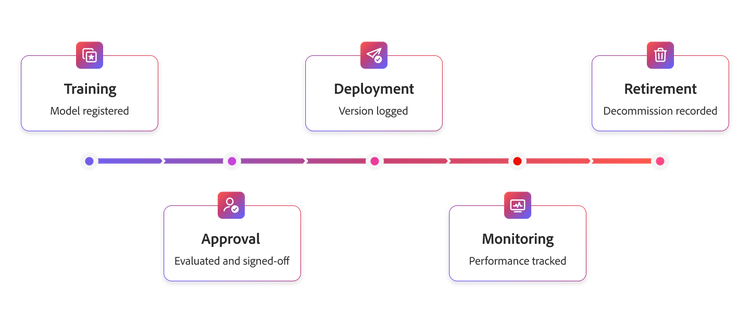
AI model lifecycle strategy from training to retirement.

Governance does not end when a model is approved. In many cases, that is where the real work begins.

AI models evolve long after deployment. They are retrained on new datasets, updated to improve performance, adapted to changing business requirements and eventually retired when they no longer serve their purpose.

Managing these changes responsibly requires oversight across the entire model lifecycle, from training and configuration through deployment, monitoring and retirement. An AI model registry plays a critical role at this stage. It helps teams govern AI models across the lifecycle by helping them to maintain visibility and accountability as content moves from one stage to the next.

A mature model lifecycle management strategy typically includes:

  • Training, configuration and validation: Models are developed, tested and evaluated before they are approved for use.
  • Approval and deployment: Governance stakeholders can review model performance, ownership and compliance requirements before a model is deployed.
  • Monitoring and optimisation: Teams track how models perform in real-world environments and determine when updates or retraining are needed.
  • Retirement and replacement: Outdated models are retired in a controlled manner, reducing the risk of unauthorised or obsolete versions remaining in use.

The registry helps connect these stages by maintaining a continuous record of model activity, approvals, versions and changes over time. Ongoing monitoring becomes more important in production environments as it can reveal performance shifts, compliance concerns or opportunities for improvement.

Most importantly, a model registry helps organisations view governance as a continuous process rather than a one-time checkpoint. Instead of approving a model and moving on, teams can manage it throughout its lifecycle with greater confidence, consistency and oversight.

Building responsible AI governance for the future.

Governance can no longer rely on isolated policies, manual approvals or fragmented record-keeping. Organisations need a structured way to manage AI models. An AI model registry does this by creating a reliable framework for managing how models are approved, deployed, audited and maintained over time.

This helps enterprises operationalise and scale AI without sacrificing control. It creates a trusted system of record for decisions, approvals and changes that shape an organisation's AI portfolio. Clear guardrails help teams move faster, collaborate more effectively and adopt new AI capabilities with greater confidence.

The need for that foundation will continue to grow as enterprises roll out larger portfolios of customised, fine-tuned and domain-specific models. The more models an organisation creates, the more critical it becomes to manage versions, permissions and traceability through a single governance framework.

The need for that foundation will continue to grow as enterprises roll out larger portfolios of customised, fine-tuned and domain-specific models. The more models an organisation creates, the more critical it becomes to manage versions, permissions and traceability through a single governance framework.

Therefore, responsible AI isn’t defined by the number of AI models an organisation deploys, but by how confidently organisations can govern them. Many organisations are therefore embedding governance directly into AI workflows.

Solutions such as Adobe Firefly Custom Models help with this shift by enabling enterprises to manage customised AI models with greater consistency and oversight.

Disclaimer: Features vary across model providers. Make sure that you check what is available to you.

Let’s talk about what Adobe can do for your business.

Get started