Most organisations know their customer experience needs work, yet many still treat it as a customer-service problem rather than a strategic discipline. The gap between knowing CX matters and actually improving it lies in measurement, data unification, and platform decisions. This guide breaks down what customer experience is, why it drives growth, and how to build a strategy that fits your organisation's maturity and scale.
Customer experience: a practical guide for Australian organisations

What is customer experience?
Customer experience (CX) is the cumulative perception a customer forms across every interaction with your organisation, from the first ad impression through post-purchase support. Consider a banking customer: their CX spans mobile app onboarding, a branch visit, call-centre hold time, and the tone of a dispute-resolution email. No single moment defines it; the whole sequence does.
CX becomes relevant the moment an organisation has more than one touchpoint, which today means virtually every business. Marketing teams encounter it through campaign responses, service teams through support tickets, and product teams through usage data. The critical distinction is that CX is longitudinal, not episodic. A retailer may deliver a flawless checkout but erode CX through poor delivery communication that leaves customers uncertain about when their order will arrive.
Why does customer experience matter for business growth?
Australian organisations face a challenge that compact markets do not: geographic scale. A customer in regional Queensland expects the same digital experience as one in Sydney CBD, yet multi-state retail and remote workforce servicing often introduce inconsistencies that erode trust faster than any competitor's campaign.
Retention economics make the case plainly. Acquiring a new customer typically costs five to seven times more than retaining an existing one, and CX directly influences churn. Organisations that consistently deliver strong experiences see higher repurchase rates and stronger word-of-mouth, both of which compound over time.
In commoditised sectors like banking and telco, where products and pricing converge, CX is often the only meaningful differentiator. Internally, a shared CX framework gives marketing, sales, and service teams common KPIs, reducing the organisational friction that arises when each function optimises for its own metrics in isolation. Strong customer engagement strategies help unify these efforts across departments.
How does customer experience differ from customer service?
Many organisations conflate customer experience with customer service, and the confusion leads to misallocated investment. Customer service is reactive and episodic: responding to a complaint, resolving a billing error. CX is proactive and holistic: designing the journey so those complaints become less likely in the first place.
Dimension
Customer service
Customer experience
Scope
Single interaction
End-to-end journey
Ownership
Support team
Cross-functional
Metrics
CSAT per ticket, resolution time
NPS, CES, lifetime value
Timeframe
Minutes to hours
Months to years
The trade-off is instructive: organisations that invest heavily in customer service without a broader CX strategy often see high CSAT on resolved tickets but declining NPS overall. The problem is upstream, in confusing onboarding flows or fragmented communications, not at the help desk.
What does good customer experience look like — and what does poor CX cost?
Good CX reduces effort at the moments that matter most. An Australian insurer that lets customers lodge a claim via app, receive real-time status updates, and get paid within 48 hours removes anxiety at an emotional peak. The design principle is not delight everywhere, it is friction removal where the stakes are highest.
Poor CX, by contrast, compounds frustration. A government service portal that requires users to re-enter information across departments, with no session persistence, is a common pain point in public-sector digital transformation across Australian states. Each redundant step signals to the citizen that the organisation has not invested in understanding their journey.
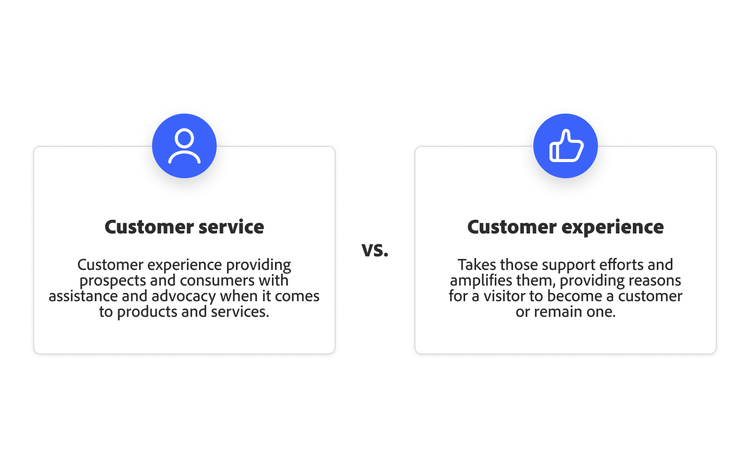
The key takeaway: good CX is not about exceeding expectations at every touchpoint. It is about identifying the moments where friction causes the most damage, and eliminating it there first.
How should you measure and analyse customer experience?
The problem is not a lack of data, it is a lack of connection. Many organisations collect survey scores but never link them to operational or revenue data, turning the metric into a vanity number rather than a decision trigger.
Three core metrics serve different purposes. NPS (Net Promoter Score) predicts organic growth via referral. CES (Customer Effort Score) predicts churn better than satisfaction alone, customers who find interactions effortful leave quietly. CSAT is useful per-interaction but misleading at journey level because it can mask systemic issues behind individual high scores.
The operational linkage is where value emerges. Pairing CX scores with behavioural data, page-path analysis, support-ticket clustering, reveals root causes. A spike in CES after checkout may trace to a confusing delivery-options UI, fixable in days rather than quarters. Robust data analysis and visualisation tools help teams move from score collection to insight generation, connecting signals across channels into a coherent picture.
What is customer experience management and how do you build a strategy?
Without a deliberate strategy, CX improvements remain ad hoc, one team fixes a pain point while another inadvertently creates a new one. Customer experience management (CXM) is the discipline of designing, orchestrating, and optimising every interaction based on unified data. It moves CX from reactive measurement to proactive design.
A practical strategy follows five steps:
- Map the current journey to identify friction hotspots, not theoretically, but with real behavioural data.
- Unify customer data across silos, a challenge amplified in multi-brand or multi-state Australian organisations where each division may run its own systems.
- Prioritise interventions by effort-to-impact ratio, fixing high-damage friction first.
- Automate personalisation at scale using AI-driven decisioning. AI-powered content creation engines can adapt email content, web banners, and app notifications per segment without manual variant creation.
- Govern data to maintain trust, particularly relevant under the Privacy Act 1988 and Australian Privacy Principles (APPs) when using behavioural data for personalisation. Organisations without clear data governance risk both compliance breaches and poor CX from stale or conflicting records.
Deeper customer journey intelligence emerges when these five steps work in concert, connecting data, decisioning, and delivery into a coherent system rather than isolated initiatives.
How can your organisation improve customer experience with the right platform?
Choosing a CX platform without a decision framework leads to one of two failures: over-investing in enterprise tooling you cannot operationalise, or under-investing in point solutions that create new silos.
Use this logic:
- If your organisation operates across three or more channels and needs real-time personalisation at scale, choose a unified CX platform with native AI and journey orchestration.
- If you are a single-channel SME with limited data volume, a lightweight CRM with basic automation may suffice initially, with a migration path planned for growth.
Evaluation criteria that matter in practice: data unification capability (can it merge behavioural, transactional, and operational data?), real-time decisioning speed, native analytics depth, integration breadth (ERP, POS, call centre), and compliance tooling aligned with Australian Privacy Principles.
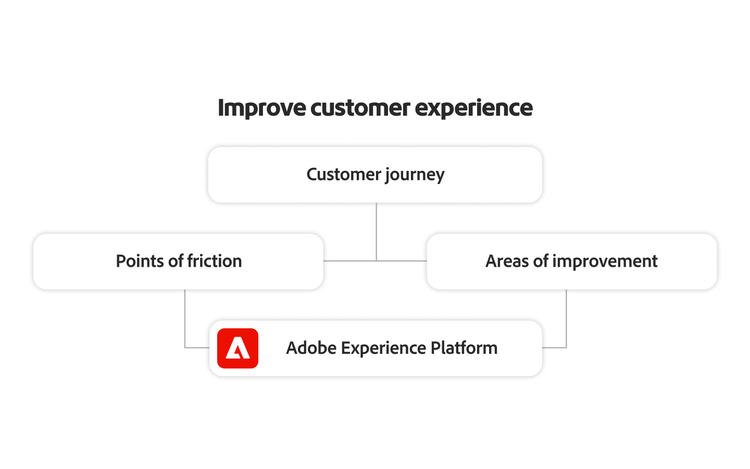
Adobe Experience Platform serves as an enterprise-tier example: it unifies data into real-time customer profiles and enables AI-driven personalisation across web, app, email, and in-store, relevant for Australian retailers and banks managing millions of cross-channel interactions daily. Effective data normalisation is a prerequisite here; without consistent data formats across sources, even the most capable platform cannot build reliable profiles.
The risk summary is straightforward: organisations that adopt point solutions without a unification layer often find the CX problem migrates rather than resolves, data stays siloed, just in different tools.
Discover how Adobe Experience Platform helps Australian organisations unify customer data and deliver personalised digital customer experience at scale. Explore the platform.
Recommended for you
Title
Customer Experience (CX): What It Is and How to Improve It
CardDescription
Learn what customer experience (CX) is, why it matters, and how to measure and improve it. Practical strategies, examples, and frameworks for Australian businesses.
cardDate
2026-09-09
cardImage

primaryTag
caas:content-type/blog
Tags
caas:content-type/blog, caas:topic/trends, caas:blog-author/adobe-for-business-team