Customer experience (CX), user experience (UX), experience management (XM) and customer service are often used interchangeably. However, they represent distinct, interconnected disciplines. For enterprise leaders, mastering the nuances between them is the difference between a fragmented journey and a cohesive experience. This guide explores the unique role of each discipline and introduces how experience management (XM) unifies them to drive customer loyalty and business growth.
What is user experience (UX)?
User experience (UX) refers to a person's perceptions and feelings from using a specific product, system or service. It encompasses everything from usability and accessibility to the emotional response someone has when interacting with a digital product. User experience focuses on making interactions intuitive, efficient and satisfying.
Consider a mobile banking app. UX determines how easily you can log in, check your balance or transfer funds. A well-designed experience allows you to complete these tasks seamlessly, without confusion or hesitation. Each interaction goes exactly as expected. When that experience breaks down, however, the disruption is immediate.
Friction points in UX create immediate frustration. Confusing navigation forces users to hunt for basic features, while slow page load times can test patience, pushing them to abandon the task entirely. Unclear error messages leave people wondering what went wrong. Each of these issues weakens the digital experience.
These problems are preventable, which is why UX designers work to eliminate friction points proactively before users ever encounter them. They create a user flow diagram to map optimal pathways through a product, identify where users might get stuck and design solutions. This methodical approach ensures that every tap, click and scroll feels natural and purposeful.
The scope of UX remains focused on individual products and interactions. A UX team might perfect your mobile app experience, but their work typically ends at the boundaries of that specific product. This focus creates deep expertise but also reveals an important limitation, great UX alone cannot guarantee customer satisfaction.
What is customer experience (CX)?
Customer experience (CX) is the customer's overall perception of your company, shaped by the sum of all their interactions over time. Unlike UX, which focuses on a single product, customer experience encompasses every touchpoint across the entire customer journey, from awareness through purchase, usage and ongoing relationship.
Returning to the banking example, your experience extends far beyond the mobile app. It includes the website where you compared account options, the support call about fees, the marketing emails introducing new services and the branch visit where you opened your account. Each interaction contributes to your overall perception of the bank.
Digital customer experience represents the subset of these interactions that occur through digital channels. For many enterprises, websites, mobile apps, email, social media and chatbots now define a significant portion of the customer journey. Effectively managing these digital touchpoints is critical to delivering a consistent and competitive brand experience.
Customer service is a CX touchpoint.
Customer service is the direct support and assistance provided before, during, and after purchase and represents one of the most influential touchpoints within CX. When customers call for help, chat with support or visit a service desk, those interactions influence their overall experience. Excellent customer service can recover from product problems, while poor service can undermine an otherwise strong offering. Despite its importance, customer service represents just one piece of the larger CX puzzle.
The broader CX challenge.
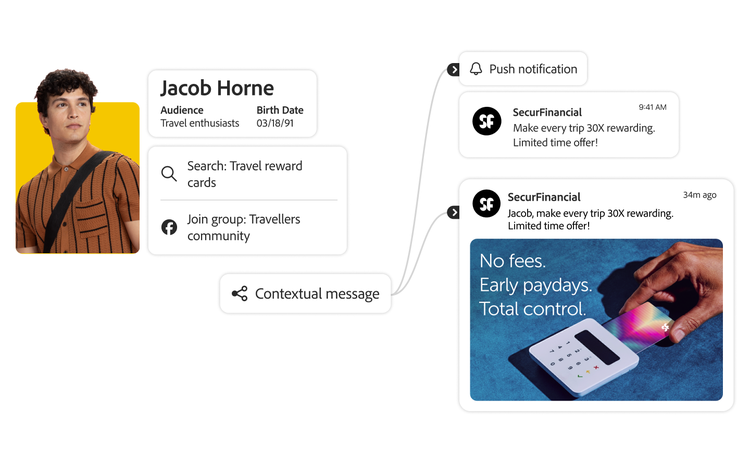
Customer experience challenges often emerge across multiple touchpoints. Inconsistent messaging confuses customers about what your brand represents. Disconnected systems force customers to repeat their information. Lack of personalisation can make long-term customers feel unrecognised.
The complexity of CX lies in its cross-functional nature. Marketing, product, sales and service teams each control different moments in the journey. Without deliberate co-ordination, customers encounter a fragmented experience instead of a cohesive one.
What is the core difference between UX and CX?
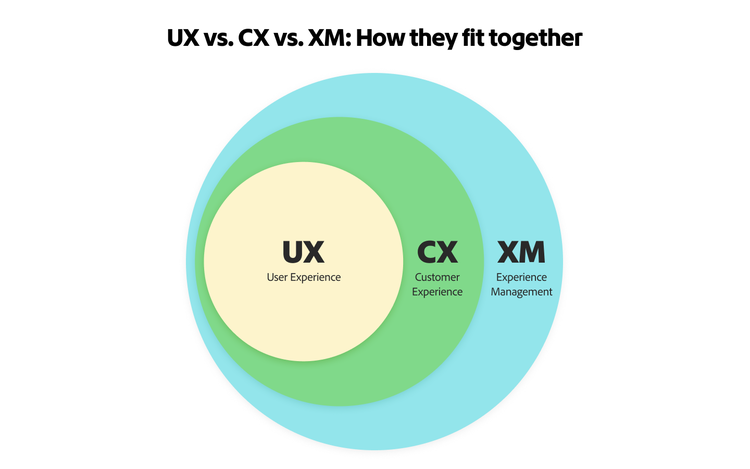
The relationship between UX and CX follows a clear hierarchy: UX is a subset of CX. Every product interaction contributes to customer experience, but customer experience extends far beyond any single product. Understanding this distinction helps leaders allocate resources and co-ordinate teams more effectively.
Consider a familiar scenario, such as making a dinner booking.
Good UX is an intuitive app that lets you book a table in seconds. You open it, browse available times, select your party size and confirm. The interface feels smooth and responsive. You close the app feeling confident about your plans.
Now imagine the broader experience. You arrive at the restaurant and wait thirty minutes despite your confirmed booking. The food arrives cold, the service feels inattentive, the bill includes unexpected charges and you leave feeling frustrated.
The app worked perfectly, yet the overall experience failed.
This illustrates a critical point: great UX cannot compensate for poor CX. Customers remember the entire journey, not just isolated moments of success.
The type of friction also differs. When UX fails, frustration is immediate. You cannot complete a task or find what you need. When CX fails, the impact runs deeper. Trust erodes. Loyalty declines. Customers begin to question whether the brand values their business at all.
Many enterprises struggle because their teams operate in silos. Product teams look at UX metrics like task completion rates and time-on-task, while marketing measures success through CX indicators like Net Promoter Score and customer satisfaction. These groups rarely share data or co-ordinate strategies, creating disconnected experiences that frustrate customers.
Breaking down these silos requires deliberate CX strategies that align teams around shared customer outcomes. Leaders must recognise that optimising UX in isolation risks missing the larger CX picture and that CX improvements often require UX enhancements to succeed.
What is experience management (XM)?
Experience management is the overarching discipline of measuring and improving the whole experience. XM combines data from customer experience, user and product experience (PX) and employee experience (EX) into a unified framework for understanding and optimising how people interact with your organisation.
Think of XM as the strategic layer that sits above individual experience disciplines. Where UX focuses on products and CX focuses on customers, XM takes a holistic view that recognises how all experiences interconnect. A frustrated employee delivers worse customer service. A confusing product interface generates more support calls. A negative brand perception makes users less forgiving of minor UX issues. XM acknowledges these connections and manages them deliberately.
The biggest hurdles to successful XM are data and co-ordination failures. Silos between departments prevent anyone from seeing the complete picture. Marketing knows which campaigns a customer received, product knows how they used the app and service knows what problems they reported, but without a unified view, these insights remain disconnected. Without consolidated customer profiles, every team operates with partial information.
This is why real-time customer experience has become essential for competitive differentiation. Customers expect companies to recognise them across channels and respond to their signals in real-time. When a customer abandons a basket, browses a help article or expresses frustration in a chat, enterprises need to respond appropriately and immediately. Delayed or disconnected responses feel tone-deaf.
Employee experience is equally important. How employees feel about their work directly affects how they serve customers. Engaged employees solve problems creatively and go the extra mile. Disengaged employees do the minimum and escalate issues unnecessarily. XM acknowledges that internal experiences shape external outcomes and manages both intentionally.
Operationalising experience management at scale.
Customer journey orchestration provides the operational capability that enables XM at scale. Rather than managing touchpoints in isolation, orchestration co-ordinates experiences across the entire journey based on real-time customer behaviour and context. This capability transforms XM from a conceptual framework into a practical reality.
This holistic approach represents the mature strategy that enterprise leaders should pursue. It acknowledges that customers, users and employees all matter and that their experiences interrelate in ways that siloed management cannot address. Enterprises that master XM gain sustainable competitive advantages that individual UX or CX improvements cannot match.
The Adobe solution: Unifying your experience management strategy.
Experience management is impossible when CX data from marketing and service lives in separate systems from UX and product data. Most enterprises face this challenge: their technology stack has evolved into a collection of specialised tools that cannot communicate with each other. Marketing automation platforms capture campaign responses, product analytics track feature usage, customer service systems log support interactions and sales CRM (customer relationship management) systems record deal progression. Each system provides valuable insights, but none can share data with the others.
The result is fragmented decision-making. Marketing may celebrate high engagement rates without seeing product usage. Product teams release features without knowing support issues. Service reps handle problems already "fixed" in prior updates. Customers experience the consequences of disconnected data through inconsistent experiences.
The solution requires a platform built specifically to break down these silos. Adobe's unified customer experience solution addresses this challenge directly by bringing all experience data together into a single, real-time customer profile. Rather than forcing teams to export, transform and import data between systems, the platform creates a unified foundation that every team can access.
This unified approach enables several critical capabilities. First, it connects every touchpoint across the customer journey, allowing teams to see how experiences in one channel affect behaviour in others. Second, it creates real-time responsiveness, so enterprises can act on customer signals as they happen rather than days or weeks later. Third, it enables true experience management by unifying CX, UX and EX data into a coherent picture.
The next step for leaders involves evaluating platforms built to deliver XM. Point solutions that excel at individual touchpoints cannot provide the unified view that modern experience management requires. Only purpose-built platforms can connect the data, co-ordinate the teams and orchestrate the journeys that XM demands.
Unifying an UX and CX strategy.
UX shapes how people interact with individual products, while CX covers the full customer journey. Experience management (XM) unifies UX, CX and EX into a single framework, giving leaders a complete view of interactions across their enterprise.
By breaking down silos and connecting all touchpoints, XM enables co-ordinated, real-time responses, seamless experiences and personalised journeys that build trust and loyalty. Enterprises that master XM gain a competitive advantage, ensuring their teams deliver cohesive, customer-focused experiences at scale.
See how it all connects. Watch this 2-minute overview video to see Adobe’s unified customer experience in action.
Recommended for you
https://business.adobe.com/fragments/resources/cards/thank-you-collections/generic