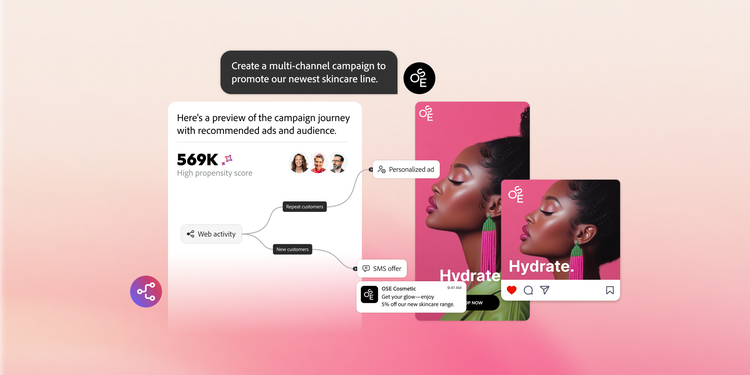
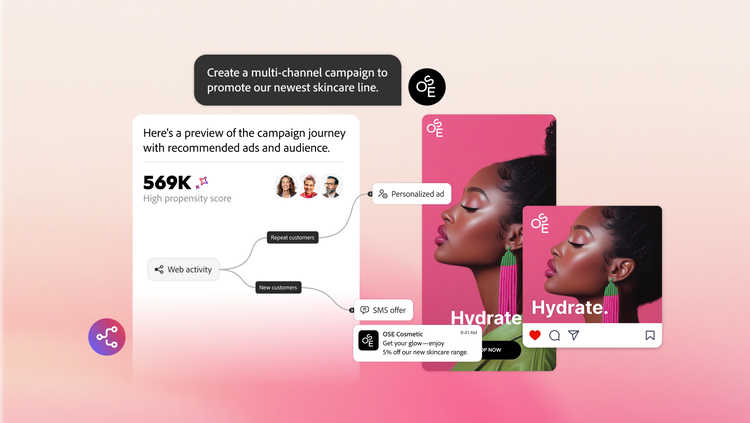
Traditional AI tools typically provide suggestions, which a marketer manually implements in a separate tool. Agentic AI helps coordinate and, in some supported workflows, automate parts of that process under user-defined guardrails. Agentic AI systems configured to operate within brand guardrails can remove the friction of manual data exports and cross-departmental handoffs. They also identify and respond to shifts in customer or target audience behavior, manage dynamic customer segments, eliminate time drains, and scale content production.
Responding to shifting customer behavior.
Agentic AI can optimize marketing campaigns by responding to subtle shifts in customer behavior as they happen. Traditional AI often relies heavily on historical patterns or requires marketers to manually act on its outputs, which can result in mismatched marketing messages for your target audience. Agentic AI, in environments with behavioral and interaction data, can detect meaningful shifts in customer behavior and help marketers respond with more relevant experiences. The system can then analyze and infer the customers' intent from timely behavioral and interaction signals.
This constant detection can directly improve user experience. For example, agentic systems that are configured correctly can recognize when a customer is purchasing a product or service rather than conducting research. It can then recommend or, in supported workflows, execute approved adjustments to the user experience to provide more relevant information or tailored offers. These capabilities help brands respond to customer needs while building a more seamless and intuitive journey for the user.
Orchestrating dynamic audience segments.
Beyond individual interactions, agentic AI can optimize marketing campaigns by changing how brands manage groups of customers. Traditional segmentation is often a static data point that quickly becomes outdated. Agentic AI, in certain enterprise environments, can use real-time behavior to group customers into segments that evolve as quickly as the users. These specialized tools can help ensure your targeting is always relevant to the customer’s current journey.
For an agentic system to optimize dynamic audience segments, it needs a single source of truth. Building a unified customer profile that combines web, mobile, offline, and CRM data is crucial. This can help the agent to reason through multi-step plans with accuracy. For example, an AI agent can recognize that a customer has already completed a purchase and help shift subsequent messaging from acquisition-oriented outreach to retention or loyalty messaging within supported channels and workflows.
Eliminating time drains.
Internal teams and agencies can use resources more effectively by automating manual operations, with agentic AI addressing the specific tasks that consume valuable time.
Content: Automating asset discovery and tagging.
- Problem: SEO and content managers often deal with a backlog of manual metadata tagging and disorganized digital repositories that make assets difficult to find.
- Solution: Agentic AI can optimize the content supply chain by automating asset discovery and intelligent tagging.
- Outcome: Configured agents scan large libraries to identify and tag assets based on brand standards and historical performance, ensuring the right creative is immediately searchable and ready for deployment.
Paid social campaigns: Driving real-time bidding and creative optimization.
- Problem: Paid social managers often manually monitor ad performance and bid adjustments across multiple platforms.
- Solution: During the execution phase, agentic AI can monitor performance across all channels simultaneously.
- Outcome: Agentic AI identifies performance changes and points marketers to possible optimization recommendations.
Campaign operations: Streamlining task routing and team handoffs.
- Problem: Digital publishing teams endure campaign launch delays due to administrative routing, status updates, and complex handoffs between strategy and creative.
- Solution: Agentic AI can automate handoffs required to move a campaign from planning to launch.
- Outcome: Once designed to handle routine tasks like routing assets for review, agents allow the organization to scale without a linear increase in manual work.
Scaling content production.
Agentic AI tools can scale content production with context and guidelines to function effectively. Large enterprises often encounter a content bottleneck where they possess the data for personalization while lacking the creative assets to keep pace with demand. A correctly configured agent can address this challenge by identifying when an audience segment requires a new variation of a hero image or a localized headline and initiating the approved production or assembly workflow for deployment. By ensuring a steady stream of relevant content, agentic AI can continuously test and optimize creative variations to find out what resonates best with users.