How to review AI content at scale without compromising brand consistency.
11-19-2026

Traditional content review processes were designed for when creating content took more time and effort than reviewing it. AI has inverted that equation. Today, marketers can produce dozens of email variations, landing pages, and social posts within minutes using AI-powered tools. Content oversight, however, remains largely dependent on manual efforts. As a result, there is a growing mismatch between content volumes and review capacity.
As enterprises ramp up the production of AI-assisted content, this imbalance makes it increasingly difficult to ensure brand consistency, quality, and compliance. Adding more reviewers can introduce additional friction and slow down execution. According to Adobe research, 58% of 1,600 surveyed marketers say more than 40% of their time is spent managing reviews and approvals rather than creating high-impact content strategies and the content itself.
Reviewing AI-generated content at scale requires more than faster approvals. Enterprises can manage growing review demands by connecting automated checks and human oversight through shared context from briefs, approved brand guidance, source assets, and prior review decisions. Intelligent workflow management then coordinates routing and handoffs. Together, these capabilities help routine content move faster, while giving reviewers the context to focus their judgment and expertise where it adds the most value.
At its core, a scalable review workflow helps content move quickly from stage to stage, without overwhelming teams. To better understand how it works in practice, let’s take a closer look at:
Why traditional review processes struggle when content production scales.
Traditional content review processes are built around the availability of human reviewers, their expertise, and their capacity to approve content. As AI accelerates content production, review processes struggle to keep pace. Content volumes can increase rapidly, while manual review capacity grows much more gradually.
When the demand for content review expands without a corresponding increase in time or resources, teams become stretched, increasing the likelihood of errors. Applying the same level of scrutiny to every asset becomes impractical, creating challenges such as:
- Review bottlenecks: As approval queues grow, content takes longer to reach publication, which in turn slows down campaign execution. This can reduce the business value of content and diminish the efficiency gains AI was intended to deliver.
- Brand inconsistency: As more teams use AI to create customer-facing content, inconsistencies in brand voice, messaging, and positioning can spread rapidly across channels and markets. What once affected a single asset can now influence an entire campaign portfolio.
- Inefficient use of expertise: Reviewers often spend valuable time addressing routine issues rather than focusing on decisions that require judgment, context, and subject-matter expertise. As content volumes increase, this limits your team’s ability to apply human oversight where it matters most.
- Expanded risk surface: AI-generated content can appear polished and credible and still contain inaccuracies, biases, unsupported claims, outdated information, or fabricated sources. If left unchecked, these issues can undermine trust, create compliance concerns, and expose your organization to reputational risk. In fact, 74% of respondents in a McKinsey survey identified inaccuracy as a highly relevant AI risk.
Rather than asking humans to review more content, enterprises need workflows that make oversight more scalable, targeted, and efficient. Building such a workflow requires a set of foundational components that work together.
Core components of a scalable AI content review workflow.
An effective AI content review workflow is a coordinated system that applies the appropriate level of oversight at the right stage of the content lifecycle. While implementations vary across organizations, most scalable review frameworks are built around four core components:
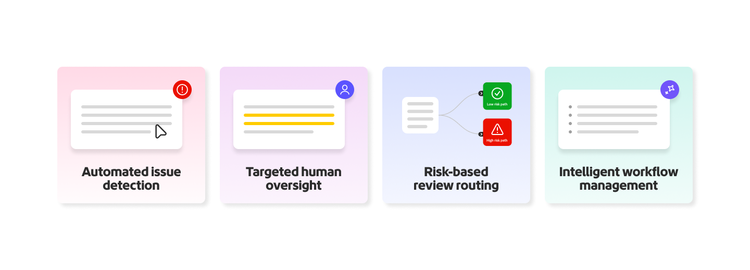
- Automated issue detection. Certain content issues can be identified without human judgment. For example, a product page may be missing a required disclosure, a marketing email may use outdated messaging, or an AI-generated article may contain unsupported claims that need verification. Automated checks can perform brand validation, identify and flag issues for reviewers, and provide scores or feedback against predefined criteria. This allows teams to spend less time on routine corrections and more time on higher-value decisions.
- Targeted human oversight. Human reviewers remain accountable for decisions involving business objectives, audience interpretation, and sensitive trade-offs. Intelligent automation supports those decisions rather than simply enforcing predefined rules. For example, in financial services, a system flags potentially non-compliant language about investment performance and provides context. At the same time, the human reviewer decides whether the message is appropriate for the campaign and audience. Targeted human oversight focuses on issues where judgment and accountability are essential.
- Risk-based review routing. Enterprises need to establish a process for assigning the appropriate level of oversight to each piece of content. A global advertising campaign, investor communication, or regulated customer message carries significantly greater risk and may require more extensive review than an internal newsletter or routine marketing update. Risk-based routing directs higher-risk content to additional review stages while allowing lower-risk assets to move through streamlined approval paths. This ensures oversight is proportionate to business impact.
- Intelligent workflow management. As content volumes grow, coordinating reviews across teams becomes more complex. For example, a product launch campaign may require inputs from marketing, legal, compliance, and regional stakeholders, while a routine blog post may only require a brand messaging review. Intelligent workflow management automates task assignment, approvals, and handoffs, ensuring content is routed to reviewers based on their responsibilities and the specific requirements of each asset. This reduces manual effort, improves visibility, and helps prevent bottlenecks.
Collectively, these components form the foundation of a scalable workflow. They shift content review from a manual bottleneck to a scalable process that has guardrails for brand compliance and governance.
6 steps to build a scalable AI content review workflow.
Building a scalable workflow is about making the best use of automation and human expertise to review AI-generated content. It starts by enhancing existing workflows with the right capabilities to ensure efforts align with business needs.
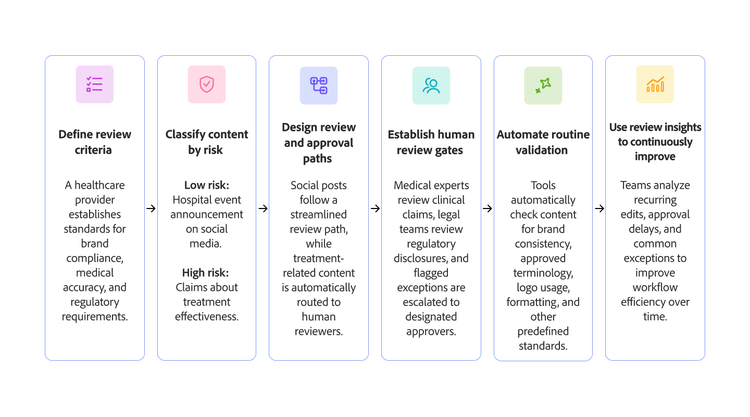
Here are six practical steps:
1. Define review criteria.
The first step is to translate brand, compliance, and quality expectations into clear review standards. Teams need a shared understanding of what constitutes acceptable, on-brand content, while automated systems require clearly defined criteria to evaluate content consistently. Established standards reduce subjectivity, improve alignment across teams and processes, and provide the foundation for both automated checks and human oversight.
Depending on the content type and use case, review criteria may include factual accuracy, regulatory compliance, brand alignment, clarity, originality, formatting, and CTA effectiveness.
2. Classify content by risk.
Teams need a clear understanding of the potential impact for each piece of content. Risk classification creates a central framework for evaluating content based on who will see it, how it will be used, and what purpose it will serve. This ensures review resources are directed toward content where errors could have the greatest consequences, while lower-risk content avoids unnecessary review steps.
Risk classifications are typically informed by factors such as audience, market, regulatory exposure, financial implications, brand sensitivity, and reputational or business impact.
3. Design review and approval paths.
Enterprises can put intelligent workflow management into practice by designing review paths that reflect different governance requirements. This includes mapping content stages, defining automated validation checkpoints, assigning ownership across teams, and establishing progression criteria throughout the content lifecycle. A well-structured pathway ensures content moves efficiently through creation, verification, approval, and publication while maintaining compliance with brand guidelines.
An effectively designed path defines the sequence of activities, the systems involved, and the conditions that every piece of content must meet before progressing to the next stage.
4. Establish human review gates.
Human oversight remains essential, but it should be concentrated on decisions that require judgment, nuanced interpretation, or regulatory accountability. Clear review gates define when content must be evaluated by a person, the individual who is responsible for a given decision, and how exceptions are escalated. This helps focus reviewer effort on higher-risk decisions while maintaining governance and accountability without creating unnecessary delays.
These decisions should be tied to content risk, approval authority, and situations requiring interpretation or discretion.
5. Automate routine validation.
Once review paths and human review processes are created, teams can identify activities that do not require human judgment. Many tasks involve verifying content against established guidelines, policies, or formatting requirements. Incorporating automated validation into the review workflow helps identify recurring issues early in the process, often before content reaches a reviewer. This reduces repetitive manual effort, improves consistency, and ensures reviewers can focus on areas that require expertise and decision-making.
Automated validation tools can scan content, flag potential issues, and suggest improvements related to grammar, compliance, and factual accuracy.
Solutions such as Adobe Brand Intelligence take automated validation a step further by assessing content against brand standards and learned brand expectations. This includes evaluating elements such as typography, logo integrity, spacing, color, and messaging consistency. The findings can help reviewers identify potential issues earlier and make more informed decisions.
6. Use review insights to continuously improve.
A review workflow should become more effective with use. By understanding where reviews stall, which issues occur most frequently, and where reviewers spend the most time, you can refine standards, strengthen automation, and simplify workflows. Over time, these insights help improve both review quality and operational efficiency.
These insights may come from review outcomes, approval cycle times, exception patterns, escalation trends, and recurring content issues identified across teams and channels.
When automation and human expertise work together within a structured workflow, teams can increase content velocity without sacrificing quality, compliance, or brand consistency. Gartner surveyed 360 organizations in the second quarter of 2025 and found that organizations that deployed AI governance platforms were 3.4 times more likely to achieve high effectiveness in AI governance than those that did not. This highlights the value of formalized oversight as enterprises scale their use of AI.
Best practices for reviewing AI-generated content at scale.
As the volume of AI-generated content increases, maintaining quality depends on applying review effort strategically. The following best practices should help strengthen your review models, balancing speed and brand standards.
- Prioritize exceptions over routine approvals. Reviewers add the most value when they're resolving complex issues, not repeatedly signing off on content that is already compliant. By prioritizing exceptions, risks, and edge cases, your teams can avoid repetitive approval work and concentrate on content that needs closer evaluation.
- Validate AI-generated variations against approved content. One approved asset can quickly generate multiple localizations, channel adaptations, and audience-specific versions. Instead of reviewing each AI-generated variation as if it were new content, use the approved source as the benchmark to identify meaningful deviations.
- Use sampling to monitor quality at scale. Sampling helps enterprises understand how well the overall review process is performing. By periodically examining representative content samples, teams can identify recurring issues, measure adherence to standards, and uncover opportunities to improve workflows and controls.
- Verify high-risk claims and factual statements. AI-generated content can sound authoritative even when information is incomplete or incorrect. Conduct thorough human verification for any content containing incorrect statements that impact an enterprise. This helps reviewers apply deeper scrutiny where inaccuracies carry meaningful consequences.
- Build traceability into review workflows. As AI-generated content becomes part of core business processes, teams need a clear record of how content was reviewed, approved, and published. Maintaining traceability across the workflows lays a foundation for audits, reporting, and continuous improvement.
- Document issues and decisions. Recording corrections, exceptions, and the reasoning behind key decisions creates valuable institutional knowledge, allowing teams to identify gaps and apply standards more consistently. Over time, this helps both people and systems perform effectively.
These best practices help enterprises adapt review processes to the realities of AI-driven content production. As a result, content review becomes an enabler of speed and scale rather than a bottleneck to growth.
How to balance speed and quality for enterprise AI content.
As content production scales with AI, teams need to be deliberate about how review effort is applied. Achieving this requires rethinking review processes to strike the right balance between automation and human oversight. A more targeted approach allows teams to personalize review processes for each asset’s specific requirements.
The most effective workflows create clarity around what requires scrutiny, what can be validated systematically, and where human judgment has the greatest impact. This targeted approach helps teams ensure that content is on-brand, protects their reputation, and strengthens audience trust — without adding additional pressure. This results in a content review workflow that scales seamlessly alongside content production.
Explore how Adobe's content supply chain solution connects shared context, automated workflows, and human-AI collaboration across the content lifecycle, and learn how Adobe Brand Intelligence helps teams apply brand standards consistently as content scales.
Recommended for you
https://business.adobe.com/fragments/resources/cards/thank-you-collections/brand-intelligence