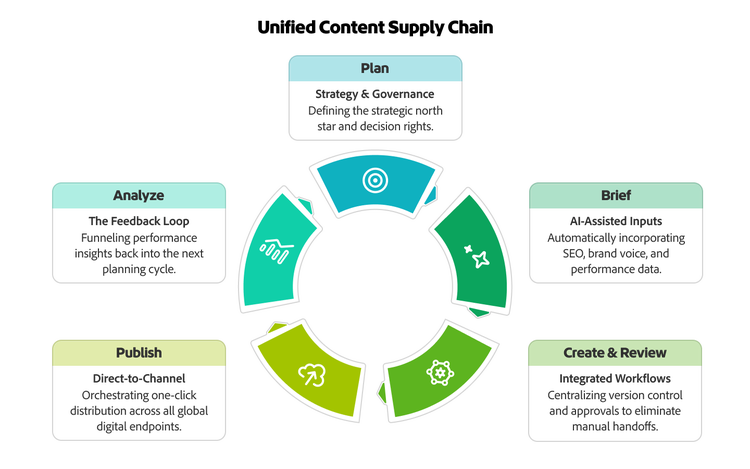
- Automated briefing and templating.
Manual briefing of new content is just one example that can slow down content production. Modern content operations replace manual briefing with dynamic, AI-assisted content briefs. AI tools, combined with human oversight, can quickly create content briefs that incorporate brand voice guidelines, keyword targets, competitive positioning, and relevant performance data.
Teams should test different brief formats and prompts to find what works best with their tools. Ideally, AI provides a structured starting point, and creative teams refine it with content-specific nuance. This can lead to stronger first drafts and faster production.
- Unified approval workflows.
The traditional content approval process struggles to ensure document versions are controlled. In these cases, drafts are sent via email, and feedback is tracked in multiple places. This makes document version control very challenging to maintain. Stakeholders lose track of the correct current draft, reviewers provide contradictory feedback, and deadlines slip while teams wait for responses buried in crowded inboxes.
Integrated approval workflows, when implemented correctly, eliminate this friction by bringing review cycles directly into one environment. Stakeholders receive automated notifications and provide feedback within a single, shared system. This provides real-time visibility into exactly where a piece of content stands and who needs to act next to keep the project moving.
- Direct-to-channel publishing.
The final friction point in many content workflows occurs at the content publishing stage. Teams manually copy approved content into separate systems for web, social media, email, and other channels. Each manual entry is an opportunity for human error and consumes time that could be spent on more important work.
Direct-to-channel publishing capabilities transform your workspace into a central orchestration hub. Approved content flows automatically to connected endpoints. This includes content management systems, social media platforms, email marketing tools, and advertising networks. This one-click publishing approach eliminates hours of manual data entry and can ensure that the approved version reaches every channel accurately.
How to decentralize content publishing.
Scalable publishing is an operational model that distributes content publishing capabilities across an enterprise while upholding brand standards. Scalable publishing empowers regional and functional teams to publish independently within defined guardrails rather than funneling all content through a single team.
Moving from a single, centralized team to a distributed model can avoid creating bottlenecks while chasing down stakeholders during a review cycle. On the other hand, complete decentralization allows for speed but increases the risk of having a fragmented brand voice and messaging. The solution is a model that provides the right guardrails for the entire content lifecycle and empowers teams to create with confidence.
- Set brand guardrails to ensure consistency.
To empower global teams, you trade direct control for strategic governance. Control dictates every action through various approvals and maintenance, often slowing down a local market's ability to reach consumers.
Brand guardrails define what attributes must remain consistent. These can include visual identity, messaging frameworks, legal requirements, and brand voice standards. Local teams gain autonomy to adapt content for their markets, respond to unique regional opportunities, and publish without waiting for central approval. Global consistency and regional relevance coexist when governance is designed thoughtfully.
- Content atomization for reuse and scalability.
Traditional content workflows produce assets such as a single blog post, one campaign landing page, or a complete video that sits in a silo. Content atomization breaks these assets into their components: headlines, body paragraphs, images, video clips, data points, and calls to action.
Atomized content can be reassembled and distributed across multiple channels simultaneously. A single long-form article yields social media posts, email snippets, advertising copy, and sales enablement materials. This approach multiplies the value of each content investment while ensuring message consistency across touchpoints. Effective content planning accounts for atomization from the beginning, maximizing the value of every asset created.
- Distribute content through API-first frameworks.
Modern publishing infrastructure increasingly relies on Application Programming Interface (API) connections rather than manual uploads to individual systems. Modern environments like headless or hybrid Content Management Systems (CMS) separate your content storage from how it’s presented. This allows the same core message to flow seamlessly across websites and mobile apps, as well as digital signage, Internet of Things (IoT) devices, and any other emerging channels.
An API-first approach ensures that content staged in your central hub reaches every digital endpoint without manual intervention. Your existing content repository is designed to scale; as new social platforms or localized apps emerge, they can simply plug into the same central source.
This infrastructure saves time and ensures your content remains adaptable as technology evolves. Separating the content from how it’s delivered allows enterprises to publish content without needing to recreate assets for every new device or platform.
Close the content loop.
Many organizations treat publishing as the final step. In an effective content lifecycle, however, publishing is simply the beginning of a new data cycle. A measurement strategy after a piece of content goes live is needed to avoid enterprise libraries that have underperforming or redundant assets. Measuring content and asset performance after launch allows teams to understand what resonates with specific audiences and test iterations of that content with confidence.
Turn performance insights into the next brief.
A unified content lifecycle creates a powerful, feedback system. Marketing leaders can see exactly which assets performed and why, rather than guessing what to prioritize for the next quarter.
Publishing tools that are directly connected to your planning solution ensure that performance data is readily available to inform the next quarterly planning meeting. This ensures that your upcoming content briefs are based on performance data rather than estimates. Understanding what resonates with your audience allows marketing leaders to focus their resources on the topics and formats that deliver results.
Maintain content hygiene.
Global teams often struggle with an abundance of outdated PDFs or blog posts that still surface in search results but no longer reflect the current brand. To solve this, you can build a review or retire milestone into your operational workflow. Flagging assets for a quick audit every six to twelve months helps you understand whether a piece is still accurate, needs a fresh update, or should be redirected to make room for new growth.
Extend content value through reuse and amplification.
Finally, closing the loop means finding simple ways to multiply valuable content. A unified system with relevant reporting metrics makes it easy to turn a high-performing white paper into a series of social posts or a webinar script. This is a strategic way to extend the life and ROI of every dollar spent during the planning phase.
What is a content calendar.
Publishing content quickly without losing brand control requires a single source of truth. A content calendar provides that foundation, giving campaign teams visibility into planned initiatives and the structure needed to manage complex handoffs and distributed publishing.
A content calendar identifies the content that will be created, when it will be published, and where it will appear. However, for a global organization, content calendars go beyond simple scheduling. They connect high-level marketing objectives to daily execution across every team.
Bridging the gap from strategy to execution.
Effective content lifecycles need a centralized planning system to avoid bottlenecks that prevent quick and efficient content publishing. This centralized planning system has three essential pillars:
- Universal visibility: Provides a single location for product marketing, brand teams, and regional managers. This transparency prevents duplicative efforts and messaging gaps that occur when teams work in silos.
- Dynamic resource allocation: Accurate resource planning is impossible without a shared view. A content calendar allows leaders to forecast creative needs and balance workloads across internal teams.
- Global-local coordination: Anchoring local adaptations to a global strategic calendar helps regional marketers see what to publish and understand how their work connects to enterprise objectives and brand standards.
How to create a content calendar for global workflows.
Building a content calendar that serves global enterprise needs requires a deliberate structure. Understanding how to create a content calendar at scale differs significantly from building one for smaller teams. The following steps provide a framework for creating calendars that scale effectively:
- Assign required content workflow stakeholders: Establish clear ownership for the calendar itself, including who can add content, who approves additions, and how conflicts are resolved. Document decision rights for different content types and regions.
- Establish content pillars aligned with business objectives: Map your calendar categories to strategic priorities rather than tactical formats. This approach ensures that every piece of content connects to measurable business outcomes.
- Set regional adaptation guidelines: Create clear guidelines for how global content can be localized, what elements must remain consistent, and what approvals are required for regional variations. This balance enables local relevance while protecting brand integrity.
- Integrate approval workflows directly into the calendar: Build review cycles into the calendar structure and integrate your calendar into your project management tool. Configure your calendar permissions to include an approval field for every asset.
- Build flexibility for emerging opportunities: Enterprise calendars must accommodate both planned campaigns and rapid-response content. Reserve capacity for timely content while protecting bandwidth for strategic initiatives.
The most effective enterprise calendars do more than just track dates; they connect directly to the broader content supply chain. By ensuring that planning visibility extends through creation, review, and final delivery, the calendar becomes a single source of truth. This integration can eliminate the handoff friction that typically slows down global teams, transforming the calendar from a static document into a dynamic engine for operational velocity.
The path to a unified content operation.
Fragmented workflows, approval bottlenecks, and the tension between global consistency and regional autonomy often stem from disconnected tools, teams, and processes across the content lifecycle. Some enterprise marketing teams operate within disconnected environments that require manual handoffs at every stage of the content lifecycle.
Adobe GenStudio addresses fragmentation by connecting content creation, reviews, activation, and performance insights into a more unified workflow. Brand guidelines can be built into the content creation process, while review and approval workflows help reinforce compliance before content is published. GenStudio also helps teams use performance insights to refine future decisions. Marketing teams can identify which creative assets are performing best. This helps scale content creation without sacrificing quality.
Explore Adobe GenStudio and supercharge your content supply chain.