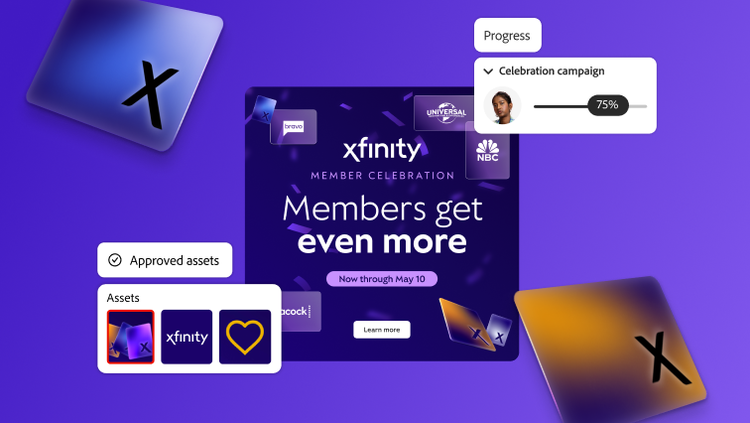
Serving millions of broadband and wireless customers across North America means marketing at an enormous scale. For Xfinity, Comcast’s consumer brand delivering Wi-Fi, mobile, entertainment, and home services to millions of customers across the US, that translates into thousands of assets tailored to different audiences, cultural moments, and channels. With licensed characters and franchises from NBCUniversal, teams also need to align co-branded creative with both Xfinity and partner standards at scale.
To address that complexity, the company has partnered with Adobe to accelerate on-brand creative campaign production and scale customized marketing messaging more efficiently. With growing demand for content across channels, Xfinity is bringing Adobe Brand Intelligence into its end-to-end creative workflow. Layering this advanced AI across the content supply chain embeds brand governance directly into content creation and review. It moves teams beyond static brand guidelines into a continuous, cohesive learning system that ingests qualitative, nuanced inputs like review-cycle feedback, annotations, rejections, and approvals.
“This partnership with Adobe allows us to embed brand intelligence into every step of our marketing workflows so our teams can spend less time managing work and more time crafting the standout storytelling that defines the Xfinity brand,” said Jon Gieselman, Chief Growth Officer, Connectivity & Platforms. “We’re quickly evolving how we work and are now using agentic tools to remove friction from our processes, enabling our people to move faster, focus on creativity, and bring more authenticity and emotion into the stories we tell.”
Catching issues earlier in the workflow.
To make that possible, Xfinity first needed to relieve the day-to-day pressure of production. Across multiple major campaigns in a six-month period in 2025, teams identified thousands of issues related to tone, visual identity, layout, and compliance. Combined with channel-specific variants and inconsistent execution of brand standards, these issues slowed internal reviews and stretched campaign timelines by several weeks.
The pattern was clear: Xfinity needed a way to catch issues during production, not at the end of the review cycle.
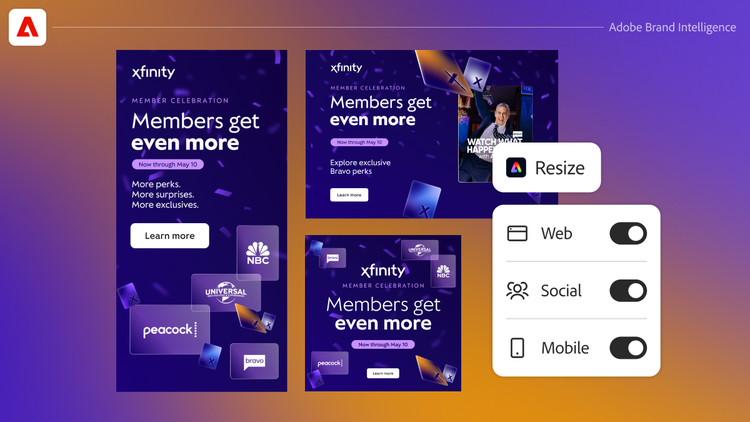
With Adobe Brand Intelligence, brand standards are woven directly into creative workflows, allowing teams to assemble and validate content variants simultaneously. This reduces bottlenecks caused by channel-by-channel execution and inconsistent application of brand rules.
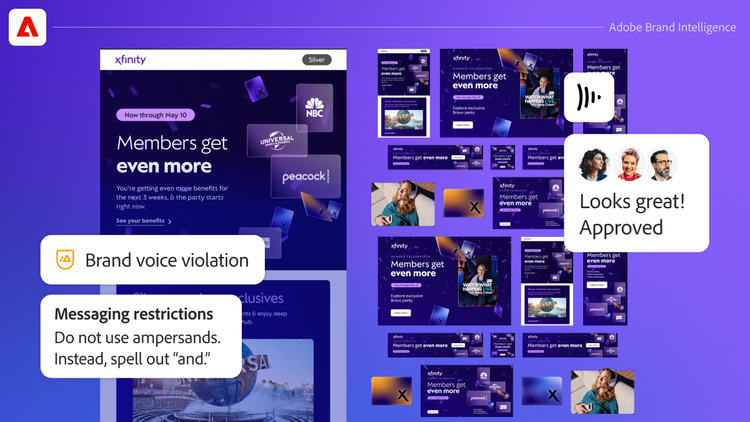
When Xfinity tested the system on a complex membership campaign, teams built 500 personalized display and email variants from a small set of base creatives, tailoring content by tier, audience, and market. Each variation was validated in real time for cross-channel consistency, supported by last-mile edits, and synced automatically to Frame.io for review and approval. The result: 10x creative output generated in minutes instead of weeks.
A system built to work together.
This shift is part of Xfinity’s broader effort to build a more connected content supply chain. Adobe Brand Intelligence has the potential to serve as the foundation, embedding brand governance directly into production workflows. Alongside Adobe GenStudio for Performance Marketing, Firefly Creative Production for Enterprise, and Adobe Workfront, it connects content creation, validation, review, and activation into a more unified process. Together, these tools help teams automate time-intensive tasks, reduce friction in review cycles, and scale personalized content more efficiently — supporting faster campaign execution without compromising consistency.
A new way forward.
For Xfinity, reaching millions of customers means managing a huge range of audiences, channels, and cultural moments, often with licensed characters and franchises in the mix. The pressure is not only to produce more, but to keep all of that work recognizable as Xfinity.
That is what makes this change so meaningful. As more of the process becomes connected, teams can spend less time untangling bottlenecks and more time building campaigns that are timely, relevant, and ready to scale.
Varun Parmar is Senior Vice President and General Manager of GenStudio and Firefly Enterprise at Adobe. These industry-defining, generative AI-first offerings enable marketing teams to quickly plan, create, manage, activate, and measure on-brand content, and automate repetitive tasks while accelerating production of high-quality asset variations for different audiences, channels, and markets, respectively. Previously, Varun was Chief Operating Officer at Miro, a digital collaboration platform, where he led a global team across product management, engineering, design, customer engagement, and partnerships. Earlier, he was Chief Product Officer at Box, a leader in enterprise content management, co-founded a document collaboration startup that was acquired by Box, and held senior product remits at Dell EMC. Varun spent six years at Adobe earlier in his career, during which he focused on corporate strategy, as well as product management for Adobe Acrobat and Document Cloud. Varun graduated from MIT with a joint master’s degree in business and engineering.